
On this page
Wide stated field and a defined water limit in an 8x30
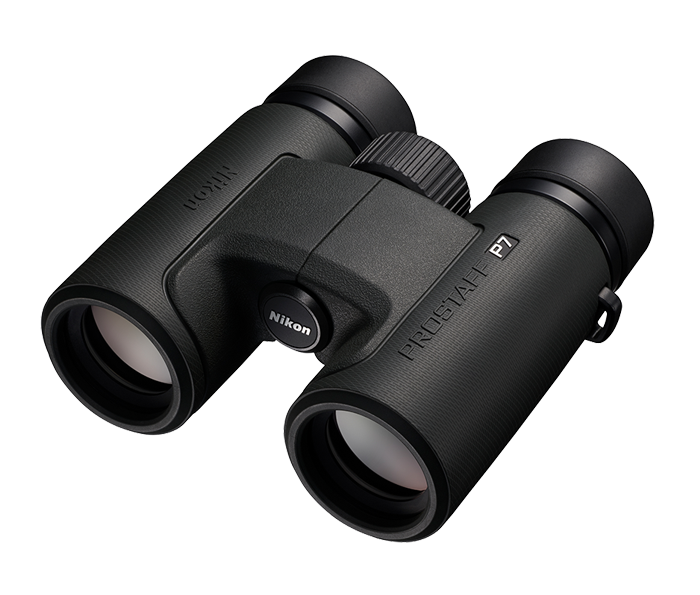
The PROSTAFF P7 8x30 publishes an 8.7° field and weighs 17.1 oz; its manual states a 1 m / 10 minute limit and says it is not for underwater use. Check its 15.4 mm eye relief with intended glasses rather than assuming a fit.
Explore the needs this model fits
- Waterproof 8x binoculars: compare field, fit and rating detail
- Waterproof binoculars under 20 ounces: compare carry and focus tradeoffs
- Waterproof binoculars: what the exact-model rating does and does not establish
- Choosing among binoculars that show an 8x view
- Binoculars with a broad real scene field
- Binoculars with a wide apparent field of view
Your needs, this model
Does it fit your priorities?
Does the P7 8x30 give this line’s widest real scene for handheld subject finding?
Yes. Nikon lists a 456 ft real field at 1,000 yd, wider than the 10x30’s 346 ft, and an 8.7 degree real field. This is a scene-width comparison, not an edge-sharpness claim.
Explore this need in the finder →Is a locking diopter ring confirmed for this exact compact size?
Yes. Nikon lists the locking diopter for the exact P7 8x30; the manual explains how to unlock, adjust and lock it.
Explore this need in the finder →Can this model fit a weather-resistant handheld plan without claiming underwater use?
Yes. The exact P7 manual rates it waterproof to 1 m for 10 minutes and fogproof, but explicitly says it is not designed for underwater use.
Explore this need in the finder →The Nikon PROSTAFF P7 8x30 is the compact, wide-view member of the P7 family. Its official specification is 456 feet at 1,000 yards, the widest real field among these four sizes, in a 17.1 oz body. It also adds the P7 line’s locking diopter and oil- and water-repellent lens treatment. The 30 mm objectives keep it easier to carry than the 42 mm pair, but the 3.8 mm exit pupil and 15.4 mm eye relief are meaningful compromises.
The compact P7 when finding the subject matters
At eight power, the P7 8x30 gives the broadest real scene in this family: 8.7 degrees, or 456 feet across a landscape at 1,000 yards. That generous sweep is useful when a bird is moving through branches, when you are following play across a field, or when you want to locate a distant landmark without searching through a narrow view. The apparent field is 62.6 degrees. Those measurements describe different things: real field is the width of the scene; apparent field describes how large that field looks through the eyepieces.
The lower magnification also tends to be easier to hold steady than a 10x instrument. Small changes in hand position appear less amplified, and the wider real field can make it quicker to reacquire a subject after you lower the binocular. Neither benefit changes the subject’s actual distance or guarantees sharpness at the edge. Nikon publishes the optical values, not a resolution or edge-performance measurement for this review.
What you trade for the smaller objective
The 30 mm objective diameter contributes to the short 4.9 in length and 17.1 oz weight. It is a reasonable all-day pack choice if carrying bulk matters. In exchange, its 3.8 mm exit pupil is smaller than the 5.3 mm of the P7 8x42, and Nikon’s relative-brightness index is 14.4 rather than 28.1. Those are optical geometry and manufacturer indices, not a promise of a particular low-light view. If dusk wildlife or a forgiving view in changing light is central to your use, the 8x42 deserves the extra size and roughly 3.7 oz of published weight.
At 15.4 mm, eye relief is shorter than the 8x42’s 20.2 mm. Nikon’s manual directs glasses wearers to begin with the eyecups fully retracted; it also provides two intermediate click stops. A published eye-relief figure cannot guarantee that a particular pair of eyeglasses will show the full field comfortably, so an in-person fit check is useful if glasses stay on while viewing.
Why choose P7 rather than the similar P3?
The PROSTAFF P3 8x30 is the closest Nikon alternative: its published real field is also 456 feet at 1,000 yards and its apparent field is 62.6 degrees. The P7 case is not a wider-view claim. Instead, Nikon confirms phase and dielectric prism coatings for the P7, a locking right-eye diopter, and an oil- and water-repellent treatment on the objective and eyepiece lenses. That last feature can make ordinary fingerprints or water spots easier to clear, but it does not make the glass scratch-proof or eliminate careful cleaning.
The P7 8x30 weighs 17.1 oz, while the current P3 detail page lists 16.75 oz; official P3 documents differ on its exact weight. If the lightest compact body is the first priority, compare the P3 8x30 review. If retaining a diopter setting and the confirmed P7 coatings matter more, this P7 has the better documented feature fit. Nikon does not document ED glass for this exact P7 size, so it should not be selected to meet an essential ED requirement.
Fit, weather protection and setup
The manual describes central focusing and a separate right-eye diopter adjustment with a lock. To adjust it, extend the right eyecup, pull the diopter ring up to release it, adjust, then push it down to lock. The lock helps keep the setting from being changed accidentally; it does not replace focusing for the scene or another user. The 56–72 mm interpupillary adjustment range is useful to compare with the observer’s face rather than assume that a bridge shape fits everyone.
Nikon rates the body waterproof to 1 m / 3.3 ft for up to 10 minutes and describes it as fogproof and nitrogen-filled. The manual explicitly says it is not designed for underwater use and cautions against strong water pressure. That is practical protection for ordinary rain, not dive equipment. The manual lists the binocular, eyepiece cap, two objective caps, soft case and neck strap as supplied. It does not establish tripod compatibility or an adapter, so this assessment does not promise a mounted operating plan.
Who should pick another size?
Move to the P7 10x30 if more magnification matters more than scene width; its 346-foot real field and 3.0 mm exit pupil are smaller, and its 16.6 oz published weight is slightly lower. Choose the 8x42 for its larger exit pupil and longer eye relief, accepting a longer, heavier binocular with a narrower 377-foot real field. Choose the 10x42 if you want 10x reach and a 62.9-degree apparent field; it is a full-size 21.2 oz choice. The P7 30 and 42 mm comparison guide lays out those compromises. The 8x30 is the practical pick when scene-finding and compact carry outweigh long eye relief and late-light pupil size.
Exact-model facts: Nikon PROSTAFF P7 8x30 page. Setup, supplied items and model-family specifications: Nikon Download Center PROSTAFF P7 manual listing.
Key specifications
Key details at a glance
| Magnification | 8× |
|---|---|
| Objective diameter | 30 mm |
| Real field of view | 8.7° |
| Apparent field of view | 62.6° |
| Field width at 1,000 m | 152 m |
| Eye relief | 15.4 mm |
More specifications and setup details
| Exit pupil | 3.8 mm |
|---|---|
| Close focus distance | 8.2 ft |
| Manufacturer-published weight | 17.1 oz |
| Phase coatings confirmed | Yes |
| Locking diopter ring confirmed | Yes |
| Lens and prism coatings | The exact Nikon USA page confirms phase and dielectric prism coatings and describes multilayer-coated optics; Nikon’s P7 line page states that both objective and eyepiece lenses have oil- and water-repellent surfaces. These descriptions do not confirm ED glass for this exact configuration. |
| Water and fog protection | Nikon’s 30/42 mm family manual rates this size waterproof to 1 m / 3.3 ft for up to 10 minutes and fogproof with nitrogen filling. It is not intended for underwater use, and the manual warns against strong water pressure. |
| Tripod use | The inspected exact US page, 30/42 mm instruction manual and P7 family page do not establish tripod compatibility, an adapter model or adapter-in-box status. No tripod operating plan is asserted. |
| Published weight note | Nikon’s exact US page and 2022 family table agree on this model’s published mass; the published figure is not an independent measurement. |
| Package contents | The Nikon English P7 30/42 mm manual lists one binocular, one eyepiece cap, two objective lens caps, one soft case and one neck strap. No adapter is listed. Seller-added US bundle contents are not established by that standard items list. |
| Manufacturer-rated waterproof | Yes |
Use the exact model’s instructions for operating limits, supplied equipment and version differences.
Sources for this review
Sources for this assessment
Choose your optical trade-off first.
Choose viewing purpose first, then magnification, objective size, scene width and any fit, weather or mounting constraint. A direct-Sun requirement is separate: only exact manufacturer-confirmed solar binoculars can pass it.
Your needs, this model
Waterproof 8x binoculars: compare field, fit and rating detail
Choose it when: The P7 8x30 brings the wider published field of these two examples and a numeric water-protection limit. At 17.1 oz it is also 0.9 oz lighter than the Nature DX 8x32, making it the clearer choice when a quantified limit matters more than longer eye relief.
Waterproof 8x binoculars: compare field, fit and rating detail →Binoculars with a broad real scene field
Choose it when: Choose this example if seeing a wider actual scene is more important than the tighter 10x framing. Its exact 8.7° real field is comfortably above the 6° boundary and Nikon supplies a linear field figure for comparison.
Binoculars with a broad real scene field →Choosing among binoculars that show an 8x view
Choose it when: This is the lighter of these two examples and publishes the broader field. Its exact P7 8x30 specification and family manual provide a quantified 1 m / 10 minute water limit, so it is the clearer choice here if both scene width and a stated immersion limit matter.
Choosing among binoculars that show an 8x view →