
On this page
Your needs, this model
Does it fit your priorities?
Does the P3 8x30 show the widest real scene in this four-model line?
Yes. Nikon lists 8.7° and 456 ft at 1,000 yd; the next closest P3 model, 8x42, is 377 ft. This helps with broad scanning, though it does not guarantee better edge performance.
Explore this need in the finder →Is the P3 8x30 lighter than the P3 8x42 while keeping 8x magnification?
Yes by both official weight records: the current pages show 16.75 oz versus 20.3 oz, and the older launch table shows 17.1 oz versus 20.8 oz. The exact size of the difference varies by source.
Explore this need in the finder →Can it meet a weatherproof requirement without being a diving binocular?
Yes. Its manual specifies waterproofing to 1 m / 3.3 ft for 10 minutes and says it is not designed for underwater use.
Explore this need in the finder →The PROSTAFF P3 8x30 is the widest-scanning compact choice in Nikon’s current four-model line: its manufacturer page lists a 456-foot field at 1,000 yards and 16.75 oz. The 10x30 is slightly lighter on the current detail pages, while this 8x model offers a broader daylight view and lower power. Nikon’s older launch table gives a different weight, so use the comparison below rather than treating that ounce figure as a measurement.
Why this is the P3 for scanning
At 8x, the P3 8x30 combines an 8.7° real field with a 62.6° apparent field. Nikon lists 456 feet across the scene at 1,000 yards. That is materially wider in real field than the P3 8x42’s 377 feet, the 10x42’s 367 feet and the 10x30’s 346 feet. That extra scene width can make it easier to find a bird in brush, follow a moving subject or sweep a sports field without moving the barrels as far. Those are consequences of the specification, not a claim that the image is brighter, sharper or better at the edges.
The 8x setting is also the steadier starting point for casual handheld viewing than either 10x option: small hand movements appear less magnified, and the broad field gives a little more room for locating a subject. If distant wildlife is a higher priority than scanning or you want a stronger apparent reach, compare the P3 10x30 or 10x42 instead. The 10x42 has an apparent field slightly wider than 60°, but its actual scene field is still narrower than this 8x30’s.
What the 30 mm size gives up
A 30 mm objective keeps the body compact, but the exit pupil is 3.8 mm, compared with 5.3 mm for the P3 8x42. Nikon’s relative-brightness index is 14.4 versus 28.1 for the larger 8x42. These are calculated manufacturer figures, not a twilight test or a promise about what your eyes will see. In bright daylight the 8x30 may be the more agreeable carry; for late-evening wildlife or a more forgiving pupil position, the larger 8x42 deserves consideration. It is a trade between body size and the optical geometry, not a universal brightness verdict.
The 15.4 mm eye-relief specification is shorter than the 8x42’s 20.2 mm. Glasses wearers should try the eyecups with their own glasses if possible. Nikon’s manual says glasses wearers should start with the eyecups fully retracted and describes two click stops for fine positioning. A published eye-relief number cannot guarantee that a particular face and lens combination will see the full field comfortably.
Compact, but not a pocket monocular
The technical table gives dimensions of 125 × 130 × 52 mm and 475 g / 16.75 oz. The current family page rounds that to 16.8 oz. Nikon’s 2022 launch table instead states 485 g / 17.1 oz. Both are official Nikon records and differ by about 10 g; this review preserves the conflict instead of pretending to settle it. Either figure makes the 8x30 distinctly lighter than the 20.3 oz 8x42 on the current US detail page, but it is still a binocular that occupies space in a daypack.
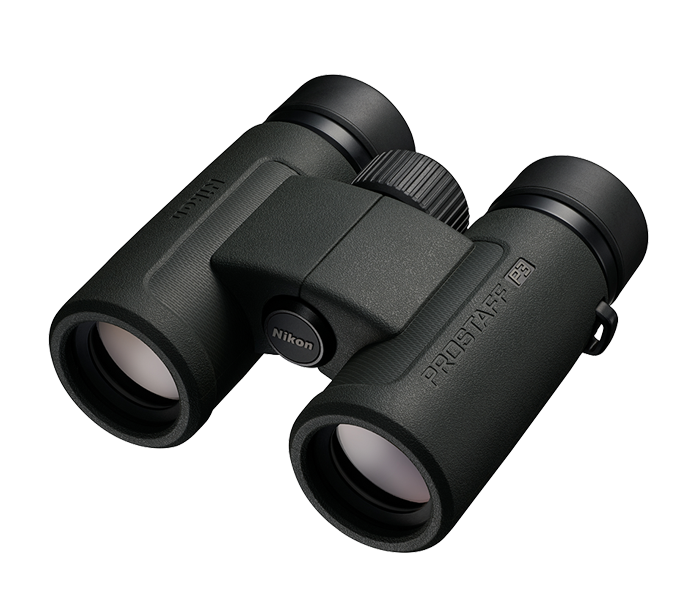
The roof-prism body has center focus, a right-eye diopter ring and turn-and-slide eyecups with multiple stops. Nikon describes multilayer-coated lenses and a highly reflective silver-alloy coating on the roof-prism mirror surfaces. That does not establish ED glass, phase-correction coating, a locking diopter, oil/water-repellent lens surfaces or an adapter-ready tripod fitting for this exact P3. Those details remain unknown here rather than assumed absent or present. If a confirmed ED or locking diopter requirement is essential, the matcher should not treat this model as satisfying it.
Weather limits and the included basics
The model manual rates the P3 waterproof to 1 m / 3.3 ft for up to 10 minutes and fogproof, with nitrogen filling. Nikon explicitly says the design is not for underwater use and warns against strong water pressure. This is useful protection for ordinary rain and a wet trail, not a diving rating. After moisture, wipe the body before moving the focus or eyepiece parts. The English instruction manual lists a binocular, eyepiece cap, two objective caps, soft case and neck strap as items supplied. A tripod adapter is not listed, and the reviewed Nikon documents do not confirm tripod compatibility.
When to choose a different P3
Choose the 8x30 when a broad real field and carry weight lead the decision and you accept shorter eye relief and a smaller exit pupil. Move to the P3 8x42 for the larger 5.3 mm exit pupil and 20.2 mm eye relief, recognizing the narrower real field and roughly four-ounce heavier current-page figure. Choose the 10x30 if you want the lightest listed P3 and greater apparent reach but can live with a 346-foot field and 3.0 mm exit pupil. The P3 10x42 is for a 10x view with a large objective; it does not match this 8x30’s scene width. For the exact comparisons, use the P3 size and magnification guide and the linked individual reviews.
Exact-model specifications: Nikon PROSTAFF P3 8x30 product page; setup, included items and water limits: Nikon Download Center P3 manual listing.
Key specifications
Key details at a glance
| Magnification | 8× |
|---|---|
| Objective diameter | 30 mm |
| Real field of view | 8.7° |
| Apparent field of view | 62.6° |
| Field width at 1,000 m | 152 m |
| Eye relief | 15.4 mm |
More specifications and setup details
| Exit pupil | 3.8 mm |
|---|---|
| Close focus distance | 8.2 ft |
| Manufacturer-published weight | 16.75 oz |
| Lens and prism coatings | Nikon describes multilayer-coated lenses and a highly reflective silver-alloy coating on roof-prism mirror surfaces for the P3 line. The exact P3 sources do not document ED glass, phase correction, dielectric coating or oil/water-repellent objective and eyepiece coatings; those details remain unknown. |
| Water and fog protection | The exact P3 manual rates the models waterproof to 1 m / 3.3 ft for up to 10 minutes, fogproof and nitrogen-filled. Nikon says they are not for underwater use and warns against strong water pressure. |
| Published weight note | The current exact US page reports 475 g / 16.75 oz (the family page rounds to 16.8 oz), while Nikon’s 2022 launch table reports 485 g / 17.1 oz. Preserve this official-source discrepancy. |
| Manufacturer-rated waterproof | Yes |
Use the exact model’s instructions for operating limits, supplied equipment and version differences.
Sources for this review
Sources for this assessment
Choose your optical trade-off first.
Choose viewing purpose first, then magnification, objective size, scene width and any fit, weather or mounting constraint. A direct-Sun requirement is separate: only exact manufacturer-confirmed solar binoculars can pass it.