
On this page
A 10x32 with a longer published water-protection duration
The TrailSeeker ED 10x32 publishes a 6.2° field, 17.6 oz instrument weight and IPX7 protection at 1 m for 30 minutes, with ED glass confirmed for this exact model. That is a finite protection specification, not underwater-viewing approval.
Explore the needs this model fits
- Waterproof 10x binoculars: field width versus a longer stated limit
- Waterproof binoculars under 20 ounces: compare carry and focus tradeoffs
- Waterproof binoculars: what the exact-model rating does and does not establish
- Choosing binoculars with 10x magnification
- Binoculars with a broad real scene field
- 32 mm binoculars: compare 8x and 10x ED models
- 32 mm ED binoculars: choose 8x field or 10x reach
Your needs, this model
Does it fit your priorities?
Do you want fixed 10x32 ED and an instrument within its listed carry limit?
Exact item 71403 is the ED configuration at 10x32 and lists 17.6 oz.
Explore this need in the finder →Does the listed 14.4 mm eye relief and broad real-field option fit?
The exact page lists 14.4 mm; selecting the finder’s broad real field (at least 6°) also fits the listed 6.2°. The field option does not distinguish this model from other products also above 6°. A 14.5 mm eye-relief minimum excludes the model, and the published number does not promise glasses fit.
Explore this need in the finder →Does its 8.2 ft close-focus figure and listed waterproofing meet your brief?
The exact page lists IPX7 to 1 m for 30 min. A maximum focus distance of 8 ft rejects the 8.2 ft spec.
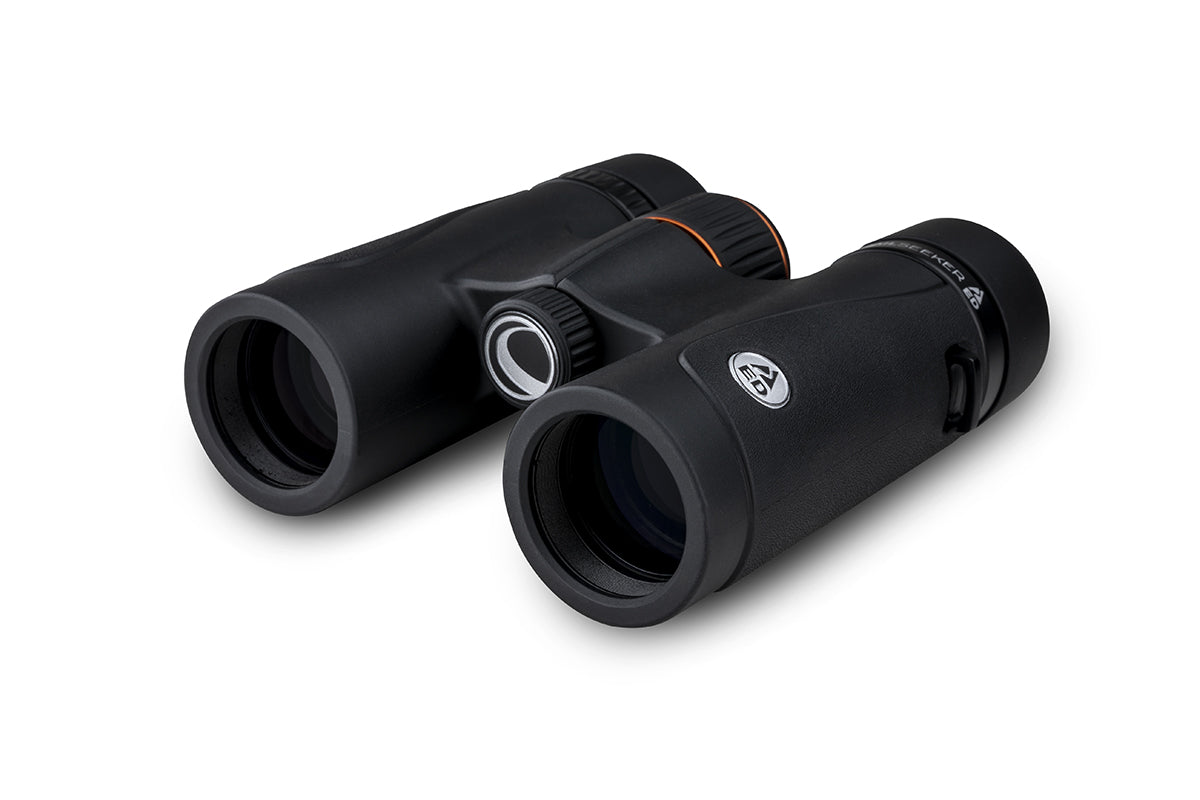
Explore this need in the finder →The TrailSeeker ED 10x32 (Celestron item 71403) puts a 10x view in the compact 32 mm ED body. That combination is for an observer who values more magnification in a lighter carry and accepts the narrower 6.2° field, shorter 14.4 mm stated eye relief and smaller exit pupil. At 17.6 oz, it is much lighter on the published scale than the 10x42 ED item 71407, but it is not simply a shrunken version with every fit and viewing property unchanged.
Why choose 10x in a 32 mm body?
Ten-power makes a distant subject appear larger than an 8x view, but any hand movement is magnified too. The exact page lists a 6.2° field and 326 feet at 1,000 yards (109 metres at 1,000 metres). That is narrower than the ED 8x32 item 71401’s published 7.8° scene, so quick searching through brush or tracking fast motion will often be easier with 8x. The case for the 10x32 is the balance of a compact body with greater apparent reach, not a promise of more detail in every viewing situation.
Celestron lists a 3.2 mm exit pupil and 17.6 oz (499 g) weight. The 32 mm objective keeps the instrument compact, but the smaller exit pupil is a published geometric consequence of 10x magnification and 32 mm objectives; it is not an independent brightness measurement. If long twilight sessions matter more than pack size, compare a 42 or 50 mm objective and consider whether its additional mass is acceptable. No comparative low-light test is claimed here.
ED objectives and the limit of the claim
Celestron says the ED objective glass reduces chromatic aberration, the colored fringe that can appear along high-contrast edges, and promotes sharper, brighter views. The exact page does confirm ED glass, but the reviewed source is manufacturer copy—not an independent comparison test. This makes 71403 a reasonable candidate to compare when color fringing matters to you, not an automatically superior pick for every scene. The separate standard TrailSeeker 10x32 should be considered if ED is optional, but its exact model page—not this article—must support any claim about that configuration.
The exact page also lists fully multi-coated optics and phase- and dielectric-coated BaK-4 roof prisms. Those coating and material details are useful screening facts; they do not tell you how an individual viewer will perceive the full image. If you cannot compare these binoculars in person, avoid interpreting a technical label as a quantified performance ranking.
Fit and operating limits
Celestron lists 14.4 mm eye relief, 56–73 mm interpupillary adjustment and a close-focus distance of 8.2 feet. The TrailSeeker instructions explain setting barrel spacing, the central focus and the right-eye diopter; they recommend lowering the eyecups for glasses. At 14.4 mm, users who wear glasses should be particularly cautious about assuming the full field will be visible. If your hard fit requirement is 15 mm or more, the ED 10x32 fails it even though Celestron describes the eyecups as suitable for glasses.
The 8.2-foot minimum focus is another real limit: it is not the better ED TrailSeeker choice if you routinely view butterflies or plants closer than that. Item 71401 is listed at 6.5 feet and has both a wider field and longer eye relief, although it trades away the 10x power. The 10x42 ED item 71407 preserves 10x and publishes 15 mm relief, but is heavier. Those exact differences matter more than the shared ED name.
Weather rating and included equipment
This exact 10x32 page rates the binocular IPX7 to 1 metre for 30 minutes and lists nitrogen fill. It is fair to count that as confirmed waterproofing for a matcher, but it is not a promise of safe prolonged underwater observation, high-pressure cleaning or protection after damage. The manufacturer also lists tripod adaptability; the TrailSeeker series manual shows threads under the hinge cap and requires a separate binocular adapter. The exact package list includes a deluxe soft case, lens caps, neck strap, carrying harness, lens cloth and instruction manual, but not an adapter.
How the finder changes the answer
Select 10x and 32 mm to retain 71403; choosing 8x rejects it even if a similar compact form is attractive. The finder’s broad-real-field option is only a 6° floor, so the listed 6.2° qualifies; that choice does not distinguish it from a wider field such as the ED 8x32’s 7.8°. A 15 mm eye-relief minimum excludes its stated 14.4 mm, while a 14 mm minimum does not. The 8.2-foot focus figure meets a 9-foot maximum but fails an 8-foot one. Its exact page lists IPX7 protection; requiring an adapter in the box excludes it because that item is separate. Unknown glasses fit remains unknown.
Who should shortlist item 71403
Consider the ED 10x32 if keeping weight and size down is important but you want fixed 10x reach and an exact ED claim. Avoid it if broadest scanning, long eye relief, very close focusing, large objectives or an adapter-in-box kit are essentials. Its most direct sibling comparison is the ED 8x32: same listed weight and objective diameter, but the 8x model has a wider field, longer eye relief and closer focus. The ED 10x42 suits someone who can carry more mass for a larger objective and a 15 mm stated relief. This conclusion follows the item-specific Celestron page and TrailSeeker manual, not a field test or personal ownership story.
Key specifications
Key details at a glance
| Magnification | 10× |
|---|---|
| Objective diameter | 32 mm |
| Real field of view | 6.2° |
| Field width at 1,000 m | 109 m |
| Eye relief | 14.4 mm |
| Exit pupil | 3.2 mm |
More specifications and setup details
| Close focus distance | 8.2 ft |
|---|---|
| Manufacturer-published weight | 17.6 oz |
| ED glass confirmed for this exact model | Yes |
| Phase coatings confirmed | Yes |
| Lens and prism coatings | Exact model page identifies ED objective lenses, fully multi-coated optics, BaK-4 roof prisms with phase and dielectric coatings. ED performance descriptions are manufacturer claims; no independent comparison is claimed. |
| Water and fog protection | Exact model page lists Waterproof (IPX7 - 1 m / 30 min.) and nitrogen fill. This rating is not an endorsement for underwater viewing. |
| Tripod use | Exact page lists tripod adaptability and says the adapter is sold separately; manual identifies threads beneath the front hinge logo plate and a separate binocular adapter. Exact adapter SKU/compatibility is not established. |
| Published weight note | Exact item page lists 499 g (17.6 oz). This is instrument weight, not packed-kit weight. |
| Manufacturer-rated waterproof | Yes |
| Tripod adapter in package | No |
Use the exact model’s instructions for operating limits, supplied equipment and version differences.
Sources for this review
Sources for this assessment
- Official Celestron US TrailSeeker collection; exact row manually rechecked in archived 18-object JSON
- Official Celestron TrailSeeker collection object; exact 71403 row and page-linked image URL personally inspected
- Celestron exact US product page, TrailSeeker ED 10x32mm Roof Binoculars, item 71403; features/specifications/package/manual link
- Official exact-product-page linked original image; original bytes and visible identity cues personally inspected
- TrailSeeker Binoculars five-language series manual; English operations/care/safety pages personally inspected
- Official five-language TrailSeeker QSG linked from exact US page; English page 1 safety text inspected
- CPSC exact item ProductName query for 71403; empty JSON response on 2026-10-23, limited dated search

Choose your optical trade-off first.
Choose viewing purpose first, then magnification, objective size, scene width and any fit, weather or mounting constraint. A direct-Sun requirement is separate: only exact manufacturer-confirmed solar binoculars can pass it.
Your needs, this model
Waterproof 10x binoculars: field width versus a longer stated limit
Choose it when: Choose this example when the manufacturer-stated 30-minute water limit or confirmed ED-glass specification is important. Its 17.6 oz weight remains under the separate 20 oz ceiling, although it is 1 oz heavier than the P7 10x30.
Waterproof 10x binoculars: field width versus a longer stated limit →32 mm ED binoculars: choose 8x field or 10x reach
Choose it when: The exact 10x32 has the same listed mass and ED confirmation as the 8x, with more fixed magnification for tighter framing.
32 mm ED binoculars: choose 8x field or 10x reach →Binoculars with a broad real scene field
Choose it when: Choose this example if you want the tighter 10x view but still require a published real field above 6°. Celestron's exact item 71403 page lists 6.2° and confirms ED glass for this configuration.
Binoculars with a broad real scene field →