
On this page
An 8x waterproof option with close focus but no stated immersion limit
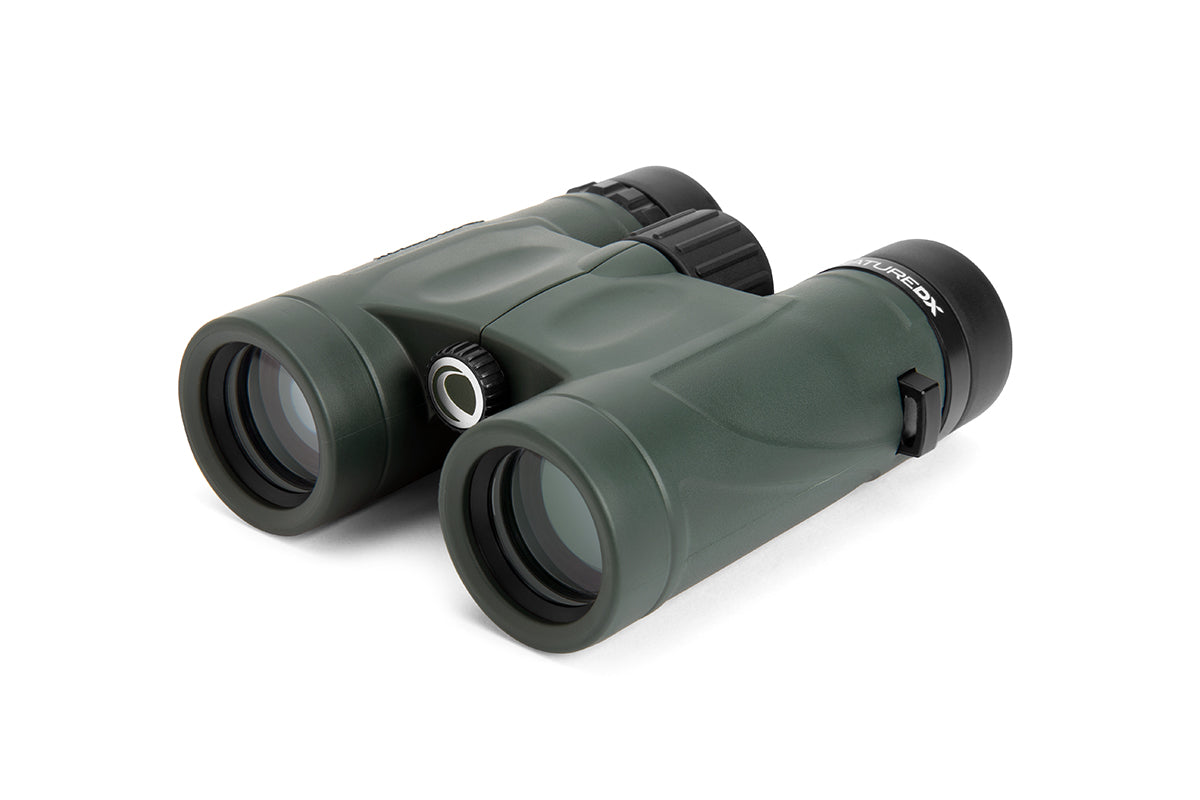
The Nature DX 8x32 lists a 7.4° field, 18 oz instrument weight, 17.5 mm eye relief and 6.5 ft close focus. Celestron identifies this exact model as waterproof but gives no depth or duration on the reviewed page, so do not infer an underwater rating.
Explore the needs this model fits
- Waterproof 8x binoculars: compare field, fit and rating detail
- Waterproof binoculars under 20 ounces: compare carry and focus tradeoffs
- Waterproof binoculars: what the exact-model rating does and does not establish
- Ordinary binoculars for wildlife, travel and the night sky
- Choosing among binoculars that show an 8x view
- Binoculars with manufacturer-confirmed tripod adaptability
Your needs, this model
Does it fit your priorities?
Does the 8x32 71330 combine a broad scene with a 20 oz carry ceiling?
Yes. Item 71330 is listed as 8x32, 7.4° wide and 18 oz.
Explore this need in the finder →Does the 8x32 have a published 6.5 ft close-focus distance and waterproof construction?
Celestron lists 6.5 ft and labels the construction waterproof, without giving an immersion limit.
Explore this need in the finder →Is a tripod adapter included with the 8x32?
The body is tripod adaptable, but a separate adapter is required and is not listed in the standard items.
Explore this need in the finder →Celestron Nature DX 8x32 item 71330 is the lighter, smaller-objective member of this page’s documented Nature DX group: fixed 8x magnification, a 32 mm objective, a 7.4° real field and a listed weight of 18 oz. It suits a walker or day birder who values a broad scene and less mass in the pack more than a large objective. It is not a substitute for a full-size 42 or 56 mm binocular when the intended use, face fit or support requirements demand a different plan.
Eight power and a broad field make a useful walking combination
The manufacturer lists 388 ft at 1,000 yards, corresponding to about 129 m at 1,000 m, and a 4 mm exit pupil. Its 7.4° angle is the clearest way to compare the real scene with other Nature DX choices: it is wider than the 5.8° 10x32 and 5.5° 12x56. That broader frame can make it easier to scan a hedgerow or find a bird moving through branches. The 8x image is also less sensitive to hand movement than a same-size 10x view in ordinary use, although no binocular eliminates shake. The product page lists no image stabilization.
The 32 mm objective and 4 mm exit pupil help explain the compact, 18-ounce class, not a measured brightness result. Compared with a 42 mm 8x model’s 5.25 mm exit pupil, this 8x32 has a smaller exit pupil; whether that difference matters depends on light, the viewer’s pupil, steadiness, optical transmission and the scene. A specification cannot promise a bright dusk image. If regular low-light viewing is essential, compare a 42 mm alternative rather than buying this because “8x32” sounds like an all-hours instrument.
Close subjects, glasses and body fit
Celestron specifies a 6.5 ft close-focus distance, so the model can serve for close-by plants or insects as well as birds across a field. Its stated eye relief is 17.5 mm; the twist-up eyecups have multiple positions. The Nature DX manual recommends lowering the eyecups when using glasses, but neither a millimeter figure nor the phrase “eyeglass friendly” guarantees that every frame will show the entire field. If you wear glasses, check that you can see a full, even circle without forcing the cups against the lenses. The page lists a 56–74 mm interpupillary range and ±3 diopter adjustment.
For first setup, the shared series manual says to bring the barrels together until the two images merge, focus a distant object with the center wheel while the right objective is covered, then adjust the right-eye diopter with the left side covered. Afterward, use the center wheel for ordinary focusing. This sequence helps distinguish a fit or diopter problem from a supposedly soft view; it is not a claim that every eye will achieve the same focus or comfort.
Weather protection and optional support
The exact page lists waterproof construction, nitrogen fill and rubber armor. It does not publish a depth or time for immersion, so treat this as weather protection rather than permission to take the binocular underwater. Tripod adaptation is supported, but a separate binocular adapter is needed and the box list does not name one. Handheld is the simplest operating plan for a model this light and 8x. If a long fixed watch makes tripod support essential, include the appropriate adapter and tripod in the plan before comparing the 18-ounce body weight alone.
The listed carton contents are a neck strap, objective caps, rainguard, padded nylon case, lens cloth and instruction manual. The site page also warns never to look at the Sun through binoculars or project its image; permanent eye damage can result. The manual’s storage and cleaning guidance is straightforward: replace the caps between uses, keep the instrument dry when stored and remove loose grit before wiping the lenses. Do not use a sleeve or paper towel as a lens cloth.
How answers change the shortlist
Select 8x and 32 mm to isolate this compact size from the 8x42 and 12x56 models. A 6° real-field requirement keeps the 7.4° figure; an essential 10x or 42 mm choice removes it. A 20-ounce ceiling and a 17 mm eye-relief minimum both fit the published figures, while an 18 mm minimum does not. A 7 ft close-focus ceiling accepts the specified 6.5 ft distance. Waterproofing can be retained as a documented feature; a supplied-adapter requirement should reject it because the adapter is separate. ED glass is not confirmed for this standard model, so an essential ED request must point to a product page that actually identifies ED.
Choose the Nature DX ED 8x42 item 72332 if the 42 mm objective and ED designation are more important than this model’s smaller package and lower weight. The ED 8x42 has a slightly wider listed angle (7.5°) and a 5.25 mm exit pupil, but it weighs 24.9 oz. Choose item 71331 if you prefer 10x with the same 32 mm objective and weight; its real field is narrower and its stated relief shorter. This 8x32 is the practical option when carrying weight and a quick, wide sweep lead the decision.
Exact identity and specifications: Celestron Nature DX 8x32 item 71330. Setup, care and safety: Celestron Nature DX binoculars series manual.
Key specifications
Key details at a glance
| Magnification | 8× |
|---|---|
| Objective diameter | 32 mm |
| Real field of view | 7.4° |
| Field width at 1,000 m | 129 m |
| Eye relief | 17.5 mm |
| Exit pupil | 4 mm |
More specifications and setup details
| Close focus distance | 6.5 ft |
|---|---|
| Manufacturer-published weight | 18 oz |
| ED glass confirmed for this exact model | No |
| Phase coatings confirmed | Yes |
| Lens and prism coatings | Celestron lists fully multi-coated optics and phase-coated BaK-4 roof prisms. This exact model is not identified as ED; no comparative optical measurement is inferred. |
| Water and fog protection | Celestron lists waterproof construction and nitrogen fill. The exact page gives no depth or duration for submersion; do not treat this as an underwater-use specification. Keep caps on and store the instrument dry per the series manual. |
| Tripod use | The exact product page calls the model tripod adaptable; the family manual shows an adapter between the binocular thread and a photographic tripod. The adapter is required and not in the manufacturer-listed package contents. |
| Published weight note | Celestron publishes 18 oz (510 g). Dimensions are the published numeric tuple; where the imperial tuple conflicts, the dossier records the conflict and leaves interpreted inches unknown. These are manufacturer values, not independent packed-weight measures. |
| Manufacturer-rated waterproof | Yes |
| Tripod adapter in package | No |
Use the exact model’s instructions for operating limits, supplied equipment and version differences.
Sources for this review
Sources for this assessment
- Celestron Nature DX US collection page 1; exact linked model row observed
- Celestron exact Nature DX US product page, item 71330
- Celestron Nature DX standard five-language manual; English setup and care inspected
- Celestron Nature DX QSG; English IPD/center-focus/right-eye-diopter instructions inspected
- CPSC exact item-number ProductName query for 71330; empty array on 2026-10-23
Choose your optical trade-off first.
Choose viewing purpose first, then magnification, objective size, scene width and any fit, weather or mounting constraint. A direct-Sun requirement is separate: only exact manufacturer-confirmed solar binoculars can pass it.
Your needs, this model
Waterproof 8x binoculars: compare field, fit and rating detail
Choose it when: This exact 8x32 is the comparison to examine when longer published eye relief and the closer 6.5 ft focus specification matter. Its listed 18 oz instrument mass remains below the 20 oz ceiling used by the separate lightweight-waterproof page.
Waterproof 8x binoculars: compare field, fit and rating detail →Choosing among binoculars that show an 8x view
Choose it when: Choose this example when its longer stated eye relief or 6.5 ft close focus is more relevant than a quantified immersion limit. Celestron lists the exact 8x32 as waterproof and publishes its real field, eye relief and focus distance.
Choosing among binoculars that show an 8x view →Ordinary binoculars for wildlife, travel and the night sky
Choose it when: This 8x32 is the broader-field example for someone scanning a moving subject or wanting a little more stated eye relief. Its 7.4° field is wider than the P7 10x30's published 6.6° field, and the exact model page lists a 6.5 ft close-focus distance.
Ordinary binoculars for wildlife, travel and the night sky →