
On this page
A lighter 10x30 with a stated water limit
The P7 10x30 lists a 6.6° field and 16.6 oz instrument weight, with a manual-stated 1 m / 10 minute water limit. It is not intended for underwater use; if a longer stated duration is important, compare the TrailSeeker ED 10x32 instead.
Explore the needs this model fits
- Waterproof 10x binoculars: field width versus a longer stated limit
- Waterproof binoculars under 20 ounces: compare carry and focus tradeoffs
- Waterproof binoculars: what the exact-model rating does and does not establish
- Ordinary binoculars for wildlife, travel and the night sky
- Choosing binoculars with 10x magnification
Your needs, this model
Does it fit your priorities?
Does this compact P7 pair 10x magnification with 30 mm objectives?
Yes. Nikon identifies the exact 10x30 configuration; it has a 346 ft real field and 3 mm exit pupil. The 10x view narrows the scene relative to the 8x30.
Explore this need in the finder →Does the 10x30 meet a 17 oz maximum instrument-weight choice?
Yes. Its current Nikon specification is 16.6 oz (470 g), below 17 oz before strap or other carried accessories.
Explore this need in the finder →Is the P7’s locking diopter documented for this exact 10x30?
Yes. The exact US product page marks a locking diopter and the model-family manual gives its use sequence.
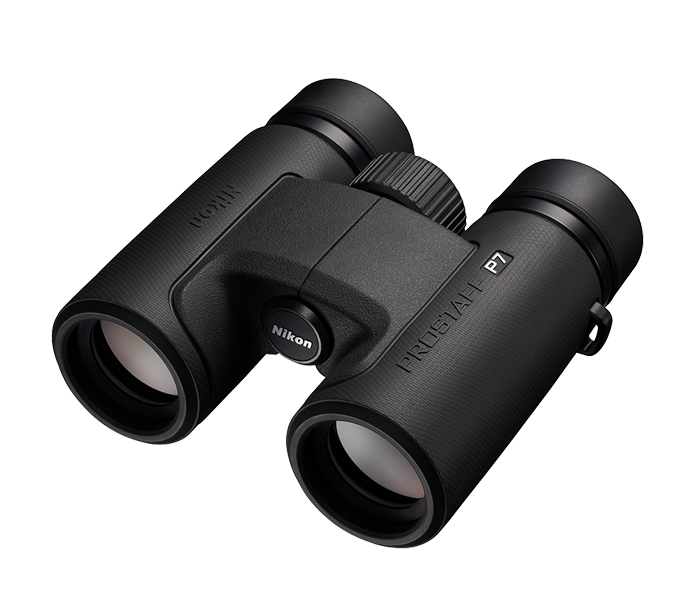
Explore this need in the finder →The PROSTAFF P7 10x30 is the lightest published weight among these four P7 sizes at 16.6 oz, and it puts 10x magnification in a short 4.9 in body. That combination can appeal to a traveler or daytime observer who wants more reach than an 8x compact without moving to a full-size objective. The price of that choice in optical geometry is clear: a 346-foot real field, a 3.0 mm exit pupil and 15.4 mm eye relief.
Choose 10x30 for more reach in a compact body
Ten power makes a distant subject appear larger than an 8x view. That is useful when you are watching a far-off animal or reading the broad shape of a landmark, provided you can keep the binocular steady. Hand movement is also magnified more, so the P7 10x30 is less forgiving than its 8x30 sibling for quick scanning. Nikon lists a real field of 6.6 degrees, or 346 feet at 1,000 yards. The 8x30 covers 456 feet at the same distance, leaving more surrounding scene available while searching.
The 10x30’s apparent field is 59.9 degrees. It remains a substantial view, but the family’s wider 8x30 apparent field is 62.6 degrees. Do not confuse a broad apparent-field specification with scene width: if tracking a fast-moving subject is your priority, the 8x30’s wider real field is the more relevant figure. If the subject is usually stationary and extra magnification leads your decision, this 10x may suit you better.
Carry and light limits
At 16.6 oz and 4.9 in long, the 10x30 is the lightest and shortest P7 configuration in Nikon’s four-model 30/42 mm table. Its 30 mm objectives reduce the package compared with the 42 mm models, which weigh 20.8 oz at 8x and 21.2 oz at 10x. You give up exit-pupil diameter: this 10x30’s is 3.0 mm, compared with 4.2 mm for the 10x42 and 5.3 mm for the 8x42. Nikon’s relative-brightness index is 9 for this 10x30. These figures clarify the compromise but are not measured brightness tests; the viewing result also depends on light, pupil size, fit and other factors not captured by the table.
Eye relief is 15.4 mm, the shortest class of eye-relief figure among these P7 options. The instruction manual says eyeglass wearers should begin with the eyecups fully retracted and provides two intermediate click stops. If you normally view with glasses, verify that the full field remains visible at a usable eyecup position. If long relief is more important than size, the 8x42’s 20.2 mm is the strongest fit in this group; the 10x42 is 15.7 mm.
P7 details are more than the magnification
This roof-prism binocular uses central focusing and a separate adjustable right-eye diopter with a locking mechanism. The ring can be released, adjusted and relocked so a chosen setting is less likely to shift in a bag. Nikon also confirms phase-correction and dielectric coatings on the P7 prisms, plus oil- and water-repellent treatment on the objective and eyepiece lenses. These are specific construction and handling features, not an independent finding that the P7 is brighter or sharper than a competitor. ED glass is not documented for this exact 10x30, so an ED requirement should rule it out rather than invite a guess.
The close-focus specification is 8.2 ft, the same as the P7 8x30. It may support nearby subjects such as a butterfly on a garden wall, but binocular close-focus figures are not camera-like macro claims. The user still needs to focus the instrument correctly and find a comfortable eye position.
Rain-ready, not meant for submersion viewing
Nikon’s manual specifies waterproofing to 1 m / 3.3 ft for 10 minutes, fogproofing and nitrogen filling. It says the binocular is not designed for underwater use and warns against strong water pressure. After rain or condensation, wipe off moisture before adjusting moving parts. The listed standard items are a binocular, eyepiece cap, two objective caps, soft case and neck strap; an adapter for a tripod is not confirmed in the manual or the exact US page. The matcher therefore treats waterproofing as known and tripod support as unknown, not as an assumed feature.
When the 10x30 is and is not the right answer
Pick it when compact carry and a higher magnification than 8x are both important, particularly in daylight. The P7 8x30 is the better P7 choice for a wider real scene, lower hand-shake sensitivity and a larger exit pupil, though it is 0.5 oz heavier. The P7 10x42 keeps 10x magnification while increasing the exit pupil to 4.2 mm and the real field to 367 feet, at a cost of about 4.6 oz and a longer body. Nikon’s P7 size guide helps separate those choices. For longer eye relief, consider the P7 8x42 rather than hoping the 10x30 eyecups will fit every glasses wearer.
Exact-model specifications and feature summary: Nikon PROSTAFF P7 10x30 page. The P7 manual listing links the English 8x30/10x30/8x42/10x42 instructions: Nikon Download Center.
Key specifications
Key details at a glance
| Magnification | 10× |
|---|---|
| Objective diameter | 30 mm |
| Real field of view | 6.6° |
| Apparent field of view | 59.9° |
| Field width at 1,000 m | 115 m |
| Eye relief | 15.4 mm |
More specifications and setup details
| Exit pupil | 3 mm |
|---|---|
| Close focus distance | 8.2 ft |
| Manufacturer-published weight | 16.6 oz |
| Phase coatings confirmed | Yes |
| Locking diopter ring confirmed | Yes |
| Lens and prism coatings | The exact Nikon USA page confirms phase and dielectric prism coatings and describes multilayer-coated optics; Nikon’s P7 line page states that both objective and eyepiece lenses have oil- and water-repellent surfaces. These descriptions do not confirm ED glass for this exact configuration. |
| Water and fog protection | Nikon’s 30/42 mm family manual rates this size waterproof to 1 m / 3.3 ft for up to 10 minutes and fogproof with nitrogen filling. It is not intended for underwater use, and the manual warns against strong water pressure. |
| Tripod use | The inspected exact US page, 30/42 mm instruction manual and P7 family page do not establish tripod compatibility, an adapter model or adapter-in-box status. No tripod operating plan is asserted. |
| Published weight note | Nikon’s exact US page and 2022 family table agree on this model’s published mass; the published figure is not an independent measurement. |
| Package contents | The Nikon English P7 30/42 mm manual lists one binocular, one eyepiece cap, two objective lens caps, one soft case and one neck strap. No adapter is listed. Seller-added US bundle contents are not established by that standard items list. |
| Manufacturer-rated waterproof | Yes |
Use the exact model’s instructions for operating limits, supplied equipment and version differences.
Sources for this review
Sources for this assessment
Choose your optical trade-off first.
Choose viewing purpose first, then magnification, objective size, scene width and any fit, weather or mounting constraint. A direct-Sun requirement is separate: only exact manufacturer-confirmed solar binoculars can pass it.
Your needs, this model
Waterproof 10x binoculars: field width versus a longer stated limit
Choose it when: This is the lighter of the two examples and has the broader published real field. Its exact-model family manual provides a numeric water limit, useful when a shopper wants more detail than an unquantified waterproof label.
Waterproof 10x binoculars: field width versus a longer stated limit →Ordinary binoculars for wildlife, travel and the night sky
Choose it when: This is the example to examine if 10x magnification is more important than a wider field. It weighs 16.6 oz, slightly less than the 8x32 here, and the exact page lists a central-focus design with a separate locking diopter.
Ordinary binoculars for wildlife, travel and the night sky →Choosing binoculars with 10x magnification
Choose it when: Use this as the lower-carry fixed-10x example: Nikon lists 16.6 oz, a 6.6° field and an 8.2 ft close-focus distance. Its exact 30/42 mm family manual gives a 1 m / 10 minute waterproof limit.
Choosing binoculars with 10x magnification →