
On this page
Your needs, this model
Does it fit your priorities?
Do you specifically need the R310’s exact 10x32 configuration?
Vortex identifies SKU R310 as fixed 10x32; the related R385 is a different 8.5x32 configuration.
Explore this need in the finder →Does the R310’s 13 mm eye-relief figure and 19 oz instrument limit fit your requirements?
The exact page and manual table list 13 mm eye relief and 19.0 oz. Glasses fit remains personal and the listed weight excludes the case and other accessories.
Explore this need in the finder →Must the binocular’s published minimum IPD setting reach 50 mm?
The exact Raptor table lists a 50–70 mm IPD adjustment range for R310. The number does not guarantee an individual fit.
Explore this need in the finder →The Vortex Raptor 10x32, SKU R310, is the higher-power member of the two Raptor 32 mm models listed on Vortex’s current U.S. page. The maker publishes a 6.3° real field, 13 mm eye relief, 15-foot close focus, 19.0-ounce weight and a 50–70 mm interpupillary range. Its shared Raptor manual contains a separate R310 specification column and operating instructions. This is a source-based assessment rather than an optical field test.
More magnification, less scene width
Against the 8.5x32 Raptor R385, this model has the narrower published view: 339 feet per 1,000 yards, or 6.3°, compared with 390 feet and 7.4°. In return, its 10x power makes a distant subject appear larger. That can help when watching relatively still detail at a distance, but it can make hand movement more apparent and make it harder to reacquire a moving subject when panning. These are common consequences of the format; Vortex does not supply a controlled head-to-head test or a guarantee that a particular user will prefer either view.
The objective diameter stays at 32 mm in both models, while the published carry-weight difference is only 0.3 ounce: 19.0 ounces for R310 and 18.7 for R385. So choose between the two by power, framing and eye position rather than treating 10x as a heavier design. The exact product page describes the Raptor line as a mid-size, wide-angle Porro-prism design. The R310 still has a wide scene by some standards, but it is materially narrower than the R385’s listing. If following birds in a busy canopy is the priority, the 8.5x32’s wider field deserves attention. If your targets are distant and you accept a tighter view, the 10x32 may better match the preference.
Shared fit range, different eye-relief figure
The R310’s manufacturer-listed eye relief is 13 mm, one millimeter shorter than the 14 mm quoted for R385. That difference is worth checking if you view through glasses, but neither number guarantees that your own frames will allow a full field. Try the exact pair with the glasses you wear and the eyecup position you intend to use. The manual describes twist-up, twist-down eyecups: extend them without glasses, lower them when looking through glasses, and adjust until the scene is a single, undistorted image.
Both Raptor models share a 50–70 mm interpupillary-distance range. The manual says to rotate the barrels inward or outward until your eye centers align with the ocular lenses. That broad listed adjustment can be useful when multiple viewers share the binocular, particularly if they do not all use the same spacing. It is not a guarantee of fit for every face, and “family” positioning should not be mistaken for a child-specific design. The model page does not identify this Raptor as child-focused.
For focus, the manual recommends setting the left view with the center wheel while the right eye is closed, then using the right-side diopter for the other eye. The diopter range is listed at ±4. Once the two sides are balanced, the center control handles changes in viewing distance. R310’s close-focus figure is 15 feet, the same as the R385. If nearby flowers, feeder activity or other close subjects are central, compare a model with a shorter confirmed close-focus distance instead.
What the sources establish about the instrument
The manual specifies Porro prisms and BaK4 prism material for both Raptor sizes. Vortex describes the optical system as SD and says its lenses are fully multi-coated. Those are product descriptions, not independent measurements of chromatic aberration, color, contrast or low-light performance. The page also says the instrument is nitrogen-purged and O-ring sealed and uses waterproof, fogproof and shockproof wording. Neither the page nor the manual gives a numeric water-resistance code, immersion depth or duration. Keep the distinction between the maker’s language and a tested submersion limit.
R310’s listed dimensions are five inches high by 6.2 inches wide, and its weight is the binocular alone. No rangefinder, electronic display or stabilization system appears in the product information; it requires no battery. The exact page/manual materials do not establish tripod adaptability. Therefore, do not treat this model as a confirmed tripod pair if hands-free support is an essential requirement. The included kit is a rainguard, tethered objective covers, comfort neck strap, carry case and lens cloth; those accessories add to the weight you pack.
Care and safety
Before wiping a lens, the Raptor manual instructs users to blow away dust and grit; it recommends cleaning products intended for coated optical surfaces. The body may be wiped with a soft cloth. It says the internal components are permanently lubricated, advises against adding lubricant and warns against disassembling parts other than removing the rainguard and objective covers. The manual also cautions against storing binoculars for long periods in direct sunlight or a very hot place.
These are ordinary binoculars, not solar viewers. The manual explicitly warns that looking at the Sun or another intense source can cause blindness. Do not point them at the Sun, including during an eclipse.
Who should shortlist the R310?
Choose the exact 10x32 if a larger view of distant subjects matters more than the R385’s wider published scene and extra millimeter of stated eye relief. Both make sense for a viewer who wants a mid-size passive binocular and needs a broad 50–70 mm IPD range; both are listed at 32 mm objectives and 15-foot close focus. R310 passes a 10x, 32 mm, 13 mm eye-relief floor and 19-ounce instrument-weight ceiling. It fails a 13.5 mm eye-relief minimum, an 18.9-ounce cap, or a requirement for at least 7° real field. The R385 has the converse fit and field advantages but does not satisfy a strict 10x requirement.
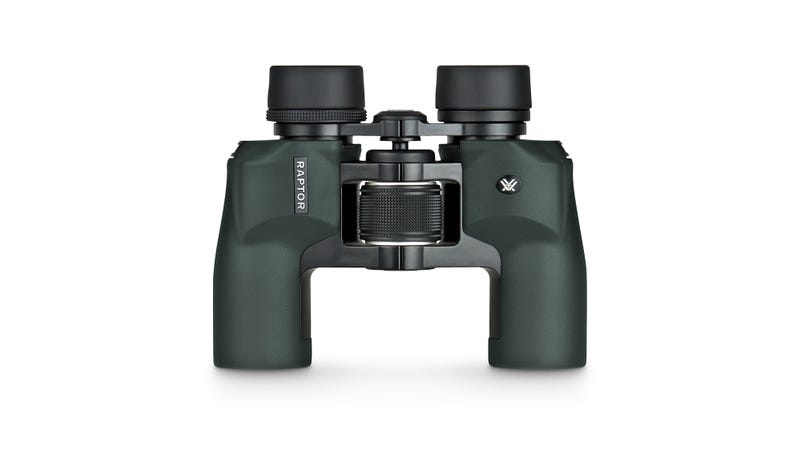
The exact R310 page links a front-view image that Vortex also links from the R385 product page. The archived 800 × 450 files are byte-identical: they show a Raptor body but no readable magnification or SKU. The shared manual’s own illustration note says images are representative and the product may vary slightly. Power identification therefore comes from the model-specific page/manual table, not appearance. Vortex does not state whether the product image is a photo or render, and its current Where to Buy link is not evidence of retailer inventory or price.
Manufacturer sources: Raptor 10x32 product page, the official Raptor product manual (specifications on p. 2; setup, care and safety on pp. 3–7, with identifier M-00104-1 on p. 12), and the Vortex binoculars category page 4.
Key specifications
Key details at a glance
| Magnification | 10× |
|---|---|
| Objective diameter | 32 mm |
| Real field of view | 6.3° |
| Field width at 1,000 m | 113 m |
| Eye relief | 13 mm |
| Close focus distance | 15 ft |
More specifications and setup details
| Manufacturer-published weight | 19 oz |
|---|---|
| Lens and prism coatings | Vortex describes fully multi-coated lenses; no exact-source claim of ED glass or phase/dielectric prism coating was found. |
| Water and fog protection | Vortex says the binocular is nitrogen-purged and O-ring sealed and uses waterproof/fogproof/shockproof language. The reviewed exact page/manual do not give a numeric ingress code or immersion depth/duration. |
| Tripod use | The exact page and Raptor manual do not state tripod compatibility. A tripod adapter is not listed in the package; compatibility remains unknown rather than presumed. |
| Published weight note | Vortex-listed instrument-only weight; carry case, strap, covers and lens cloth add to the packed system. No independent weighing was done. |
| Manufacturer-rated waterproof | Yes |
| Built-in image stabilization confirmed | No |
| Integrated laser rangefinder | No |
| Onboard ballistic solution display | No |
| Tripod adapter in package | No |
Use the exact model’s instructions for operating limits, supplied equipment and version differences.
Sources for this review
Sources for this assessment
- Exact Vortex U.S. Raptor 10x32 product page, SKU R310
- Official Vortex U.S. binocular category page 4 observation, row for Raptor 10x32
- Official shared 12-page Raptor Product Manual, model table contains SKU R310; printed footer M-00104-1
- Official 800 x 450 image URL linked from exact R310 product gallery

Choose your optical trade-off first.
Choose viewing purpose first, then magnification, objective size, scene width and any fit, weather or mounting constraint. A direct-Sun requirement is separate: only exact manufacturer-confirmed solar binoculars can pass it.