
On this page
Your needs, this model
Does it fit your priorities?
Is an 8x32 configuration your preference?
The DB-212 page and SKU sheet identify fixed 8x32; the sibling DB-213 is 10x32.
Explore this need in the finder →Does a 16-ounce instrument limit work?
The manufacturer lists 15.9 oz, which meets an inclusive 16-ounce cap but not 15.5.
Explore this need in the finder →Do you need 16 mm stated eye relief?
DB-212 is listed at 16.0 mm, meeting 16 but not 16.5; try the eyecups with your frames.
Explore this need in the finder →The Vortex Diamondback HD 8x32 (U.S. SKU DB-212) is the lightest of the new 32 mm HD options at a listed 15.9 ounces. It combines eight-power magnification with a notably broad 8.1-degree real field, 426 feet at 1,000 yards, and five-foot close focus. It is a compact general-purpose configuration for walking and scanning, with the smaller objective and 16 mm eye relief setting clear limits.
A wide scene in a compact package
The broad field is the most useful reason to choose this model. The 8.1-degree view makes it easier to search across an open patch, keep a moving bird in sight or understand more of the scene around a subject. The higher-power 10x32 DB-213 magnifies distant detail more but lists a narrower 6.5-degree field. If your binocular habit is to raise the instrument, locate, follow and lower it again, the 8x32 can make that process less fussy. Its 8x image also shows less hand motion than the 10x version, though grip and posture still matter.
It weighs 15.9 ounces on Vortex’s published figure, nearly matching the 10x32’s 16 ounces and substantially below the 8x42 DB-214’s 21.8 ounces. The smaller 32 mm objectives keep the body shorter at 4.4 by 5 inches. That is a meaningful hiking trade if your priority is always carrying the binocular. It is not proof of equal performance in dim light: its exit pupil calculates to 4 mm (32 divided by 8), while the 8x42 is about 5.25 mm. These ratios describe geometry only; they are not measured transmission or a brightness grade. If late-day observation is frequent, compare the 8x42 or another larger aperture model, then account for the extra bulk and weight.
Near focus, eye relief and fit
The listed close-focus distance is five feet, which helps with flowers, insects at a sensible distance and other nearby outdoor subjects. It is not intended for close-up photography or magnified work at arm’s length. Vortex lists eye relief at 16 mm and interpupillary distance at 55–72 mm. The longer 17 mm relief of DB-214 may be worth testing for glasses wearers, though neither number guarantees comfort. Lower the eyecups if needed, then check that the entire field remains visible with your actual eyewear. Also make sure the barrels align to your eyes within the stated range.
The shared Diamondback HD manual’s center-focus and diopter instructions are particularly useful if the image seems fuzzy in one barrel: set eye spacing, focus one side to your eye, then use center focus for changing distance. The official page’s “close focus” figure describes the nearest distance at which the image focuses; it does not change the instrument into a near-work tool.
Package and protection
The DB-212’s box list uses a Deluxe carrying case rather than the GlassPak harness supplied with many 42 and 50 mm models. Vortex also lists tethered objective covers, a rainguard, strap and lens cloth. The exact SKU XVIEW sheet names DB-212 and documents its parts package. The model is described as tripod adaptable, but the box list does not include an adapter. A stable mount therefore needs a separately verified compatible adapter; if mounting is central to your use, compare models with a confirmed included adapter such as the 15x56 DB-218.
The manufacturer describes an HD Optical System with fully multi-coated lenses, dielectric prism coatings, phase correction and ArmorTek exterior protection. It lists argon purging, O-ring sealing, waterproof, fogproof and shockproof construction. Those statements do not include a published IP code or a submersion depth and duration, so this is not a documented underwater binocular. The exact page does not explicitly specify ED glass. No battery or electronics are needed; it has no integrated rangefinder or image stabilization.
Who should choose the 8x32
Shortlist the DB-212 if a broad real field, small carry footprint, five-foot close focus and quick scanning matter more than the aperture of a 42 or 50 mm model. It is a good comparison for the DB-213: you give up 2x magnification and gain 1.6 degrees of real field while almost matching the listed weight. The 8x42 DB-214 has a narrower 7.5-degree field but a larger objective and 17 mm listed eye relief; its weight rises about 5.9 ounces. For glasses fit or frequent twilight viewing, test that larger sibling before deciding.
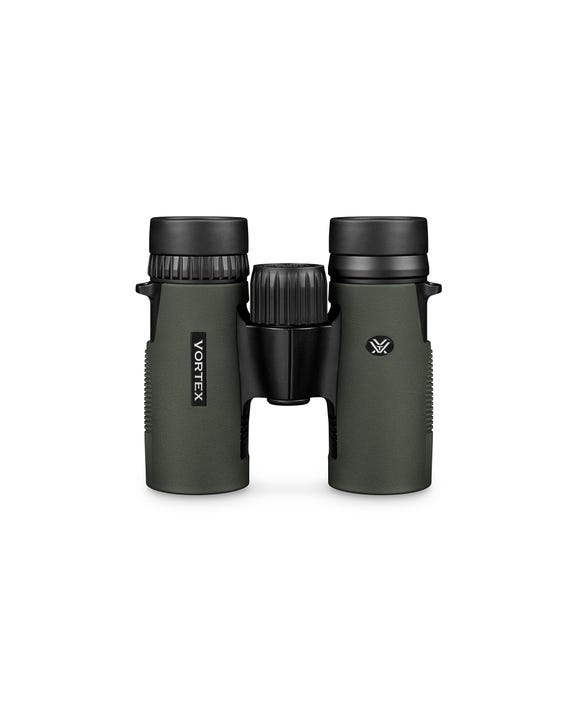
The exact manufacturer page currently offers a “Where to Buy” route, not verified store inventory. The page-linked image is a source for the Diamondback HD 32 mm body but does not show a legible power marking; the exact model is confirmed by the DB-212 SKU page and sheet. Vortex does not say whether its picture is a photograph or a rendering. The shared owner manual cautions never to view the Sun with ordinary binoculars.
Key specifications
Key details at a glance
| Magnification | 8× |
|---|---|
| Objective diameter | 32 mm |
| Real field of view | 8.1° |
| Eye relief | 16 mm |
| Exit pupil | 4 mm |
| Close focus distance | 5 ft |
More specifications and setup details
| Manufacturer-published weight | 15.9 oz |
|---|---|
| Phase coatings confirmed | Yes |
| Lens and prism coatings | Vortex lists fully multi-coated lenses, dielectric prism coatings, phase correction, ArmorTek exterior-lens protection and its HD Optical System. The exact page does not explicitly identify ED glass. |
| Water and fog protection | Vortex describes the exact HD model as waterproof, fogproof and shockproof, argon-purged and O-ring sealed. The page supplies no IP code, immersion depth or duration; underwater use is not established. |
| Tripod use | A tripod is not listed as included. Adapter availability is SKU-specific; exact DB-218 page/XVIEW list an adapter, other exact HD SKU box lists do not. |
| Published weight note | Manufacturer-listed instrument weight only; not independently measured and excludes carrying kit. |
| Manufacturer-rated waterproof | Yes |
| Built-in image stabilization confirmed | No |
| Integrated laser rangefinder | No |
| Onboard ballistic solution display | No |
| Tripod adapter in package | No |
Use the exact model’s instructions for operating limits, supplied equipment and version differences.
Sources for this review
Sources for this assessment
- Official Vortex U.S. exact product page, Vortex Diamondback HD 8x32, SKU DB-212
- Official Vortex SKU-specific DB-212 parts and in-box XVIEW sheet
- Official Vortex-linked Diamondback HD owner manual, page/in-box label M-00253-0; PDF footer M-00253-1
- Official Vortex gallery image linked from the exact DB-212 page; archived native product-image asset
- Official Vortex U.S. binocular category page 3, item 5; item manually matched to exact product page

Choose your optical trade-off first.
Choose viewing purpose first, then magnification, objective size, scene width and any fit, weather or mounting constraint. A direct-Sun requirement is separate: only exact manufacturer-confirmed solar binoculars can pass it.