
On this page
Your needs, this model
Does it fit your priorities?
Do you want the wider-view 8x28 member of this pair?
DB-210 is the fixed 8x28 configuration: it gives a wider listed 332-foot real field than the 10x28 sibling, in the same 28 mm objective class.
Explore this need in the finder →Does a real field of at least 6 degrees matter for locating moving subjects?
The exact manufacturer page lists 6.2 degrees (332 feet at 1,000 yards), which meets a 6-degree real-field preference; it does not establish a 60-degree apparent field.
Explore this need in the finder →Do you need the full 18 mm published eye-relief figure?
The exact page and table list 18.0 mm. It meets an 18 mm minimum but not 18.5 mm; glasses fit still needs a trial.
Explore this need in the finder →The Vortex Diamondback HD 8x28 (U.S. SKU DB-210) pairs an eight-power view with a 28 mm objective in a short, light body. Vortex publishes a 6.2-degree real field, or 332 feet at 1,000 yards, 18 mm eye relief, six-foot close focus and a 13.7-ounce instrument weight. That mix points toward a compact pair for daylight walks and travel where quickly finding a subject matters more than maximum reach or a large low-light exit pupil.
Why the 8x28 makes sense
The 8x28's strongest practical distinction from its Diamondback HD 10x28 sibling is the view, not a big weight saving. The 8x28 is only 0.4 ounce heavier in the published numbers, but its lower power brings a wider 332-foot scene versus 273 feet for the 10x28. That extra context is useful when sweeping a shoreline, finding a bird in branches or following movement without repeatedly lowering the binocular to relocate the subject. Eight power also enlarges the image less, which many people find easier to hold steady than ten power. Neither benefit is a measured stabilization claim.
The 28 mm objective is the compromise. Dividing 28 by eight gives a calculated 3.5 mm exit pupil; it is a geometric ratio rather than a brightness rating. A compact objective can keep the package convenient, but this is not the first choice for twilight, shaded woodland or long astronomy sessions if a larger instrument is comfortable to carry. Do not mistake the “HD” label or the selected-glass marketing for a confirmed ED-glass specification: the exact page names an HD Optical System, but does not state ED for this SKU.
Carry, glasses and close subjects
Vortex lists the body at 4.6 by 4.5 inches and 13.7 ounces. That is a relatively modest instrument weight, not a pocketable folded roof pair or the total weight of its case, strap and anything else you carry. The page lists 18 mm eye relief and adjustable eyecups. For glasses wearers, 18 mm is a helpful specification to compare, not a promise that every frame will show the full field. The manual generally recommends collapsing the eyecups with glasses; test the actual binocular at your normal eye position before relying on the field figure.
The close-focus figure is six feet, so it can focus on near garden details as well as distant scenery. That does not turn it into a macro lens: close-up depth of field and eye placement remain binocular constraints. Its interpupillary adjustment is listed as 55–72 mm. If the eyepieces cannot align comfortably with your eyes, or you see a dark edge or double image, this configuration is not a good fit regardless of its size.
Setup and care are part of the decision
The page describes center focus, adjustable eyecups, waterproofing, fogproofing, shock protection, argon purging and O-ring sealing. It gives no IP code, immersion depth or duration, so treat those statements as weather protection—not permission to submerge it. The exact linked nine-page Diamondback HD manual explains setting the interpupillary distance until the view becomes one image, focusing one barrel at a time with the center wheel and right-eye diopter, then using the center wheel for ordinary focusing. It also describes protecting the lenses with the tethered objective covers and eyepiece rainguard, blowing away grit before wiping, and using products made for coated optics.
There is a small manual-label discrepancy worth keeping intact: the exact page links a file named M-00253-0 and its SKU sheet lists that in-box manual number, while the downloaded nine-page PDF's footer says M-00253-1. Its model table covers the 8x28 values above, but the revision label is not reconciled here. The manual explicitly says not to look at the Sun through ordinary binoculars; no solar filter is included or confirmed.
What the package does—and does not—solve
The exact page and DB-210 parts-and-box sheet identify a 28 mm soft-sided case, tethered objective covers, neck strap, rainguard, lens cloth and the owner manual. The product page also describes a tripod socket and adapter compatibility, but the SKU sheet does not list a tripod adapter in the box. Verify a compatible adapter separately if you plan to mount it; the integrated socket is not the adapter itself, and there is no built-in image stabilization. The compact case, rather than a chest harness, is the supported carry arrangement documented for this configuration.
Choosing it over the alternatives
Pick the DB-210 over the 10x28 if you favor a wider, easier-to-scan scene and longer listed eye relief. The 10x28 is fractionally lighter and enlarges distant detail more, but its real field is narrower and its 16 mm eye-relief figure leaves less numerical margin for glasses. If either 28 mm option seems too small for dim conditions, compare a 32 or 42 mm binocular before deciding: a larger objective may better suit those sessions, at the cost of a larger carry package. The correct trade depends on when and how long you watch, not on an “HD” label alone.
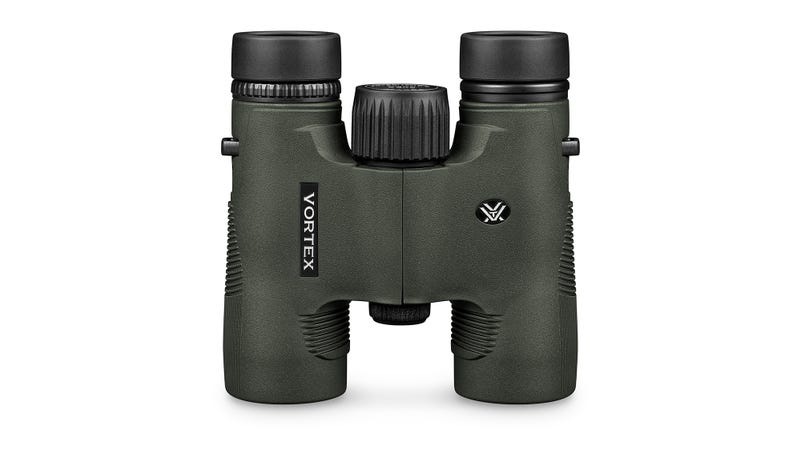
For a traveler, casual birder or hiker who values uncomplicated daylight viewing, useful close focus and a broad scene in a small body, the 8x28 is the more forgiving member of this pair. It is a poor match for someone whose essential need is a verified ED label, a large twilight pupil, a supplied tripod adapter, an exact immersion rating or guaranteed full-field glasses fit. This assessment uses the exact U.S. SKU DB-210 page, its linked parts sheet and the linked Diamondback manual. The page routes to “Where to Buy”; that is not a verification of retail stock. The front-view image is the same unmarked 28 mm image linked from both exact pages, so its appearance does not distinguish 8x from 10x; Vortex does not state whether it is a photograph or a rendering. This is source-based analysis, not a personal ownership or laboratory test.
Key specifications
Key details at a glance
| Magnification | 8× |
|---|---|
| Objective diameter | 28 mm |
| Real field of view | 6.2° |
| Eye relief | 18 mm |
| Exit pupil | 3.5 mm |
| Close focus distance | 6 ft |
More specifications and setup details
| Manufacturer-published weight | 13.7 oz |
|---|---|
| Phase coatings confirmed | Yes |
| Lens and prism coatings | Vortex lists fully multi-coated lenses, dielectric prism coatings, phase correction, ArmorTek exterior-lens protection and its HD Optical System. The exact model page does not explicitly identify ED glass. |
| Water and fog protection | Vortex describes the exact model as waterproof, fogproof and shockproof, argon-purged and O-ring sealed. It publishes no IP code, immersion depth or duration; underwater use is not established. |
| Tripod use | Vortex describes the binocular as tripod adaptable and the manual identifies a tripod-adapter socket. The exact SKU sheet does not include an adapter; adapter model/fit was not established from these materials. |
| Published weight note | Vortex-listed instrument weight only, not the case/strap system and not independently measured. |
| Manufacturer-rated waterproof | Yes |
| Built-in image stabilization confirmed | No |
| Integrated laser rangefinder | No |
| Onboard ballistic solution display | No |
| Tripod adapter in package | No |
Use the exact model’s instructions for operating limits, supplied equipment and version differences.
Sources for this review
Sources for this assessment
- Official Vortex U.S. exact product page, Vortex Diamondback HD 8x28, SKU DB-210
- Official Vortex SKU-specific DB-210 parts drawing and in-box XVIEW sheet
- Official Vortex-linked nine-page Diamondback HD operation manual; PDF footer M-00253-1 despite page/SKU filename M-00253-0
- Official Vortex front product gallery image linked from this exact SKU page; shared unmarked 28mm image
- Official Vortex U.S. binocular-category page 3, page 3, item 11; exact title and product URL manually reconciled

Choose your optical trade-off first.
Choose viewing purpose first, then magnification, objective size, scene width and any fit, weather or mounting constraint. A direct-Sun requirement is separate: only exact manufacturer-confirmed solar binoculars can pass it.