
On this page
Your needs, this model
Does it fit your priorities?
Do you want ten power in the compact 32 mm class?
Exact DB-213 page and SKU sheet identify a 10x32 model distinct from 8x32 DB-212.
Explore this need in the finder →Does a 16.5-ounce instrument cap fit your carry plan?
Vortex lists 16.0 oz; the 16.5 cap admits DB-213 and a 15.5 cap does not.
Explore this need in the finder →Is 14 mm published eye relief your minimum?
Exact page lists 14.0 mm. It meets 14 but not 14.5; eyewear comfort is individual.
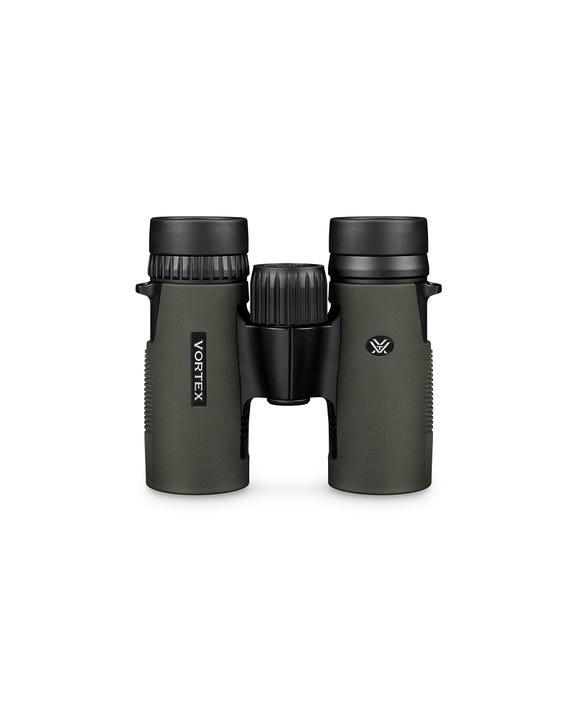
Explore this need in the finder →Vortex Diamondback HD 10x32 binoculars (U.S. SKU DB-213) are the compact choice for someone who wants ten-power reach without the 21-ounce body of the 10x42. The exact page lists a 16-ounce instrument weight, a 340-foot field at 1,000 yards, 14 mm eye relief and six-foot close focus. Its strengths are portability and a relatively broad field for 10x; the short eye relief and smaller objective call for a fit and light-use check.
Compact does not mean effortless
A 32 mm body is easier to pack than a 42 or 50 mm model, and at 16 ounces this pair is well below the 21.3-ounce DB-215. It still uses 10x magnification, so the view will show more hand motion than an 8x32. If you are walking, stopping briefly and looking into nearby trees, the body size can be welcome. If you plan to track birds continuously, keep the binocular raised for a long time, or scan a wide landscape, compare the 8x32 DB-212: it weighs 15.9 ounces and has an 8.1-degree field instead of this model’s 6.5 degrees.
The 6.5-degree real field (340 feet at 1,000 yards) is wider than the 10x42 DB-215’s 6.3 degrees, a small but genuine listed advantage. It is not a 60-degree apparent-field rating, and the exact page does not publish a separate apparent field. Its calculated exit pupil is 3.2 mm (32 mm divided by 10x). That is only geometric output size, not a promise of brightness or a measure of image quality. A compact front objective may not be the best match for extended twilight watching; a larger objective adds weight, not guaranteed contrast or resolution.
Check glasses and face fit early
At 14 mm, the DB-213 has the shortest listed eye relief in the reviewed HD family. Some glasses wearers may struggle to see the entire field from a comfortable position. Treat this number as a reason to try the instrument with your normal glasses, not a reason to assume it will or will not fit. The adjustable eyecups help position the eye, but they cannot change the optics’ eye-relief specification. Vortex lists a 57–73 mm interpupillary range, which is somewhat narrower than DB-212’s 55–72 mm; align the barrels to your own eyes and make sure the image merges without forcing the hinge.
Six feet of close focus makes this more useful for a nearby subject than the 15x56 DB-218, whose listed close focus is 14 feet. But six feet is not a macro lens. Focus one barrel’s diopter to your vision, then use the center wheel as the subject distance changes. The manufacturer’s shared HD manual explains the adjustment sequence. Do not expect one user’s diopter setting to work for another pair of eyes.
Exact kit and the absent adapter
The DB-213 page lists a Deluxe Case, strap, rainguard eyepiece cover, tethered objective covers and lens cloth. The DB-213-specific XVIEW sheet supports its exact SKU and in-box configuration. Unlike several 42 and 50 mm models, the page does not list a GlassPak harness. It is described as tripod adaptable, but no adapter appears in the exact box list; if you plan to mount it, check compatibility and purchase the correct separate adapter. The body is passive, with no battery, electronic display, stabilization or laser rangefinder.
Vortex lists fully multi-coated lenses, dielectric prism coatings, phase correction and ArmorTek protection under its HD Optical System. It describes the model as argon-purged, O-ring sealed, waterproof, fogproof and shockproof. The page does not explicitly say ED glass and does not specify an IP code or immersion limit. For someone who needs ED confirmation or a measured water rating, those details remain unknown, not satisfied by the product-family name.
Best use and better alternatives
Choose the DB-213 when compact packability matters but you still want a 10x view, have tested the 14 mm eye relief and usually observe in reasonable daylight. It could suit travel, an event, or an outing where weight and a little extra detail matter more than a very wide scan. Choose the 8x32 DB-212 for tracking and a broad view; choose the 10x42 DB-215 if you want a longer stated eye relief, a full-size grip and a GlassPak harness, accepting 5.3 extra ounces. For prolonged late-day observation, compare a 50 mm model and consider the 10x50 DB-216’s 17 mm eye relief, wider objective and 30-ounce weight as a trade, rather than assuming the larger lens will automatically look brighter.
Check the full field through your own glasses and decide whether the included case suits your carrying plan. The exact product page directs buyers to “Where to Buy,” which is not a live stock count. Its exact-page image is archived; the manufacturer does not state photo or rendering method. Power and model identity come from the SKU-specific page and sheet, not the image. The linked manual explicitly warns against pointing ordinary binoculars at the Sun.
Key specifications
Key details at a glance
| Magnification | 10× |
|---|---|
| Objective diameter | 32 mm |
| Real field of view | 6.5° |
| Eye relief | 14 mm |
| Exit pupil | 3.2 mm |
| Close focus distance | 6 ft |
More specifications and setup details
| Manufacturer-published weight | 16 oz |
|---|---|
| Phase coatings confirmed | Yes |
| Lens and prism coatings | Vortex lists fully multi-coated lenses, dielectric prism coatings, phase correction, ArmorTek exterior-lens protection and its HD Optical System. The exact page does not explicitly identify ED glass. |
| Water and fog protection | Vortex describes the exact HD model as waterproof, fogproof and shockproof, argon-purged and O-ring sealed. The page supplies no IP code, immersion depth or duration; underwater use is not established. |
| Tripod use | A tripod is not listed as included. Adapter availability is SKU-specific; exact DB-218 page/XVIEW list an adapter, other exact HD SKU box lists do not. |
| Published weight note | Manufacturer-listed instrument weight only; not independently measured and excludes carrying kit. |
| Manufacturer-rated waterproof | Yes |
| Built-in image stabilization confirmed | No |
| Integrated laser rangefinder | No |
| Onboard ballistic solution display | No |
| Tripod adapter in package | No |
Use the exact model’s instructions for operating limits, supplied equipment and version differences.
Sources for this review
Sources for this assessment
- Official Vortex U.S. exact product page, Vortex Diamondback HD 10x32, SKU DB-213
- Official Vortex SKU-specific DB-213 parts and in-box XVIEW sheet
- Official Vortex-linked Diamondback HD owner manual, page/in-box label M-00253-0; PDF footer M-00253-1
- Official Vortex gallery image linked from the exact DB-213 page; archived native product-image asset
- Official Vortex U.S. binocular category page 3, item 4; item manually matched to exact product page

Choose your optical trade-off first.
Choose viewing purpose first, then magnification, objective size, scene width and any fit, weather or mounting constraint. A direct-Sun requirement is separate: only exact manufacturer-confirmed solar binoculars can pass it.