
On this page
Your needs, this model
Does it fit your priorities?
Does the 10x25 trade field width for more magnification than its 8x sibling?
Yes. Nikon lists 10x with a 6.5° real field and 114 m at 1,000 m; the 8x25 is 8.3° and 145 m. More power can enlarge a distant subject but also magnifies hand movement.
Explore this need in the finder →Is the 10x25 suitable if a full 60-degree apparent field is essential?
No. Nikon publishes 59.2° apparent field. Choose the 8x25 in this family if the 60° threshold is essential; it is listed at 60.3°.
Explore this need in the finder →Can the 10x25 be used around rain while staying out of the water?
Yes. Nikon specifies waterproofing to 1 m for 10 minutes but says the binocular is not intended for underwater use.
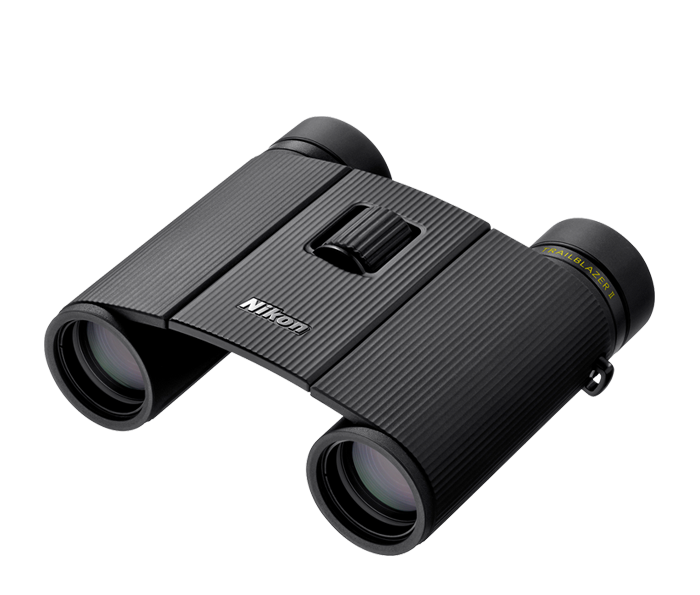
Explore this need in the finder →The Nikon TRAILBLAZER II 10x25 is a genuinely small, weather-protected binocular for observers who prefer 10x reach to the wider scene of the matching 8x25. It weighs the same listed 10.9 oz and folds to a similar footprint, but its 6.5-degree real field, 2.5 mm exit pupil and 10 mm eye relief make it a more demanding choice for finding moving subjects, wearing glasses and watching in dim light. Buy it for the power, not because 10x is automatically better.
More magnification in the same small body
The 10x25 uses 10x magnification and 25 mm objectives. Nikon lists a 6.5-degree real field, or 114 m across at 1,000 m, with a 59.2-degree apparent field. The 8x25 model has an 8.3-degree real field and 145 m at the same distance. In ordinary use, the 10x can make distant details appear larger, while the 8x exposes more of the surrounding scene and is easier to sweep across a moving target. A narrow field is not the same thing as greater resolution, and extra power can exaggerate hand motion as well as the subject.
If you often search through trees or follow birds that do not stay still, start by looking through the 8x25. If most targets are relatively steady and far away—such as a stage, landmark, or boat viewed from shore—the 10x choice can be worth testing. The useful question is whether you can hold it comfortably and find the subject quickly, not whether a higher magnification number sounds more impressive.
The small objective has visible trade-offs
The listed 2.5 mm exit pupil is smaller than the 3.1 mm figure for the 8x25, and Nikon gives the 10x25 a relative-brightness index of 6.3 rather than 9.6. These are geometric and manufacturer-published values, not an independent low-light measurement. A 25 mm front lens is a portability choice. If evening wildlife, shade or a forgiving view in changing light is central to your plans, move up to a larger objective rather than expecting stabilization or magnification to make the entrance pupil bigger.
At 310 g (10.9 oz), the 10x is unusually light for its power, and Nikon’s family dimensions put it at about 100 × 114 × 44 mm, narrowing to 69 mm across when folded. Both powers share the same listed body dimensions and weight. That makes the choice mainly optical: wider and easier to locate with the 8x, or tighter and more enlarged with the 10x.
Close focus, glasses and setup
Nikon lists the 10x25’s closest focus at 11.5 ft. This is adequate for many distant sightseeing and outdoor uses but is not a close-focus specialist. The 8x25 focuses to 8.2 ft, so it is the better of these two for inspecting a nearby flower, insect on a railing, or detail in a museum display from an appropriate distance. The numbers are manufacturer specifications; they do not promise the same close-focus experience for every user.
Published eye relief is 10 mm. That short figure deserves attention if you wear glasses while viewing: a specification alone cannot guarantee that your frames will show the full scene. The turn-and-slide eyecups are adjustable, but the best setting depends on your eye position. The binocular’s interpupillary range is 56–72 mm; narrow or wide spacing outside that range may prevent the two views from merging. Nikon describes a large focusing knob, which is easier to locate than a small control, though the exact grip and wheel reach are still personal fit questions.
Suitable weather protection, not a dive rating
Nikon says the TRAILBLAZER II is waterproof, nitrogen-filled and fogproof, and specifies submersion to 1 m (3.3 ft) for up to 10 minutes. It is explicitly not intended for underwater use. That can be reassuring in rain, on a damp trail or around spray, but it is not permission to use the binocular as snorkeling gear or to expose it to a pressure jet. The rubber-armored aluminum body and folding bridge are designed for portability; protect the eyepieces and optics from grit and clean lenses with suitable care rather than rubbing them with a sleeve.
Alternatives that answer different needs
The TRAILBLAZER II 8x25 is the first comparison if your 10x view feels too narrow or unsteady. It keeps the same 10.9 oz carry weight, gives a wider real field, has a larger exit pupil and focuses closer. Nikon’s PROSTAFF P3 10x30 is a different step: it has 10x power and a 6.6-degree real field, close to the Trailblazer’s published 6.5 degrees, but the larger 30 mm objectives and 15.4 mm listed eye relief come with a much larger body and higher published weight. That alternative is more promising for eyeglass fit and a less constrained objective, but is not a pocket-sized twin.
Do not read this as a tested brightness or sharpness ranking. Nikon’s exact pages publish the optical and physical specifications; they do not provide a lab measurement for the view in this comparison. Nor do they establish every item in a retail box. If a case, caps or strap is essential, confirm the contents for the exact seller’s SKU before ordering.
Verdict
Pick the 10x25 when you value a compact, fold-up 10x instrument and can accept a narrower scene, short 10 mm relief, a smaller exit pupil and a more distant closest-focus point. If easy scanning, glasses compatibility or regular low-light use is a stronger requirement, the 8x25 or a 30–42 mm model is a safer place to compare. The small body is the point; the decision is whether 10x power remains useful at that size for your actual viewing habits.
Model-specific specifications: Nikon TRAILBLAZER II 10x25. Family construction and dimensions: Nikon TRAILBLAZER II family page.
Key specifications
Key details at a glance
| Magnification | 10× |
|---|---|
| Objective diameter | 25 mm |
| Real field of view | 6.5° |
| Apparent field of view | 59.2° |
| Field width at 1,000 m | 114 m |
| Eye relief | 10 mm |
More specifications and setup details
| Exit pupil | 2.5 mm |
|---|---|
| Close focus distance | 11.5 ft |
| Manufacturer-published weight | 10.9 oz |
| Lens and prism coatings | Nikon describes multilayer-coated optics on the exact model page. The inspected source set does not establish ED glass, phase correction, dielectric coating, all-surface multi-coating, or oil/water-repellent objective and eyepiece surfaces; these details remain unknown. |
| Water and fog protection | Nikon describes the TRAILBLAZER II family as waterproof, nitrogen-filled and fogproof, rated to 1 m / 3.3 ft for up to 10 minutes. Nikon explicitly says it is not intended for underwater use. |
| Published weight note | Nikon publishes 310 g / 10.9 oz for this model. The family release provides unfolded body dimensions and folded dimensions; the displayed length/width/depth describe unfolded size. |
| Package contents | Nikon product sources reviewed do not establish the package contents. Do not infer accessories from product photography; confirm box contents with the exact seller if any item is essential. |
| Manufacturer-rated waterproof | Yes |
Use the exact model’s instructions for operating limits, supplied equipment and version differences.
Sources for this review
Sources for this assessment
Choose your optical trade-off first.
Choose viewing purpose first, then magnification, objective size, scene width and any fit, weather or mounting constraint. A direct-Sun requirement is separate: only exact manufacturer-confirmed solar binoculars can pass it.