
On this page
Your needs, this model
Does it fit your priorities?
Does the P7 8x42 give an 8x, 42 mm view while keeping the real field over 350 ft?
Yes. Nikon lists 8x, 42 mm and a 377 ft field at 1,000 yd. The P7 8x30 scans a wider real scene, while this 8x42 has a larger exit pupil.
Explore this need in the finder →Is the 8x42 the P7 30/42 mm choice with at least 20 mm stated eye relief?
Yes. Nikon specifies 20.2 mm, longer than the 8x30 and both 10x configurations; exact fit still depends on the user and eyewear.
Explore this need in the finder →Is a locking diopter part of this exact 8x42 configuration?
Yes. Nikon confirms a locking right-eye diopter, which the manual says to release before setting and push down afterward.
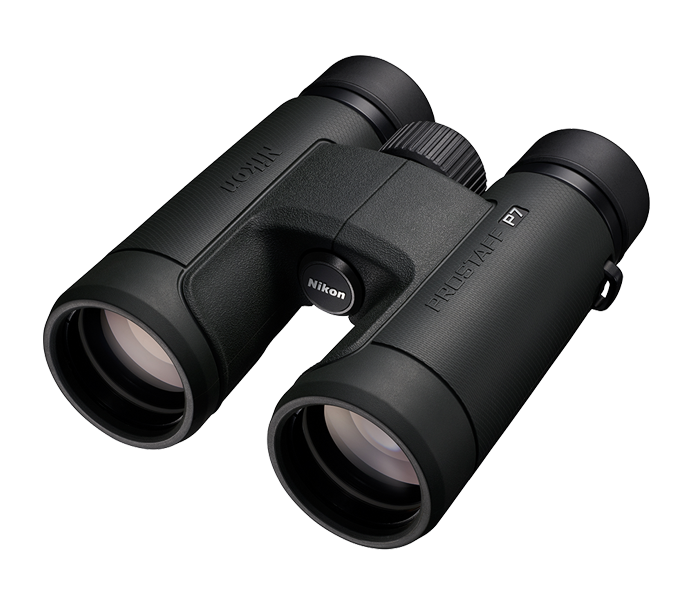
Explore this need in the finder →The PROSTAFF P7 8x42 trades the pocketable proportions of Nikon’s 30 mm models for a 5.3 mm exit pupil, 20.2 mm eye relief and a 377-foot real field. It is the full-size P7 to consider for a broad, steady handheld view when eyeglasses or changing daylight make extra eye-position margin attractive. At 20.8 oz and 6.0 in long, it is plainly heavier and longer than either compact; that extra size is the central decision, not a hidden disadvantage.
The balance of an 8x view and 42 mm objectives
Eight-power magnification is a useful starting point for handheld wildlife, birding and travel viewing: it shows less apparent movement than a comparable 10x binocular, and can make it easier to find a subject before studying it. Nikon publishes a 7.2-degree real field, which is 377 feet at 1,000 yards, and a 53.4-degree apparent field. It is not the widest real field in this P7 group—the compact 8x30 reaches 456 feet—but the larger objectives and 5.3 mm exit pupil are useful reasons to consider the 8x42 instead.
The manufacturer’s relative-brightness index is 28.1, above the 8x30’s 14.4. This should not be read as a measured comparison in real twilight. It is a derived figure tied to exit pupil and does not substitute for an observation under your own light conditions. The larger objective also increases the carrying burden: at 20.8 oz, this is 3.7 oz heavier than the 8x30 and 4.2 oz heavier than the 10x30. The 6.0 in body requires more pack space than the 4.9 in 30 mm versions.
Longer eye relief is a useful starting point, not a fit guarantee
The 20.2 mm eye-relief specification is the longest in this four-size P7 family. Nikon’s instruction manual says glasses wearers should start with the eyecups fully retracted, with two intermediate click stops if needed. That makes the 8x42 the most promising P7 variant for someone who intends to view with glasses, but a specification alone cannot ensure that every frame shape sees the whole field. If fit is the deciding requirement, try the actual binocular while wearing the glasses you use outdoors.
The close-focus figure is approximately 9.8 ft, 1.6 ft farther than for the 30 mm pair. A closer setting can help with nearby insects or detail on a trail-side object, but binoculars are not macro optics and the usable view depends on focus and eye placement. The interpupillary range in the family manual is 56–72 mm; measure your own comfort at the bridge rather than treating that range as a promise of universal fit.
P7 controls and surface treatments
The 8x42 uses a roof-prism design with a center focusing ring and a separate right-eye diopter ring. The diopter ring locks after adjustment, helping protect that setup from incidental movement. Nikon also confirms phase and dielectric prism coatings, and oil- and water-repellent treatments on the eyepiece and objective lenses. The surface treatment can simplify removal of ordinary smudges, but does not mean that a cloth, grit or salt residue can safely be rubbed across a lens without care.
Nikon does not document ED glass for this exact configuration. That is unknown, not a claim that no ED material exists. If ED glass is a hard condition for your purchase, a model with explicit manufacturer confirmation is the sensible shortlist. If you want the P7’s verified locking diopter and coatings, however, those features are established for this model.
Outdoor protection has clear boundaries
The manual’s rating is waterproof to 1 m / 3.3 ft for up to 10 minutes, with nitrogen filling and fog resistance. It explicitly says the binocular is not for underwater use, and cautions against exposure to strong water pressure. This should handle ordinary wet weather when used as directed, but it is not a diving optic. Nikon advises wiping off moisture before moving the focus or eyepiece parts. The package list in the manual names the binocular, eyepiece cap, two objective caps, soft case and neck strap. Nikon’s inspected 30/42 mm documentation does not establish a tripod adapter or tripod-compatible plan, so do not assume those are part of the purchase.
Choose between the P7 8x42 and its alternatives
The P7 8x30 is lighter and wider-scanning, while this 8x42 gives the larger exit pupil and longer eye relief. If you want more magnification and a particularly wide apparent-field figure, the 10x42 moves to 10x and a 62.9-degree apparent field, but has only 15.7 mm eye relief and a 367-foot real field. The P3 8x42 is a close same-power alternative; the P7’s documented locking ring and coating package distinguish it. Use the P7 size comparison to decide whether your outings justify the full-size carry. Choose the 8x42 when long relief and a larger exit pupil lead; choose the compact when weight and fast scanning dominate.
Exact model record: Nikon PROSTAFF P7 8x42 product page. Exact 30/42 mm manual listing: Nikon Download Center.
Key specifications
Key details at a glance
| Magnification | 8× |
|---|---|
| Objective diameter | 42 mm |
| Real field of view | 7.2° |
| Apparent field of view | 53.4° |
| Field width at 1,000 m | 126 m |
| Eye relief | 20.2 mm |
More specifications and setup details
| Exit pupil | 5.3 mm |
|---|---|
| Close focus distance | 9.8 ft |
| Manufacturer-published weight | 20.8 oz |
| Phase coatings confirmed | Yes |
| Locking diopter ring confirmed | Yes |
| Lens and prism coatings | The exact Nikon USA page confirms phase and dielectric prism coatings and describes multilayer-coated optics; Nikon’s P7 line page states that both objective and eyepiece lenses have oil- and water-repellent surfaces. These descriptions do not confirm ED glass for this exact configuration. |
| Water and fog protection | Nikon’s 30/42 mm family manual rates this size waterproof to 1 m / 3.3 ft for up to 10 minutes and fogproof with nitrogen filling. It is not intended for underwater use, and the manual warns against strong water pressure. |
| Tripod use | The inspected exact US page, 30/42 mm instruction manual and P7 family page do not establish tripod compatibility, an adapter model or adapter-in-box status. No tripod operating plan is asserted. |
| Published weight note | Nikon’s exact US page and 2022 family table agree on this model’s published mass; the published figure is not an independent measurement. |
| Package contents | The Nikon English P7 30/42 mm manual lists one binocular, one eyepiece cap, two objective lens caps, one soft case and one neck strap. No adapter is listed. Seller-added US bundle contents are not established by that standard items list. |
| Manufacturer-rated waterproof | Yes |
Use the exact model’s instructions for operating limits, supplied equipment and version differences.
Sources for this review
Sources for this assessment
Choose your optical trade-off first.
Choose viewing purpose first, then magnification, objective size, scene width and any fit, weather or mounting constraint. A direct-Sun requirement is separate: only exact manufacturer-confirmed solar binoculars can pass it.