
On this page
Your needs, this model
Does it fit your priorities?
Does the P3 8x42 have the longest stated eye relief and largest exit pupil in the line?
Yes. Nikon lists 20.2 mm eye relief and a 5.3 mm exit pupil, above the figures for each of the other three P3 models. Neither number guarantees an individual glasses fit or image brightness.
Explore this need in the finder →Is its 8x scene wider in real field than the P3 8x30?
No. The 8x42 lists 377 ft at 1,000 yd; the 8x30 lists 456 ft. The 42 mm model trades some scene width for its larger pupil and longer eye relief.
Explore this need in the finder →Can it meet a weatherproof requirement without an underwater claim?
Yes. Nikon states 1 m / 3.3 ft for up to 10 minutes and fog resistance, while the manual says the binocular is not for underwater use.
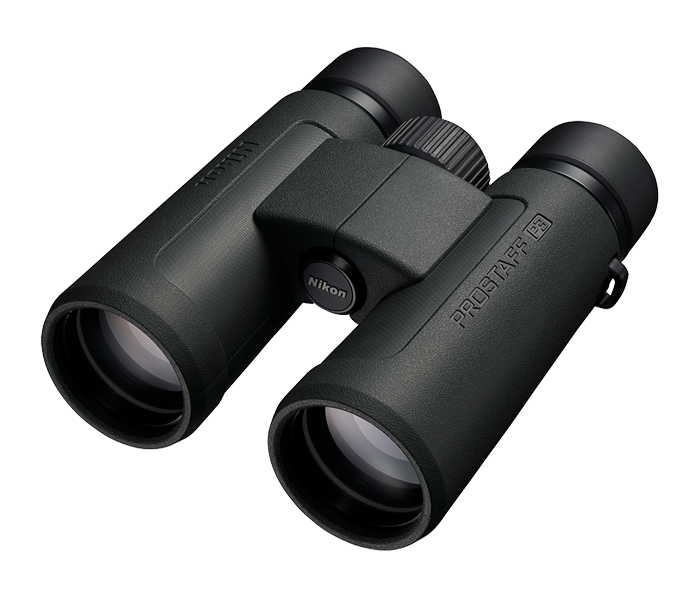
Explore this need in the finder →The PROSTAFF P3 8x42 is the most forgiving pupil-and-eye-relief configuration in Nikon’s four-size P3 lineup: its published 5.3 mm exit pupil and 20.2 mm eye relief are both the line’s largest. It also weighs 20.3 oz on Nikon’s current detail page, notably more than either 30 mm model. Choose it when 8x handling and a larger objective matter more than the compact pair’s lighter carry or the 8x30’s exceptionally broad real field.
It is not the widest real view in this family
The 8x42 has a 7.2° real field and spans 377 feet at 1,000 yards. That is a substantial view, but the P3 8x30 reaches 456 feet and 8.7°. The 8x30’s smaller objective and lower exit pupil go with that wider scan; the two designs solve different priorities. The 8x42’s 53.4° apparent field is also lower than the 8x30’s 62.6°, so it does not provide the broadest apparent view either. What it offers is an 8x image through a full-size 42 mm front objective and a more generous eye position.
Compared with the P3 10x42, the 8x42 keeps the same 42 mm objective but lowers magnification. Nikon lists 377 feet of real field against 367 feet for the 10x42, and 5.3 mm exit pupil against 4.2 mm. An 8x view is generally easier to keep steady by hand and gives more scene width, while the 10x42 brings distant subjects closer and has a 62.9° apparent field. If tracking a moving subject is your everyday task, the 8x42 is the more natural first comparison; if distant fine detail takes priority, test the 10x42 but check how steady you can hold it.
Eye relief and the glasses question
The 20.2 mm stated eye relief is longer than the other P3 models’ 15.4–15.7 mm. That can give glasses wearers a better chance of seeing the whole view without pressing their lenses against the eyecups, but it is not a guarantee. Frames, lens thickness, facial geometry and eyecup position all matter. Nikon’s model manual says to retract the turn-and-slide eyecups for glasses, with the intermediate click stops available for fine tuning. Try the instrument with your own glasses if possible instead of using the number as a comfort score.
The larger objective also gives an exit pupil of 5.3 mm and Nikon’s relative-brightness index of 28.1. The 8x30 produces a 3.8 mm exit pupil and index 14.4. These are geometry-derived figures, not a controlled comparison of transmission, resolution, contrast or twilight performance. They explain why the 8x42 may be more tolerant of eye placement and available ambient light, but they cannot establish that it will look brighter or sharper in every real scene.
Full-size handling, honest weight figures
Nikon’s current 8x42 detail page lists 575 g / 20.3 oz and dimensions of 5.9 × 5.1 in; the manual gives a length of 6.0 inches and a depth of 2.1 inches. Nikon’s 2022 P3 launch table lists 590 g / 20.8 oz, a difference of 15 g. Keep that source discrepancy in mind if a strict carry-weight ceiling matters. The body is larger and roughly four ounces heavier than the current-page 8x30 figure, but it is still lighter than a 50 mm binocular in the P3’s adjacent P7 family. Check actual comfort in the hand before choosing by ounce alone.
Nikon describes multilayer-coated lenses and a reflective silver-alloy coating on the mirror surfaces of the roof prisms. The body is fiberglass-reinforced polycarbonate with rubber armor. The sources reviewed do not confirm ED glass, phase-correction or dielectric prism coatings, a locking diopter, oil/water-repellent lens surfaces, or a tripod adapter/fitting for the exact P3 8x42. Do not let a similar product name transfer these features from the PROSTAFF P7. If one of those capabilities is essential, compare only models whose exact documents establish it.
Weather rating and practical operation
The manual covers all four P3 configurations and rates them waterproof to 1 m / 3.3 ft for up to 10 minutes, fogproof and nitrogen-filled. Nikon explicitly excludes underwater use and warns against strong water pressure. The rating helps for rain and outdoor damp, but this is not diving gear. If it gets wet, wipe off moisture before changing focus or moving the eyecups. Its central focus ring and separate right-eye diopter let you set focus for both eyes; do not expect a locking ring when the sources do not document one. The manual lists binocular, eyepiece cap, two objective caps, soft case and neck strap as supplied; it does not confirm a tripod adapter.
Who the 8x42 fits best
Choose the 8x42 for handheld birding, wildlife and general outdoor observation if you want an 8x view with the P3 family’s longest listed eye relief and largest exit pupil, and you accept the heavier body and narrower real field than the 8x30. A glasses wearer should compare its eyepiece directly with the lighter 8x30. Pick the 10x42 for more reach and a wide apparent field if you can hold 10x steady; move to 8x30 if width and travel weight come first. This product’s particular numbers, including 20.2 mm eye relief and 9.8-foot close focus, should not be substituted for another P3 size. The family guide compares all four at once.
Primary sources: Nikon PROSTAFF P3 8x42 product page, Nikon launch specifications and the model-family manual listing.
Key specifications
Key details at a glance
| Magnification | 8× |
|---|---|
| Objective diameter | 42 mm |
| Real field of view | 7.2° |
| Apparent field of view | 53.4° |
| Field width at 1,000 m | 126 m |
| Eye relief | 20.2 mm |
More specifications and setup details
| Exit pupil | 5.3 mm |
|---|---|
| Close focus distance | 9.8 ft |
| Manufacturer-published weight | 20.3 oz |
| Lens and prism coatings | Nikon describes multilayer-coated lenses and a highly reflective silver-alloy coating on roof-prism mirror surfaces for the P3 line. The exact P3 sources do not document ED glass, phase correction, dielectric coating or oil/water-repellent objective and eyepiece coatings; those details remain unknown. |
| Water and fog protection | The exact P3 manual rates the models waterproof to 1 m / 3.3 ft for up to 10 minutes, fogproof and nitrogen-filled. Nikon says they are not for underwater use and warns against strong water pressure. |
| Published weight note | The current exact US page and manual report 575 g / 20.3 oz, while Nikon’s 2022 launch table reports 590 g / 20.8 oz. Official sources differ by 15 g. The current page gives 5.9 in length while the manual rounds 152 mm to 6.0 in. |
| Manufacturer-rated waterproof | Yes |
Use the exact model’s instructions for operating limits, supplied equipment and version differences.
Sources for this review
Sources for this assessment
Choose your optical trade-off first.
Choose viewing purpose first, then magnification, objective size, scene width and any fit, weather or mounting constraint. A direct-Sun requirement is separate: only exact manufacturer-confirmed solar binoculars can pass it.