
On this page
Your needs, this model
Does it fit your priorities?
Is the P3 10x30 the lighter of the two 10x P3 choices on Nikon’s current pages?
Yes. The current individual pages list 16.4 oz for this 10x30 and 20.6 oz for the 10x42. Nikon’s older announcement also reports a lower weight for 10x30, though at 16.6 oz.
Explore this need in the finder →Does its 10x view come with a narrower real field than the P3 8x30?
Yes. Its published field is 346 ft at 1,000 yd versus 456 ft for 8x30. The higher magnification brings subjects closer but may make fast-moving targets harder to keep in view.
Explore this need in the finder →Can it meet a weatherproof requirement without being rated for underwater use?
Yes. Nikon’s manual rates it to 1 m / 3.3 ft for 10 minutes, but explicitly says the binocular is not intended for underwater use.
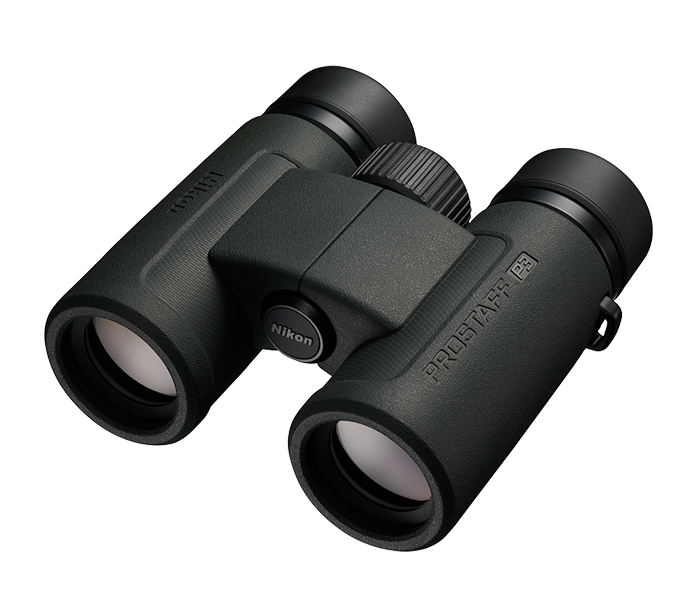
Explore this need in the finder →The Nikon PROSTAFF P3 10x30 is the lightest of the four P3 sizes on the current US product pages, at 16.4 oz, and it gives a compact body a 10x view. Its compromise is a 346-foot real field and a 3.0 mm exit pupil, both smaller than the 8x30’s. It is a plausible daylight travel or event option when carrying less matters and you can keep a narrower, more magnified view steady.
Ten-power reach in the compact pair
Within Nikon’s two 30 mm P3 models, the 10x30 shows a closer view than the 8x30. Nikon lists the same 8.2-foot close-focus distance for both, but the 10x30’s real field narrows to 6.6° and 346 feet at 1,000 yards; the 8x30 covers 8.7° and 456 feet. This makes the 10x30 a more focused way to inspect distant details once you find them, while the 8x30 is easier to sweep across a scene. A narrower field can make a moving subject harder to keep centered, so 10x should be an intentional choice rather than an automatic upgrade.
Compared with the larger P3 10x42, the 10x30 keeps the same 10x power in a smaller body and lists 59.9° apparent field, 346 feet real field and 15.4 mm eye relief. The 10x42 lists 62.9° apparent field, 367 feet, 15.7 mm eye relief and a 4.2 mm exit pupil. If your main concern is the view’s width or lower-light pupil size, the 10x42 is the more suitable direction; if it is carry weight and compact dimensions, this 10x30 has the edge on the current product figures.
How compactness changes the optical fit
The 10x30 exit pupil is 3.0 mm and the relative-brightness index is 9.0. At the same 30 mm objective, the 8x30 gives a 3.8 mm exit pupil and 14.4 index. Both figures are based on the published specifications; they are not independent low-light measurements. For a bright afternoon, that may be a sensible trade to get a more magnified image. At dusk, the 10x30’s smaller exit pupil can be a less forgiving fit for how much light reaches the eye, and hand motion is more apparent at 10x. Consider a 42 mm model if you routinely watch in changing or dimmer conditions.
Eye relief is listed at 15.4 mm. That is the shortest value in this P3 group along with the 8x30, while the 8x42 gives 20.2 mm. If you wear glasses, extend/retract the multi-click eyecups exactly as the manual describes and check that your eye can see the full field. Nikon says the eyecups have four positions including both ends; the fit still depends on your face and frames. A long-specification comparison cannot replace trying the eyepiece with your usual glasses.
Weight figures with an official discrepancy
The current Nikon detail page gives 465 g / 16.4 oz and 125 × 130 × 52 mm; the PROSTAFF P3 collection rounds the figure to 16.4 oz. Nikon’s 2022 launch table instead lists 470 g / 16.6 oz. The difference is only about 5 g, but both numbers are manufacturer-published, so the discrepancy should remain visible. Either one is below the current detail-page weight for the other P3 variants, making this the line’s lightest option on the current individual pages. It remains a full binocular rather than a folding pocket unit.
Nikon describes P3 lenses as multilayer coated and the roof-prism mirror surfaces as silver-alloy coated. Its manual identifies central focusing, a separate diopter adjustment ring, lead/arsenic-free glass and turn-and-slide eyecups. The reviewed P3 documents do not specify ED glass, a locking diopter, phase correction, dielectric prism coating, oil/water-repellent eyepiece surfaces or tripod compatibility. If any of those is a must-have, do not count an unconfirmed feature as present. Consider a P7 if a locking diopter and water-repellent lens treatment are priorities, or compare the separate M5/P7 reviews where ED glass is specifically documented.
Outdoor protection without an underwater claim
Nikon rates this P3 waterproof to 1 m / 3.3 ft for 10 minutes and fogproof with a nitrogen-filled interior. Nikon says not to use it underwater or expose it to strong water pressure. The specification suits ordinary outdoor exposure better than an unsealed dry-weather binocular, but it does not mean the instrument should be submerged in a stream. Wipe moisture before operating the movable focus or eyepiece parts. The manual’s list of standard items is the binocular, one eyepiece cap, two objective caps, soft case and neck strap; it does not list a tripod adapter. Adapter compatibility itself is not established in the sources used here.
Who should buy the 10x30, and who should move on?
Start with this configuration if 10x is a firm preference, you want the smallest P3 body, and most viewing will be in good light from a steady stance. Choose the 8x30 instead if following action or locating birds is more important than magnification; it has a wider real field and larger exit pupil. Choose the 10x42 when you want to stay at 10x but need the larger objective and its wider published field. If 10x feels difficult to hold steady, the more useful change may be dropping to 8x, not buying a different coating. See the four-model P3 comparison for the trade-offs side by side.
Exact-model sources: Nikon PROSTAFF P3 10x30 specifications, the Nikon P3/P7 launch table for the older weight figure, and the P3 manual listing.
Key specifications
Key details at a glance
| Magnification | 10× |
|---|---|
| Objective diameter | 30 mm |
| Real field of view | 6.6° |
| Apparent field of view | 59.9° |
| Field width at 1,000 m | 115 m |
| Eye relief | 15.4 mm |
More specifications and setup details
| Exit pupil | 3 mm |
|---|---|
| Close focus distance | 8.2 ft |
| Manufacturer-published weight | 16.4 oz |
| Lens and prism coatings | Nikon describes multilayer-coated lenses and a highly reflective silver-alloy coating on roof-prism mirror surfaces for the P3 line. The exact P3 sources do not document ED glass, phase correction, dielectric coating or oil/water-repellent objective and eyepiece coatings; those details remain unknown. |
| Water and fog protection | The exact P3 manual rates the models waterproof to 1 m / 3.3 ft for up to 10 minutes, fogproof and nitrogen-filled. Nikon says they are not for underwater use and warns against strong water pressure. |
| Published weight note | The current exact US page and model manual report 465 g / 16.4 oz; Nikon’s 2022 launch table reports 470 g / 16.6 oz. Preserve this official-source discrepancy. |
| Manufacturer-rated waterproof | Yes |
Use the exact model’s instructions for operating limits, supplied equipment and version differences.
Sources for this review
Sources for this assessment
Choose your optical trade-off first.
Choose viewing purpose first, then magnification, objective size, scene width and any fit, weather or mounting constraint. A direct-Sun requirement is separate: only exact manufacturer-confirmed solar binoculars can pass it.