
On this page
Your needs, this model
Does it fit your priorities?
When scanning moving wildlife, does the 8x25 give a broader published real field than its B.7 sibling?
Yes. Maven lists 6.8° and 356 ft at 1,000 yd for the 8x25; the other B.7 power is narrower. This is a published specification, not a tracking test.
Explore this need in the finder →Does the 8x25 meet a 13 oz carry cap and a 15 mm stated eye-relief floor?
Maven lists 12.4 oz and 15 mm eye relief. That meets those numeric screens but does not prove a particular glasses fit.
Explore this need in the finder →Can the 8x25 be used where waterproofing is essential, and does it offer tripod support?
Maven lists waterproof/fogproof construction and an IPX7 test at 1 m for 30 minutes, but marks this B.7 not tripod adaptable. It suits a hand-held wet-weather requirement, not an essential tripod-support requirement.
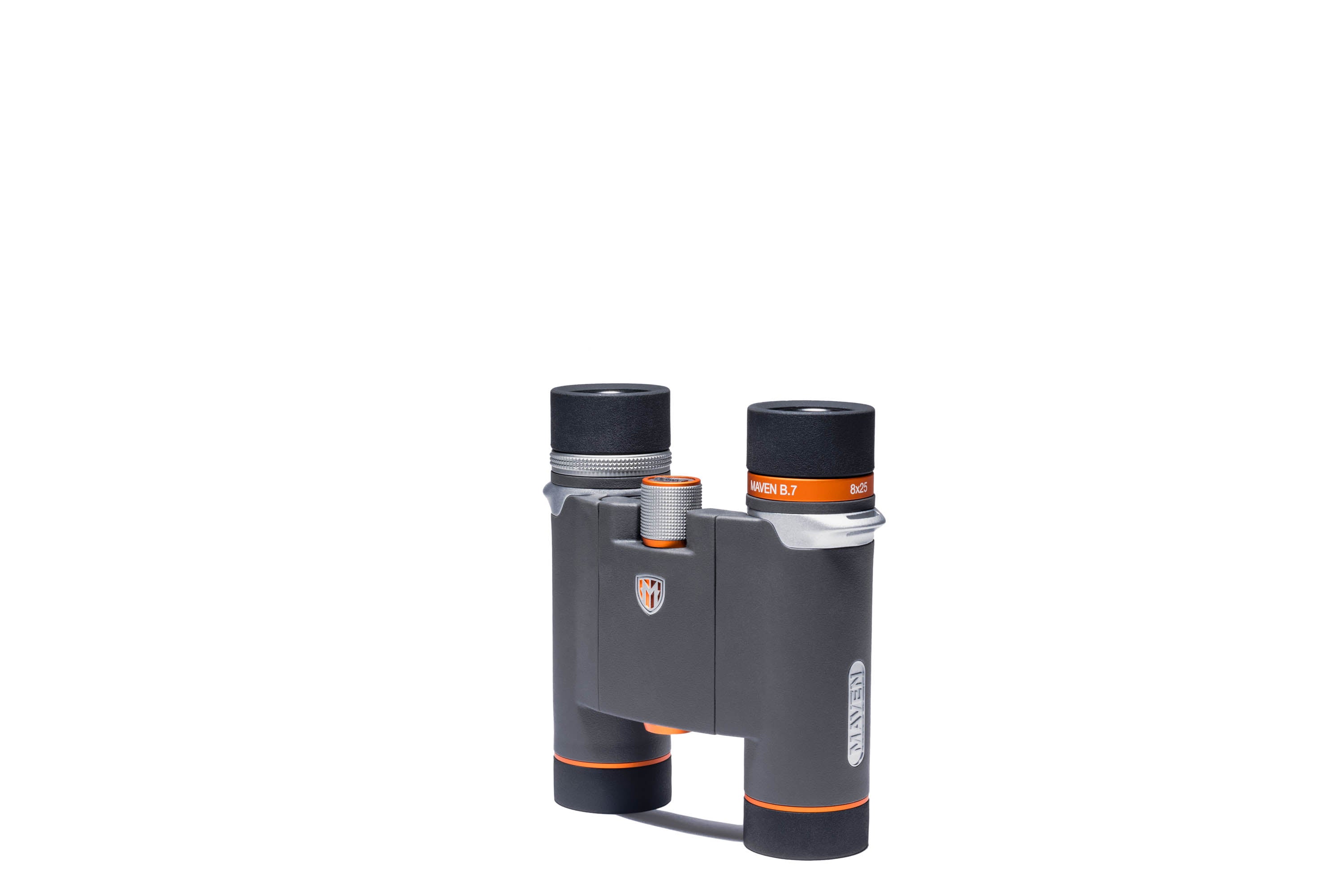
Explore this need in the finder →The Maven B.7 8x25 is a fixed-power compact for a viewer who wants a broad scene in a light, weather-rated package. Maven lists a 6.8° real field, 356 feet at 1,000 yards, 15 mm eye relief and a 12.4-ounce bare-instrument weight. Its small objectives and lack of tripod adaptation matter just as much as its premium glass: this is a carry-first handheld binocular, not a small replacement for a larger dawn-and-dusk optic.
The 8x choice is about finding and following a subject
At eight power, the B.7 shows a wider real scene than its 10x25 sibling. Maven’s table gives the 8x model 6.8° and 356 feet at 1,000 yards; the 10x is listed at 6.0° and 314 feet. That extra scene width is useful when scanning a trail edge, picking a bird out of brush, or trying to keep a moving subject in view. The lower magnification also tends to be less demanding to hold steady. These are consequences of the published configuration, not claims from a field trial.
Both versions use 25 mm objectives, but their exit pupils differ: 3.1 mm for the 8x and 2.5 mm for the 10x. The 8x’s larger exit pupil is a useful geometric advantage in dimmer daylight, yet it does not make a 25 mm compact equivalent to a 42 or 50 mm pair. If viewing in the last light, under heavy tree cover, or on a stationary night sky is the priority, compare a larger objective model and accept the added bulk.
Compact carrying weight with uncommon optical details
Maven lists the B.7 at 12.4 ounces, with a 25 mm objective, ED glass, fully multi-coated lenses, phase correction and a dielectric prism reflective coating. Those are specifications, not independent proof of sharpness or color performance. The manufacturer describes the model as waterproof and fogproof, pressure tested to IPX7 at one meter for 30 minutes, and nitrogen filled. That is a more specific published sealing statement than a generic “waterproof” label, but it is not permission to use the binocular underwater.
The stated eye relief is 15 mm, and the product page lists a 38–73 mm interpupillary adjustment range. The manual explains that the barrels should be moved until the two circles merge into one comfortable field, and that the twist-up eyecups have multiple positions. Glasses wearers should still test the exact pair: a published relief number cannot guarantee that every frame and face will show the full field. Close focus is listed at 9.8 feet, so it is suitable for ordinary nearby wildlife or exhibits at a distance, not very close tabletop subjects.
One fit detail deserves caution. Maven’s highlights give a folded size of 2.94 by 4.76 by 1.99 inches, while its specifications table lists 4.58 by 4.76 by 1.6 inches. The page also calls the body 4.8 inches. The axes and mismatch are not reconciled, so use the 12.4-ounce published mass and the compact design description—not a precise dimensional threshold—when judging a pocket, harness, or case.
Setup and care are straightforward, but mounting is not
The exact product listing includes a neoprene neck strap, lens caps and carry case. The 12-page B.7 manual shows the strap’s quick-connect fitting and explains how the caps attach without getting in the way. It also provides a practical first setup: adjust interpupillary distance; set the center focus on a distant target; cover the left objective and tune the right-eye diopter; then return to both barrels. The manual warns not to look at the Sun or another bright light. Twist eyecups down when glasses require it, and keep lenses free of grit before cleaning; Maven’s care instructions caution against wiping optics with clothing or tissue.
The product table says “Tripod Adaptable: No.” Do not select the B.7 if tripod support is essential, even though the 10x view may tempt a viewer to seek support. It is designed for handheld compact use, with no manufacturer-confirmed adapter in the package.
When it fits—and when another compact makes more sense
Choose the 8x25 B.7 if a wide real field, the lower of the two fixed powers, stated 15 mm relief, ED/phase-corrected roof optics and a specific IPX7 test are worth a 12.4-ounce carry. The Celestron Outland X 8x25 is a useful contrast: its page lists a still wider 8.2° field and lighter 11.5-ounce mass, but only 9.3 mm eye relief and no numeric immersion rating. Nikon’s TRAVELITE 8x25 is lighter at 9.3 ounces and lists a 5.6° field, but its cited pages do not establish waterproofing. These exact maker figures make the choice concrete without turning either comparison into a lab ranking.
Consider the B.7 10x25 if the extra magnification matters more than the 8x sibling’s wider view. Step up to a 32 or 42 mm model if dim-light use, a tripod, or a larger eye box is more important than compact carry. Maven’s exact product page and B.7 manual support the specifications and instructions discussed here; no personal ownership, independent optical measurement, or image-production method is claimed.
Maven B.7 product page · Maven manuals index. Exact-model product information and instructions are manufacturer-published.
Key specifications
Key details at a glance
| Magnification | 8× |
|---|---|
| Objective diameter | 25 mm |
| Real field of view | 6.8° |
| Apparent field of view | 54.4° |
| Eye relief | 15 mm |
| Exit pupil | 3.1 mm |
More specifications and setup details
| Close focus distance | 9.8 ft |
|---|---|
| Manufacturer-published weight | 12.4 oz |
| ED glass confirmed for this exact model | Yes |
| Phase coatings confirmed | Yes |
| Lens and prism coatings | Maven lists fully multi-coated lenses, scratch/oil-resistant lens coatings, phase correction and a dielectric prism reflective coating. No independent optical test is claimed. |
| Water and fog protection | Maven lists waterproof/fogproof and an IPX7 pressure test of 1 m for 30 minutes; this is not an underwater-viewing claim. |
| Tripod use | Maven lists Tripod Adaptable: No; this is a handheld configuration and should not pass an essential tripod-support need. |
| Published weight note | Maven lists 12.4 oz for the binocular. This is a manufacturer specification, not an independent weighing or packed-system mass. |
| Manufacturer-rated waterproof | Yes |
Use the exact model’s instructions for operating limits, supplied equipment and version differences.
Sources for this review
Sources for this assessment
Choose your optical trade-off first.
Choose viewing purpose first, then magnification, objective size, scene width and any fit, weather or mounting constraint. A direct-Sun requirement is separate: only exact manufacturer-confirmed solar binoculars can pass it.