
On this page
Your needs, this model
Does it fit your priorities?
When scanning moving wildlife, does the 10x25 give a broader published real field than its B.7 sibling?
Yes. Maven lists 6.0° and 314 ft at 1,000 yd for the 10x25; the other B.7 power is narrower. This is a published specification, not a tracking test.
Explore this need in the finder →Does the 10x25 meet a 13 oz carry cap and a 15 mm stated eye-relief floor?
Maven lists 12.4 oz and 15 mm eye relief. That meets those numeric screens but does not prove a particular glasses fit.
Explore this need in the finder →Can the 10x25 be used where waterproofing is essential, and does it offer tripod support?
Maven lists waterproof/fogproof construction and an IPX7 test at 1 m for 30 minutes, but marks this B.7 not tripod adaptable. It suits a hand-held wet-weather requirement, not an essential tripod-support requirement.
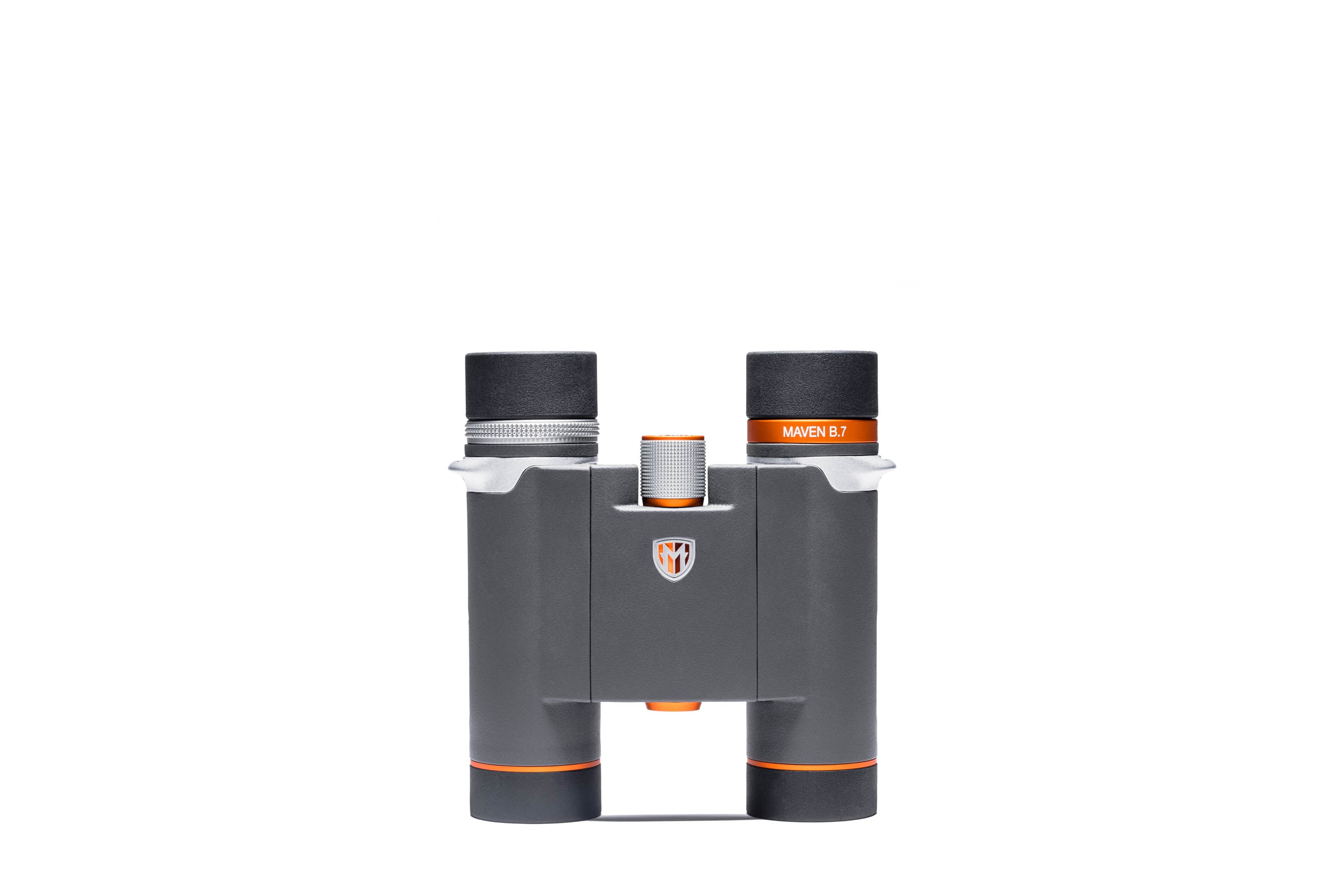
Explore this need in the finder →The Maven B.7 10x25 is a compact fixed-power option for a traveler, birder or wildlife observer who values more subject enlargement than a typical 8x compact can provide. Maven lists the same 12.4-ounce weight and 15 mm eye relief as the 8x version, but the 10x has a narrower 6.0° field, a 2.5 mm exit pupil and no tripod adaptation. Its case, strap and lens caps are included; the trade is a small objective and a view that asks for a steadier hold.
More reach, less scene width
The 10x setting enlarges a distant subject more than the 8x25, which can help separate detail at a comfortable viewing distance. But magnification is not a free upgrade. Maven lists a 6.0° real field and 314 feet at 1,000 yards for the 10x; its 8x sibling is 6.8° and 356 feet. The wider 8x view gives more context while searching or tracking. Ten power can also make hand movement more apparent, so the B.7 10x is best for a viewer who can brace their elbows or pause rather than sweep rapidly.
The 25 mm objectives are shared, but the exit pupil changes from 3.1 mm in the 8x to 2.5 mm in the 10x. That is a simple geometric comparison, not a measured brightness verdict. A 25 mm compact can be a sound daylight carry, but it is not the obvious choice for dim woods, long dusk sessions or someone seeking a wider light bundle. For those outings, a 42 mm or larger configuration is worth considering even if it takes more room and weight.
Published fit, protection and package details
Maven specifies 15 mm eye relief, 38–73 mm interpupillary adjustment, 9.8-foot close focus and a 12.4-ounce weight for both powers. Those common values make the 10x unusual among some similarly sized options: the exact B.7 page lists 15 mm relief, compared with 9.1 mm for Celestron’s Outland X 10x25 and 11.1 mm for Nikon’s TRAVELITE 10x25. Longer stated relief may be a better starting point for glasses, but it is not a promise of full-field comfort. Eyecup position and frame shape still decide whether the eye reaches the intended position.
The manufacturer lists ED glass, fully multi-coated lenses, phase correction, dielectric prism coating, magnesium body, nitrogen filling and an IPX7 pressure test at one meter for 30 minutes. It also calls the instrument waterproof and fogproof. These are maker-published features, not independent durability or resolution tests. The model is not a submersible viewing instrument. Its included kit is a neoprene strap, lens caps and a carry case; the product table explicitly says it is not tripod adaptable.
As with the 8x version, Maven’s dimensions are inconsistent across its own page. A highlight lists a folded width/height/depth set while the specification table prints a different ordered tuple. Because the axes and discrepancy are not explained, do not use those numbers to decide whether the binocular fits a tightly measured pouch. Its 12.4-ounce instrument weight and the manufacturer’s compact description are better-supported planning points.
Setup can improve comfort; it cannot fix every hand shake
The B.7 manual walks through setting the barrels for one circular view, turning the eyecups through their positions, and adjusting the right-eye diopter after focusing the center wheel on a distant object. It gives the same method for either magnification; the product-specific numbers come from Maven’s page. The manual identifies a quick-connect neck strap, attached lens caps and removable eyecups for rinsing with clean water. For the optics, remove loose dirt first and use a clean lens cloth and appropriate lens fluid rather than a shirt or tissue. Its warning is direct: never look at the Sun or another bright light through the binocular.
If a steady view is non-negotiable, a mountable model is a better match. Maven lists tripod adaptability as “No,” so do not treat the included case or strap as substitute stabilization. The B.7 10x is a handheld compact, not a miniature tripod instrument.
Choose the 10x only when the extra power earns its cost in view
Pick this configuration when 10x25 is a real preference and 15 mm published relief, ED glass, roof-prism phase correction, weather sealing and a 12.4-ounce body are attractive together. Celestron’s Outland X 10x25 is lighter at 11.3 ounces and lists a slightly wider 6.2° field, but its page gives 9.1 mm relief and no immersion depth. Nikon’s TRAVELITE 10x25 weighs 9.5 ounces and lists a 5.0° field; its cited pages do not publish a waterproof rating. B.7 therefore offers a different specification balance, not a blanket claim of superiority.
If the main task is finding a moving subject, compare the B.7 8x25 first: it shares the body weight and stated relief, while giving a wider field and larger exit pupil. If a lower mass is the priority, a less feature-rich compact may be more convenient. If eye comfort, twilight use or a tripod matters, try a larger format rather than choosing by magnification alone. This assessment uses Maven’s exact product listing and B.7 manual; it does not claim personal field use, lab data, a retailer stock guarantee or an unverified photo/render method.
Maven B.7 product page · Maven manuals index. Specifications and instructions are manufacturer-published.
Key specifications
Key details at a glance
| Magnification | 10× |
|---|---|
| Objective diameter | 25 mm |
| Real field of view | 6° |
| Apparent field of view | 60° |
| Eye relief | 15 mm |
| Exit pupil | 2.5 mm |
More specifications and setup details
| Close focus distance | 9.8 ft |
|---|---|
| Manufacturer-published weight | 12.4 oz |
| ED glass confirmed for this exact model | Yes |
| Phase coatings confirmed | Yes |
| Lens and prism coatings | Maven lists fully multi-coated lenses, scratch/oil-resistant lens coatings, phase correction and a dielectric prism reflective coating. No independent optical test is claimed. |
| Water and fog protection | Maven lists waterproof/fogproof and an IPX7 pressure test of 1 m for 30 minutes; this is not an underwater-viewing claim. |
| Tripod use | Maven lists Tripod Adaptable: No; this is a handheld configuration and should not pass an essential tripod-support need. |
| Published weight note | Maven lists 12.4 oz for the binocular. This is a manufacturer specification, not an independent weighing or packed-system mass. |
| Manufacturer-rated waterproof | Yes |
Use the exact model’s instructions for operating limits, supplied equipment and version differences.
Sources for this review
Sources for this assessment
Choose your optical trade-off first.
Choose viewing purpose first, then magnification, objective size, scene width and any fit, weather or mounting constraint. A direct-Sun requirement is separate: only exact manufacturer-confirmed solar binoculars can pass it.