
On this page
Compact 8x25 carry example with a longer close-focus distance
The Outland X 8x25 weighs 11.5 oz and publishes an 8.2° field, but its 16.4 ft close-focus figure is farther than the 8.2 ft figures on the featured P7 8x30 and TrailSeeker ED 10x32. Celestron lists it as waterproof without a numeric depth or duration.
Your needs, this model
Does it fit your priorities?
Does item 71340 combine fixed 8x power, a 25 mm objective and a broad 8.2° real field?
Yes. Celestron lists 8x25, an 8.2° angular field and a 432.3 ft field at 1,000 yards.
Explore this need in the finder →Is the 8x25 a waterproof, nitrogen-filled model under a 12-ounce carry ceiling?
The exact page lists waterproof construction, nitrogen filling and 11.5 oz weight; no immersion depth or duration is stated.
Explore this need in the finder →Does the published 8x25 close-focus distance fit a 17-foot maximum?
Yes. Celestron lists 16.4 ft (5 m) close focus; that is a specification, not a close-focus field test.
Explore this need in the finder →The Celestron Outland X 8x25 (item 71340) is a compact, fixed-power binocular for someone who wants a wide view without carrying a full-size 42 mm instrument. Its manufacturer-listed 8.2° field, 326 g weight, waterproof construction and nitrogen fill make it a plausible travel or daytime walking companion. The important compromise is not hidden in its name: the small 25 mm objectives and 9.3 mm eye relief ask more of the viewer than a larger, longer-relief model does.
A wide scene in a genuinely lighter package
Eight-power magnification is a useful choice when the subject is moving, the viewing window is broad, or the binocular will be held at arm’s length rather than mounted. Celestron lists an 8.2° angular field and 432.3 ft at 1,000 yards (144.1 m at 1,000 m). That is the broadest stated real field among the five black Outland X configurations covered here. It gives a walker more landscape in the eyepieces than the 10x25, 10x42 or 10x50 versions, all of which are listed at 5.5–6.2°.
At 11.5 oz (326 g) and roughly 4.6 × 4.3 × 1.7 inches, it is substantially lighter than the 23.6 oz 42 mm models and the 27 oz 10x50. That is useful if the binocular is carried all day, kept in a travel bag, or handed to another person. The listing calls it waterproof and the series manual describes dry-nitrogen filling; neither statement supplies an immersion depth or duration, so do not treat it as an underwater optic.
Where the small objectives and short eye relief matter
The exit pupil is 3.1 mm. This is the result of the published 8x power and 25 mm objective, not a measurement of transmission or low-light performance. In plain terms, this compact configuration does not provide the same geometric light bundle as the 5.2 mm exit pupil of the Outland X 8x42. The 8x25 makes more sense for daylight carry than for someone choosing specifically for dawn, dusk, or a stationary sky session. Its stated eye relief is 9.3 mm. That is a meaningful caution for glasses wearers: twist-up eyecups can be folded down, but the number alone does not guarantee that your glasses will let you see the entire field comfortably. Try the exact model if eye placement is a must-have.
Close focus is listed at 16.4 ft (5 m), so it is not the Outland X choice for examining very nearby insects or objects. The 10x25 is even farther away at 19.7 ft; the larger 10x50 is listed at 8.2 ft. Item 71340 is also explicitly not tripod adaptable. A used-listing page observed during research incorrectly displays a tripod-adaptable “Yes” for the same optical configuration; the current exact 71340 product page says “No,” and the series manual describes threads only for 42 and 50 mm versions. Treat support as unconfirmed for this 25 mm model and do not choose it for an essential tripod requirement.
Setup, package and practical care
The current Celestron item page lists a neck strap, cloth carrying case, lens cloth and instruction manual. It does not list the objective caps or rainguard shown with larger Outland X sizes. Multi-coated optics, BaK-4 prisms, rubber covering, twist-up eyecups, center focus and a ±3 diopter range are manufacturer specifications; they are not independent sharpness, durability or waterproof tests.
Start by adjusting the barrels until you see one circular image. Then cover one objective, focus the left eye with the center wheel, cover the other objective and set the right-eye diopter on the same distant target. The manual recommends lowering the eyecups for eyeglasses and raising them when not wearing glasses; intermediate positions may suit some faces. Keep the binocular capped and dry after an outing, remove loose grit before wiping glass, and never use it to look at or project the Sun.
Who should choose it—and who should step up
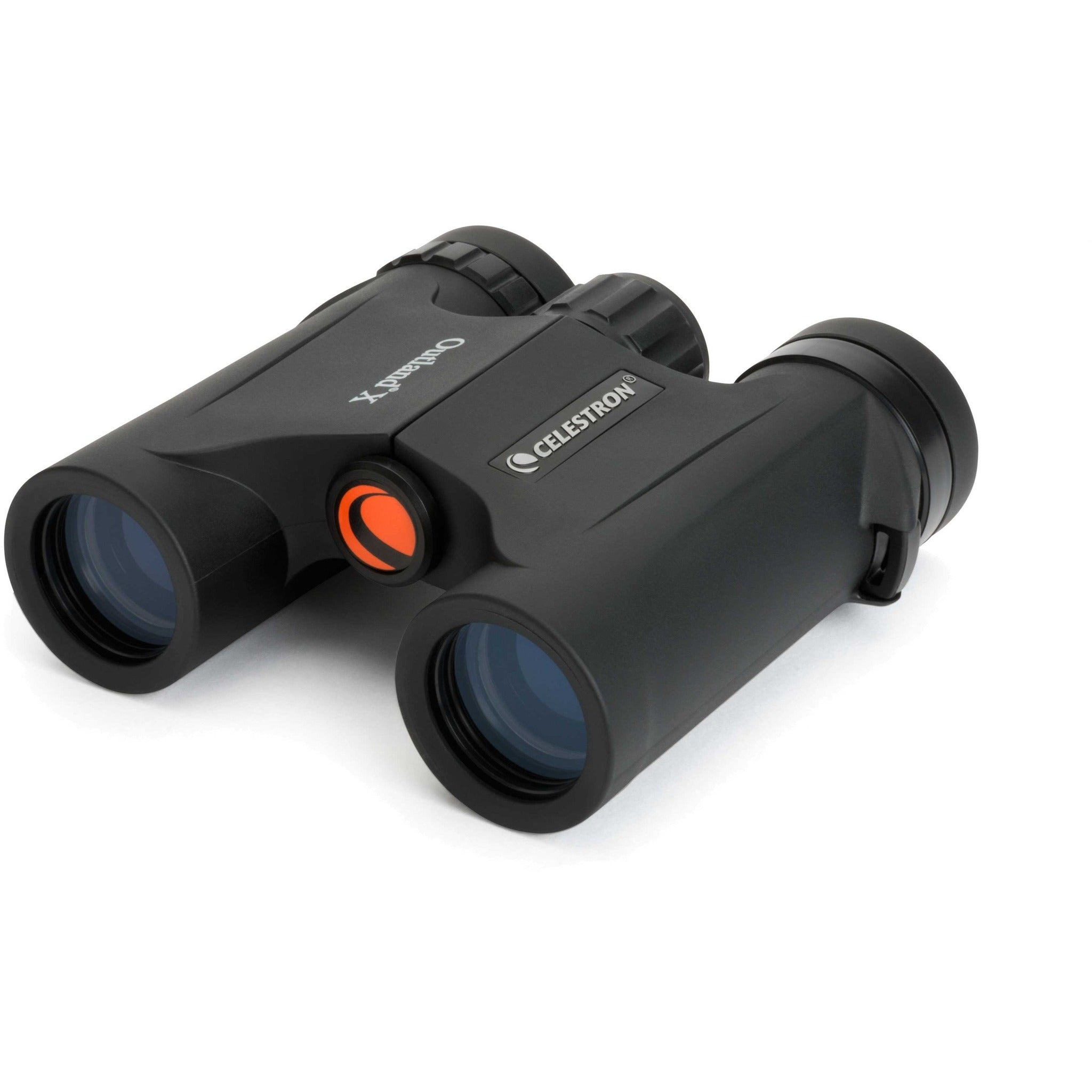
Choose the 71340 when light carry and a generous real field are more important than a large exit pupil, glasses-friendly eye relief, close focus or tripod support. If you want the same small format with higher nominal reach, the 10x25 (71341) changes the view to 6.2° and 2.5 mm exit pupil, while remaining about the same weight; its extra magnification is not automatically easier to hold steady. If you want a more generous eye position and larger objective, compare the 8x42 (71346), accepting its 23.6 oz mass and the need to buy a separate tripod adapter if mounting matters. The exact-page-linked Celestron product image is shown for identification; the manufacturer does not state whether it is a photograph or a rendering. No lab score or personal field trial is claimed here.
Key specifications
Key details at a glance
| Magnification | 8× |
|---|---|
| Objective diameter | 25 mm |
| Real field of view | 8.2° |
| Field width at 1,000 m | 144.1 m |
| Eye relief | 9.3 mm |
| Exit pupil | 3.1 mm |
More specifications and setup details
| Close focus distance | 16.4 ft |
|---|---|
| Manufacturer-published weight | 11.5 oz |
| ED glass confirmed for this exact model | No |
| Lens and prism coatings | Celestron describes multi-coated optics and BaK-4 prisms. Prism coatings are listed as N/A; fully multi-coated or phase-coated performance is not asserted. |
| Water and fog protection | Celestron lists waterproof construction and nitrogen filling and describes the series as fogproof; no exact depth or duration limit is published. Do not infer underwater use. |
| Tripod use | Celestron lists this 25 mm model as not tripod adaptable. The series manual identifies tripod threads only on 42 and 50 mm versions. |
| Published weight note | Celestron lists 11.5 oz (326 g) for the exact item. No independent scale measurement is claimed. |
| Manufacturer-rated waterproof | Yes |
| Tripod adapter in package | No |
Use the exact model’s instructions for operating limits, supplied equipment and version differences.
Sources for this review
Sources for this assessment
- Official Celestron US Outland X collection and product enumeration
- Official collection products JSON, archived catalogue enumeration
- Celestron exact US product page, item 71340
- Celestron Outland X series manual; English setup, eyecups, support, safety and care inspected
- CPSC exact item-number ProductName recall query for 71340; empty array on 2026-10-23
Choose your optical trade-off first.
Choose viewing purpose first, then magnification, objective size, scene width and any fit, weather or mounting constraint. A direct-Sun requirement is separate: only exact manufacturer-confirmed solar binoculars can pass it.
Your needs, this model
Waterproof binoculars under 20 ounces: compare carry and focus tradeoffs
Choose it when: This model illustrates a lower-mass compact 8x choice within the 20 oz ceiling; its 11.5 oz listed instrument mass leaves 8.5 oz below that cutoff. The published 8.2° field is also wider than the 10x32 example shown here.
Waterproof binoculars under 20 ounces: compare carry and focus tradeoffs →