
On this page
Your needs, this model
Does it fit your priorities?
Does the compact Outland X 71341 provide fixed 10x power with a 25 mm objective and at least a 6° real field?
Yes. The page lists 10x25 and a 6.2° angular field.
Explore this need in the finder →Is it listed as waterproof and under 12 ounces despite the current out-of-stock notice?
Yes. The model page lists waterproof construction, nitrogen filling and 11.3 oz; its captured availability status was out of stock.
Explore this need in the finder →Does its published close-focus distance fit a 20-foot limit?
Yes. Celestron lists 19.7 ft (6 m), although the 25 mm model is not a close-focus specialist.
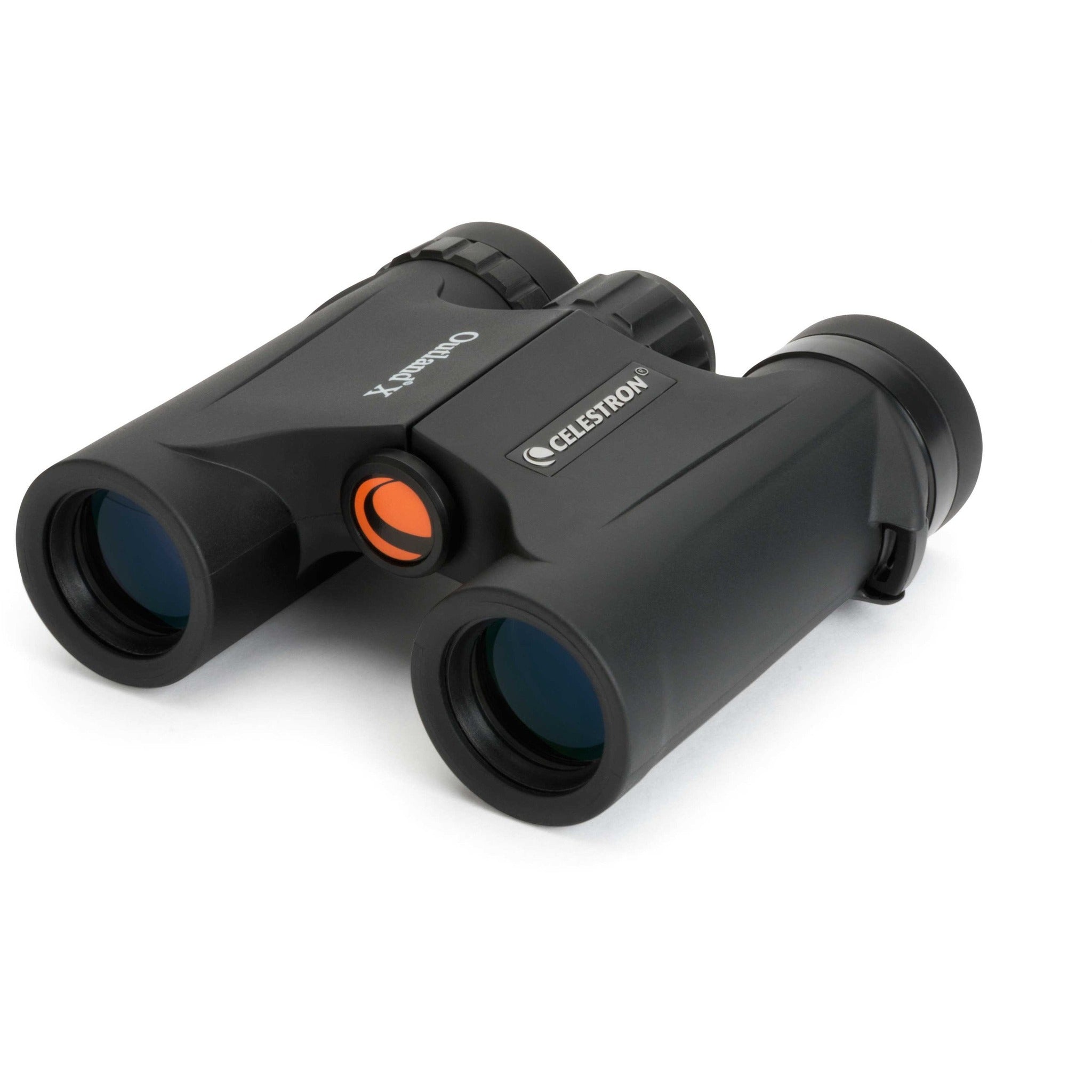
Explore this need in the finder →The Celestron Outland X 10x25 (item 71341) is the reach-first compact in this five-model black Outland X group. It weighs 11.3 oz (319 g), but Celestron lists a narrower 6.2° field, a 2.5 mm exit pupil, 9.1 mm eye relief and 19.7 ft close focus. It suits a daylight observer who prioritizes compact 10x viewing and accepts the tighter view and more exacting eye position. At the time the manufacturer page was inspected, Celestron marked this exact model out of stock; it remains a current product-page identity, not a discontinued reference model.
Small to carry, but still ten power
Ten-power makes a distant object appear larger than in the 8x25, and the 71341 shares that model’s listed 25 mm objectives and essentially the same dimensions. The cost of that step is visible in the published view: 6.2° and 325.9 ft at 1,000 yards (108.6 m at 1,000 m), compared with 8.2° and 432.3 ft for the 8x25. That difference affects the amount of scene you can scan at once, not merely a spec sheet. An observer following a bird through branches or panning across an event may prefer the broader 8x25 field; a viewer who values higher fixed magnification and expects mostly static, distant subjects may prefer the 10x25.
The unit is listed at 319 g (11.3 oz), slightly lighter than the 8x25’s 326 g. That small difference should not by itself decide a purchase. More important is the 2.5 mm exit pupil versus the 8x25’s 3.1 mm. This is a geometric consequence of the listed power and aperture, not a measured brightness score. The 25 mm objective and 10x magnification make this a compact daylight option rather than a stand-in for a larger 42 or 50 mm binocular if a larger exit pupil is a core requirement.
Check eye placement before relying on it with glasses
Published eye relief is 9.1 mm, shorter than the 9.3 mm on the 8x25 and much shorter than the 17.8–18.2 mm figures on the black 42 mm options. Folding the twist-up eyecups down is the manufacturer’s intended starting point for eyeglasses, but it cannot extend the binocular’s eye relief. If seeing the complete field while wearing your own glasses is essential, test the exact instrument rather than relying on “eyeglass friendly” as a universal fit promise.
Close focus is 19.7 ft (6 m), farther than the listed 16.4 ft on the 8x25, 13.1 ft on both 42 mm models and 8.2 ft on the 10x50. It is consequently a poor fit for close garden subjects. The exact product page also says the 25 mm binocular is not tripod adaptable. Although an archived used-outlet page for an Outland X 10x25 repeats the 10x25 specifications, it shows “Tripod Adaptable: Yes”; that conflicts with the exact new 71341 page and the series manual, which limits the threaded support feature to 42 and 50 mm sizes. Do not treat an essential tripod need as met by item 71341.
Weather claims, package and availability
Celestron identifies the 71341 as waterproof and nitrogen filled, and describes Outland X optics as multi-coated with BaK-4 prisms. The product page gives no immersion rating, so waterproof does not mean rated for submersion. The listed package contains a neck strap, cloth carrying case, lens cloth and instruction manual. It does not list the objective caps or rainguard supplied with the 42 and 50 mm models. The Celestron page showed the item out of stock during this research capture. That status can change, but a current page and valid product identity do not guarantee a purchase can be made now.
For setup, first adjust interpupillary distance until the two views merge, then focus the left side with the central wheel and correct the right eye with the diopter ring. The manufacturer’s manual says glasses worn for nearsightedness may be necessary to reach focus at infinity; use the eye correction that works for you. Store the binocular capped and dry, brush away grit before cleaning, and never point it at the Sun.
Alternatives depend on which compromise bothers you
If the restrictive view matters most, the 8x25 gives more scene and a slightly larger exit pupil at nearly the same carried weight. If low eye relief or a small objective is the problem, compare the 10x42 (71347): it is substantially heavier at 23.6 oz, but lists 18.2 mm eye relief and a 4.2 mm exit pupil. The 8x42 (71346) is the wider-field full-size alternative at 7°. The 10x50 (71348) retains 10x while increasing the objective and exit pupil, but rises to 27 oz. These published numbers describe design choices, not independent performance tests; Celestron does not publish a field trial or image-transmission measurement here.
Key specifications
Key details at a glance
| Magnification | 10× |
|---|---|
| Objective diameter | 25 mm |
| Real field of view | 6.2° |
| Field width at 1,000 m | 108.6 m |
| Eye relief | 9.1 mm |
| Exit pupil | 2.5 mm |
More specifications and setup details
| Close focus distance | 19.7 ft |
|---|---|
| Manufacturer-published weight | 11.3 oz |
| ED glass confirmed for this exact model | No |
| Lens and prism coatings | Celestron describes multi-coated optics and BaK-4 prisms. Prism coatings are listed as N/A; fully multi-coated or phase-coated performance is not asserted. |
| Water and fog protection | Celestron lists waterproof construction and nitrogen filling and describes the series as fogproof; no exact depth or duration limit is published. Do not infer underwater use. |
| Tripod use | Celestron lists this 25 mm model as not tripod adaptable. The series manual identifies tripod threads only on 42 and 50 mm versions. |
| Published weight note | Celestron lists 11.3 oz (319 g) for the exact item. No independent scale measurement is claimed. |
| Manufacturer-rated waterproof | Yes |
| Tripod adapter in package | No |
Use the exact model’s instructions for operating limits, supplied equipment and version differences.
Sources for this review
Sources for this assessment
- Official Celestron US Outland X collection and product enumeration
- Official collection products JSON, archived catalogue enumeration
- Celestron exact US product page, item 71341
- Celestron Outland X series manual; English setup, eyecups, support, safety and care inspected
- CPSC exact item-number ProductName recall query for 71341; empty array on 2026-10-23
Choose your optical trade-off first.
Choose viewing purpose first, then magnification, objective size, scene width and any fit, weather or mounting constraint. A direct-Sun requirement is separate: only exact manufacturer-confirmed solar binoculars can pass it.