
On this page
Your needs, this model
Does it fit your priorities?
Do you specifically want the V202 10x50 format?
V202 is fixed at 10x with a 50 mm objective. If 10x is right but a smaller 42 mm body matters more, compare the V201 instead.
Explore this need in the finder →Does at least a six-degree real field matter for your 10x50?
Yes: the exact page lists a 6.6-degree angular field and 346 feet at 1,000 yards. Apparent field is not separately stated.
Explore this need in the finder →Do you need at least 16 mm of stated eye relief?
The V202 page states 16.0 mm. It meets that numeric screen but fails 16.5 mm; actual glasses comfort remains personal.
Explore this need in the finder →Can your carry limit accommodate the V202’s 28.4-ounce listed weight?
A 29-ounce maximum admits the exact published figure. A strict 28-ounce maximum does not. The figure is a specification, not a weighed sample.
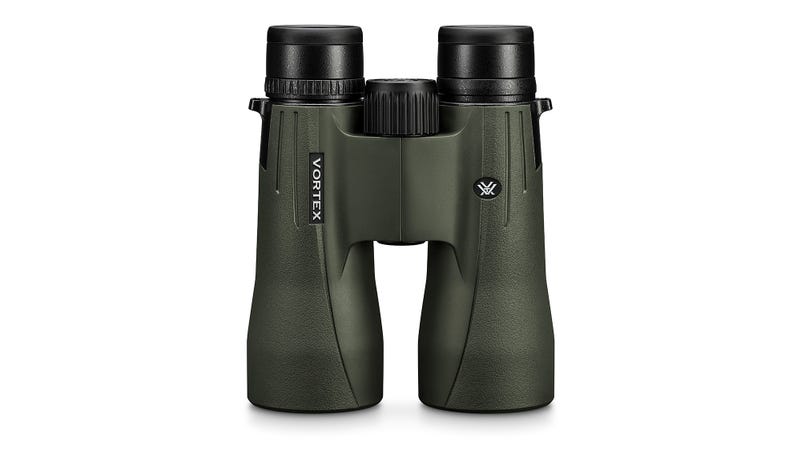
Explore this need in the finder →The Vortex Viper HD 10x50, U.S. SKU V202, adds a 50 mm objective to the family’s 10x configuration. Vortex lists a 6.6-degree real field (346 feet at 1,000 yards), 16 mm of eye relief, 28.4 ounces and an 8-foot close focus. It is best considered when you specifically want a 10x50 format and can accept its larger, heavier body—not simply as a universally better 10x42.
The larger objective changes the carry equation
Compared with the V201 10x42, V202 keeps the same magnification while moving from a 42 mm to 50 mm objective. Vortex's listed field is 346 feet at 1,000 yards rather than 341 feet, a small difference in the published number. V202 is 3.5 ounces heavier (28.4 versus 24.9 ounces), 0.9 inch taller (6.5 versus 5.6 inches) and 0.3 inch wider (5.2 versus 4.9 inches) in the manufacturer dimensions. For long hikes or hours holding a binocular up, the extra mass and size may matter more than that small field difference.
The 10x50's exit pupil is 5.0 mm by division of its stated 50 mm objective by 10x magnification; the 10x42's corresponding calculated figure is 4.2 mm. That calculation describes geometry, not a brightness measurement. A larger exit pupil can make more of the light bundle available to an eye whose pupil is large enough, but it does not guarantee a brighter or better image at every time of day. Optical transmission, eye placement, focus, weather and the observer all count. Treat this as one reason to compare the format, not an independent low-light score.
Compared with V200 8x42, V202 magnifies more and lists a narrower 346-foot scene than the 8x42's 409 feet. The 8x42 is easier to sweep across a broad landscape; the V202 shows a distant subject at greater apparent size. The 12x50 V203 pushes magnification further but its 288-foot field is considerably narrower. These are different handling choices, not a ladder where the largest number wins.
Fit and focusing
Vortex specifies 16 mm eye relief, adjustable eyecups, 59–75 mm interpupillary distance and an 8-foot close focus. The shorter stated eye relief than the V201's 17 mm can be relevant for glasses wearers, but neither figure alone predicts full-field comfort. Try the exact binocular with your usual frames and move the eyecups through their positions. Align the barrels until the view is one unshaded circle before judging sharpness or comfort.
The V202 has center focus plus a locking diopter. The shared Viper HD manual describes a sequence that avoids using the center wheel to compensate for unequal eyesight: first set interpupillary spacing, then focus the left eye with the center wheel, set the right eye at the diopter and push the ring down to lock. The product page does not publish a diopter adjustment range. Vortex's 28.4-ounce weight is the instrument specification, not an independently weighed sample and not the full load of harness, strap and other carried equipment.
Optics and protection in context
The exact page names an HD optical system with selected glass elements, XR Plus anti-reflective coatings, dielectric prism coatings, phase correction and ArmorTek exterior lens protection. Those are manufacturer descriptions, not test results. The page does not specifically designate the V202's glass as ED, so someone requiring an explicit ED label should leave that requirement unsatisfied rather than translate “HD” into a different material claim.
Vortex calls the model waterproof, fogproof and shockproof, and says it is argon-gas purged and O-ring sealed. There is no IP classification or published immersion depth and duration. That supports ordinary adverse-weather use in the manufacturer's stated terms; it does not establish suitability for underwater viewing. The manual's practical care advice is more useful day-to-day: use the supplied covers when idle, let damp equipment dry before storage, clear dust or grit before wiping, and never use ordinary binoculars to look at the Sun.
What's in the box and mounting separately
The V202 page and its SKU-specific XVIEW sheet list a rainguard, tethered 50 mm objective covers, comfort neck strap, GlassPak harness/case and lens cloth; the sheet also lists both the Viper owner’s manual and a GlassPak binocular manual. The exact sheet identifies a Pro Binocular Adapter as an accessory, not a standard in-box item. Although the binocular is tripod-adaptable, a tripod connection needs that separate adapter. Neither a tripod socket cover nor tripod compatibility is the adapter itself. The passive V202 has no confirmed built-in image stabilization, laser rangefinder or ballistic display.
When V202 is the right one
Pick the 10x50 when the objective size and handling match your viewing plan, and its 28.4-ounce listed mass, 16 mm eye relief and larger body are acceptable. Choose the 10x42 V201 if a smaller load is more valuable at the same nominal power; compare V200 8x42 for broad scanning, lower power and its 18 mm stated eye relief; choose V203 12x50 only if you intentionally want the greater reach and accept its narrower field. For a glasses requirement, test fit rather than relying on one number. For a strict 28-ounce limit, V202 exceeds the published ceiling; for an ED-only filter, Vortex's exact page does not confirm that feature.
The assessment uses the exact U.S. V202 product page, linked shared Viper HD manual and V202 XVIEW sheet. The page routes shoppers to “Where to Buy”; this review does not establish retailer stock or a particular package offered elsewhere. The official front-view product image is tied to the exact 10x50 page, but no model marking is legible and the manufacturer does not disclose photo versus rendering. See the Viper HD 10x50 page, linked owner’s manual and V202 parts and in-box sheet. This is a document-based assessment, not an ownership or laboratory test.
Key specifications
Key details at a glance
| Magnification | 10× |
|---|---|
| Objective diameter | 50 mm |
| Real field of view | 6.6° |
| Eye relief | 16 mm |
| Exit pupil | 5 mm |
| Close focus distance | 8 ft |
More specifications and setup details
| Manufacturer-published weight | 28.4 oz |
|---|---|
| Phase coatings confirmed | Yes |
| Locking diopter ring confirmed | Yes |
| Lens and prism coatings | The exact page lists XR Plus anti-reflective coatings on air-to-glass surfaces, dielectric prism coatings, phase correction and ArmorTek exterior-lens protection. The page does not explicitly designate this SKU as ED glass. |
| Water and fog protection | Vortex describes this SKU as waterproof, fogproof, shockproof, argon-gas purged and O-ring sealed. The exact page gives no IP code, immersion depth or duration; underwater use is not established. |
| Tripod use | The exact page calls the binocular tripod adaptable and lists a Vortex Pro Binocular Adapter separately; neither the product box list nor the SKU-specific XVIEW sheet includes that adapter. Obtain the compatible adapter separately for tripod use. |
| Published weight note | Vortex lists 28.4 oz for the instrument; this is a published specification, not a weighed specimen or total carried kit. |
| Manufacturer-rated waterproof | Yes |
| Integrated laser rangefinder | No |
| Onboard ballistic solution display | No |
| Tripod adapter in package | No |
Use the exact model’s instructions for operating limits, supplied equipment and version differences.
Sources for this review
Sources for this assessment
- Official U.S. Vortex Viper HD 10x50 binocular; exact SKU V202, live current-reference page, specification and package list
- Official Vortex U.S. binocular family listing (reused existing archive)
- Linked Viper HD owner’s manual M-00170-1; same archived seven-page file linked by this exact SKU page
- Vortex V202-specific Viper HD 10x50 parts and in-box XVIEW sheet (manufacturer issue 07/07/2025, version 4)
- Official image linked within exact SKU page gallery; front product view
- Official Vortex U.S. category page 2, exact row and model link individually reconciled

Choose your optical trade-off first.
Choose viewing purpose first, then magnification, objective size, scene width and any fit, weather or mounting constraint. A direct-Sun requirement is separate: only exact manufacturer-confirmed solar binoculars can pass it.