
On this page
Your needs, this model
Does it fit your priorities?
Do you want the V201 10x42 balance of added reach and 42 mm objectives?
V201 is the exact 10x42 SKU. It is the Viper family’s 42 mm ten-power option, distinct from the wider 8x42 and larger 10x50.
Explore this need in the finder →Does at least a six-degree real field matter when choosing 10x42?
Yes: the exact V201 page lists 6.5 degrees and 341 feet at 1,000 yards. It meets that real-field threshold; the apparent-field figure is not separately listed.
Explore this need in the finder →Do you need at least 17 mm of stated eye relief?
Vortex lists 17.0 mm. It meets a 17 mm numeric threshold but not 17.5 mm; fit with glasses still needs a personal trial.
Explore this need in the finder →Is the 24.9-ounce instrument weight within your limit?
Vortex lists 24.9 ounces for V201. That meets a 25-ounce maximum and exceeds a stricter 24-ounce limit.
Explore this need in the finder →The Vortex Viper HD 10x42, U.S. SKU V201, is the middle-power 42 mm option in the current Viper HD family. Vortex lists a 6.5-degree real field (341 feet at 1,000 yards), 17 mm eye relief, 24.9 ounces and a 6-foot close focus. It is an all-purpose choice when more enlargement than 8x is welcome but the 50 mm front end and extra weight of the 10x50 are not.
A compromise with a clear purpose
Moving from the V200 8x42 to V201 10x42 trades some scene width for more enlargement. The 8x42 lists 409 feet at 1,000 yards; V201 lists 341 feet. Both use 42 mm objectives, and their published weights differ by only 0.4 ounce (24.5 versus 24.9 ounces). For someone who often studies distant wildlife but also wants a hand-carried binocular, this 10x42 can occupy a useful middle ground. If finding birds quickly or following close motion is more important, the 8x42's wider view is the more forgiving starting point.
The 10x50 V202 is a useful same-power comparison. It lists a slightly wider 346-foot field and 28.4 ounces, with a larger 50 mm objective. The half-degree difference in real field is modest; the added 3.5 ounces and larger body are easier to quantify. V202 may suit a viewer who intentionally wants a 50 mm objective for extended observation, while V201 makes more sense when the 42 mm form is easier to carry or keep raised. Neither specification proves a particular person's low-light performance.
Check the fit rather than assuming it
The exact page lists 17 mm eye relief with adjustable twist-up/down eyecups. Glasses wearers should not treat that number as a guarantee of a full, comfortable field: frame shape, eye position and the way the eyecups index are individual. Try it with your normal glasses before making that a deciding requirement. The 55–74 mm interpupillary span is Vortex's published setting range; set it until both barrels form one unshaded image. Its 6-foot close focus is also a manufacturer specification, not a promise that every near object will be comfortable to view.
At 10x and 42 mm, the exit pupil is 4.2 mm by division of the two published numbers. This is a transparent calculation, not a measured brightness ranking. Ambient light, the observer's pupil, coatings, eye placement and focus all affect the view; an exit-pupil figure alone does not guarantee a brighter scene. The 24.9-ounce listing is manufacturer-published instrument weight, not a weighed sample or a total carry weight including harness and strap.
Controls and optical claims
Vortex lists a center focus wheel and locking diopter ring on the right eyepiece. The shared seven-page Viper HD owner’s manual explains the use: set the interpupillary spacing first, focus the left eye with the center wheel, adjust the right-eye diopter for that eye, then push the ring down to lock it. A fixed diopter correction helps avoid accidental movement; it does not replace refocusing when the viewing distance changes.
The page describes the Viper HD's select-glass HD optical system, XR Plus coatings on air-to-glass surfaces, dielectric prism coatings, phase correction and ArmorTek on exterior lenses. These are manufacturer claims rather than independent optical testing. It does not explicitly identify this V201 as ED glass, so a requirement for confirmed ED should not pass on the basis of “HD.” The product page also describes the model as waterproof, fogproof, shockproof, argon-purged and O-ring sealed. No IP code or underwater depth/time is provided; interpret these as weather-protection claims, not permission to submerge it.
Package and support
The V201 page and its exact XVIEW sheet list a rainguard, two 42 mm tethered objective covers, comfort neck strap, GlassPak harness/case and lens cloth. The XVIEW sheet also identifies the Viper owner’s manual and GlassPak manual. Vortex calls the binocular tripod-adaptable, but its Sport Binocular Adapter is sold separately and does not appear in the package list. A supported position can reduce hand shake if you add the adapter and a suitable support; the binocular has no confirmed built-in stabilization or integrated laser rangefinder.
These details matter if your kit plan assumes the box has everything needed for a mount. The supplied harness is useful carry equipment, not optical support. If you want distant, prolonged viewing from a stationary position, price and obtain the compatible adapter separately; if you chiefly hike and glass briefly, the included strap and harness may be enough. The page's current “Where to Buy” route establishes neither stock nor any particular retailer's bundle.
Who should pick V201?
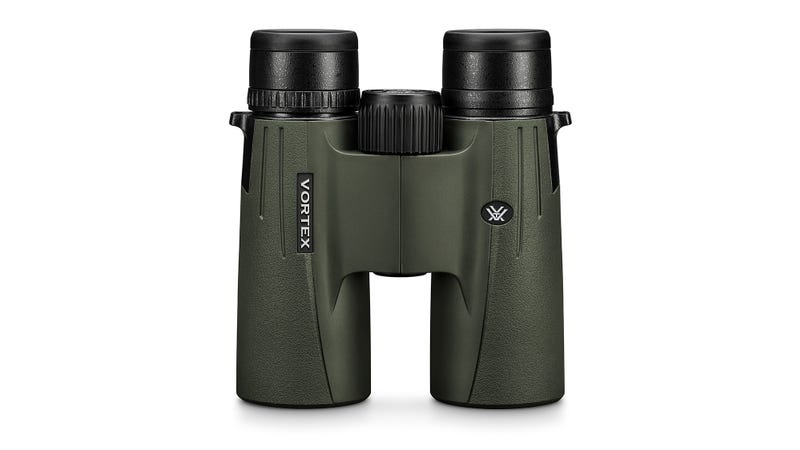
Choose this 10x42 when you want the familiar balance of moderate carry weight and extra detail, with a real field that still meets the broad six-degree threshold used in the finder. It is less suited to someone who puts maximum field width first, has a strict weight ceiling below 24.9 ounces, requires confirmed ED glass, needs the adapter in the box or cannot confirm a comfortable glasses fit. Compare the 8x42 if easy scanning dominates, and the 10x50 if its larger objective is worth the extra bulk for your use. V201 is a passive binocular, not the Vortex Talon or Ranger rangefinding model. The exact-page-linked manufacturer image shows a front-facing Viper body without a readable power label; the image-page association supports the V201 model, but the photo-versus-render status is not disclosed. See the Viper HD 10x42 page, linked owner’s manual and V201 parts and in-box sheet. The analysis is based on those documents, not user reviews, ownership or lab measurements.
Key specifications
Key details at a glance
| Magnification | 10× |
|---|---|
| Objective diameter | 42 mm |
| Real field of view | 6.5° |
| Eye relief | 17 mm |
| Exit pupil | 4.2 mm |
| Close focus distance | 6 ft |
More specifications and setup details
| Manufacturer-published weight | 24.9 oz |
|---|---|
| Phase coatings confirmed | Yes |
| Locking diopter ring confirmed | Yes |
| Lens and prism coatings | The exact page lists XR Plus anti-reflective coatings on air-to-glass surfaces, dielectric prism coatings, phase correction and ArmorTek exterior-lens protection. The page does not explicitly designate this SKU as ED glass. |
| Water and fog protection | Vortex describes this SKU as waterproof, fogproof, shockproof, argon-gas purged and O-ring sealed. The exact page gives no IP code, immersion depth or duration; underwater use is not established. |
| Tripod use | The exact page calls the binocular tripod adaptable and lists a Vortex Sport Binocular Adapter separately; neither the product box list nor the SKU-specific XVIEW sheet includes that adapter. Obtain the compatible adapter separately for tripod use. |
| Published weight note | Vortex lists 24.9 oz for the instrument; this is a published specification, not a weighed specimen or total carried kit. |
| Manufacturer-rated waterproof | Yes |
| Integrated laser rangefinder | No |
| Onboard ballistic solution display | No |
| Tripod adapter in package | No |
Use the exact model’s instructions for operating limits, supplied equipment and version differences.
Sources for this review
Sources for this assessment
- Official U.S. Vortex Viper HD 10x42 binocular; exact SKU V201, live current-reference page, specification and package list
- Official Vortex U.S. binocular family listing (reused existing archive)
- Linked Viper HD owner’s manual M-00170-1; same archived seven-page file linked by this exact SKU page
- Vortex V201-specific Viper HD 10x42 parts and in-box XVIEW sheet (manufacturer issue 12/22/2025, version 6)
- Official image linked within exact SKU page gallery; front product view
- Official Vortex U.S. category page 2, exact row and model link individually reconciled

Choose your optical trade-off first.
Choose viewing purpose first, then magnification, objective size, scene width and any fit, weather or mounting constraint. A direct-Sun requirement is separate: only exact manufacturer-confirmed solar binoculars can pass it.