
On this page
Your needs, this model
Does it fit your priorities?
Do you prefer a wide scanning field or more magnification?
The exact 8x32 lists 472 ft at 1,000 yd and 9.0 degrees. Choosing its exact power and objective distinguishes it from other Razor UHD sizes.
Explore this need in the finder →Can the model’s closest-focus distance accommodate your nearby subjects?
Vortex lists a 5.9 ft closest focus for this exact configuration; nearer fine-detail work is not confirmed.
Explore this need in the finder →Is an explicitly named ED-glass specification essential?
Vortex names UHD/APO optical features but the exact U.S. page and linked manual do not identify an ED-glass designation for this SKU. If ED is essential, do not infer it from the broader product-family labels.
Explore this need in the finder →The Razor UHD 8x32 is the lightest, widest-view member of this seven-configuration family. It suits someone who keeps binoculars close at hand for birds, wildlife, or travel and values a calm, generous scene more than extra magnification or a larger objective. Its small front lenses and modest mass make it easy to carry, but this is still a high-end optical instrument rather than a dusk-optimized 42 or 50 mm model.
Pick the 8x32 for a wide view that stays portable
Vortex lists 8x magnification, 32 mm objectives, a 9-degree angular field and 472 feet of view at 1,000 yards. Those are the widest-field published figures in the Razor UHD group. Eight power also makes it easier to keep a moving bird or distant animal in view than a 10x or 12x alternative. At 21.9 ounces and 5.7 inches high, it is the compact choice here; its open-hinge body is substantially smaller than the 42, 50, and 56 mm configurations.
The 8x and 10x 32 mm models weigh the same on Vortex’s current pages, but the 8x version shows more of the surroundings: 472 feet versus 388 feet per 1,000 yards. That difference is useful when scanning a canopy, shoreline, or a flock that changes direction. If identifying a smaller subject at longer range takes priority, the 10x32 trades field width for more apparent subject size without adding listed weight. If you expect regular viewing near dawn or dusk, the larger 8x42 gives a wider 420-foot field and a larger objective, at the cost of about ten more ounces.
Understand what the published optical labels do—and do not—say
The exact product page names Vortex’s UHD optical system, XR Plus anti-reflective coatings, magnesium chassis, Schmidt-Pechan roof prisms, phase correction, ArmorTek exterior lens protection, and argon-gas purging. Vortex also lists the model as waterproof, fogproof, and shockproof. These are manufacturer descriptions, not independent resolution, color, or weather tests. The page does not identify an ED-glass specification by that name, so do not use the APO or UHD labels as a substitute if ED glass is an essential written requirement.
An 8x32 geometry gives a 4 mm exit pupil, calculated from the stated magnification and objective size. That figure describes the light bundle leaving the eyepiece; it is not a measured brightness score. A 42 or 50 mm configuration creates a larger exit pupil at comparable magnification and may be more forgiving in dim conditions, while the smaller 32 mm instrument uses less space and weight. If your choices emphasize wide real field, 8x power, and a 32 mm objective, this is the family’s clearest fit. A strict ED-glass, confirmed-eye-relief, or stated-weight requirement should not be inferred from premium branding alone.
Set it up, then check the fit that matters to you
The product page lists 5.9 feet close focus, 55–75 mm interpupillary distance, center focus, a locking diopter, and adjustable eyecups. The manual describes focusing one barrel and then setting the diopter for the other eye before using the center wheel for later distance changes. A short published close-focus distance can help with a nearby feeder or flower, but this is still a binocular for ordinary observation, not macro work.
There is an eye-relief conflict worth treating conservatively: the exact product page lists 18.0 mm, while the linked Razor UHD family manual’s 32 mm specification row lists 19.0 mm for the 8x32. Keep that number unqualified if long eye relief is a hard glasses requirement; try the actual instrument with your own frames before depending on full-field viewing. The manual’s weight table agrees with the page’s 21.9 ounces. In the box, Vortex lists its GlassPak Pro harness, comfort neck strap, rangefinder pouch, tethered objective covers, rainguard, and lens cloth. A tripod adapter is not listed, though the binocular is tripod adaptable with a separate adapter.
Who should choose it?
Choose the 8x32 if a broad moving view and low carry weight outrank low-light headroom. Choose the 10x32 when extra reach matters more than scanning width, or move to the 8x42 for a larger objective and a more forgiving exit pupil. The 10x42 is the more natural direction for a user who wants stronger detail at medium-to-long distances and accepts a narrower view and more hand movement. For all-day pack carry, the 32 mm versions are the only Razor UHD sizes listed below 22 ounces.
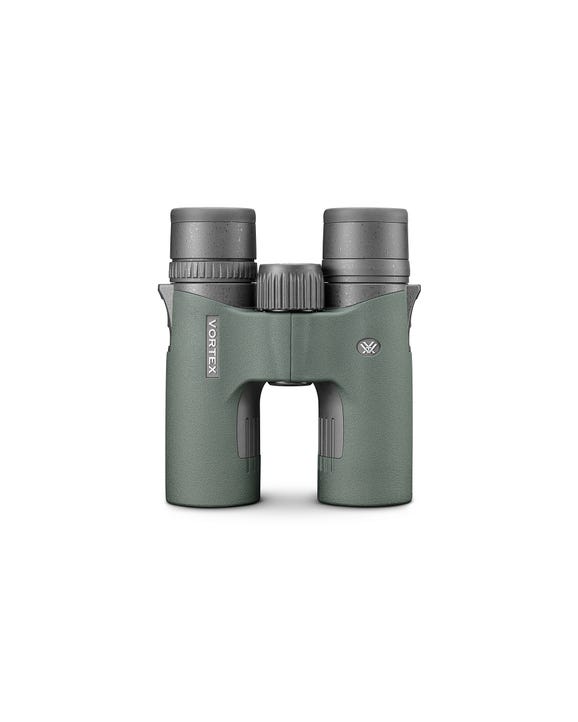
This assessment uses the exact Vortex U.S. 8x32 page, its linked Razor UHD operating manual, and SKU-specific parts/package sheet for RZB-0832. It includes no sample ownership or lab measurements. The manufacturer does not identify whether its gallery image is a photograph or a rendering; the page-linked image is shown as family appearance, not proof of magnification marking. Consult the Vortex Razor UHD 8x32 product page and the manufacturer manual for current product information and handling instructions.
Key specifications
Key details at a glance
| Magnification | 8× |
|---|---|
| Objective diameter | 32 mm |
| Real field of view | 9° |
| Close focus distance | 5.9 ft |
| Manufacturer-published weight | 21.9 oz |
| Phase coatings confirmed | Yes |
More specifications and setup details
| Locking diopter ring confirmed | Yes |
|---|---|
| Lens and prism coatings | Vortex names XR Plus anti-reflective coatings on all air-to-glass surfaces; exact page does not confirm a named ED-glass specification or dielectric coating. |
| Water and fog protection | Exact page describes waterproof, fogproof, shockproof, argon-gas-purged construction; no immersion depth or IP rating is published. Do not infer underwater suitability. |
| Tripod use | Vortex calls the model tripod adaptable and lists the Pro Binocular Adapter separately; no adapter appears in the exact package contents. |
| Published weight note | Vortex exact page and linked Razor UHD manual agree at 21.9 oz. |
| Manufacturer-rated waterproof | Yes |
| Integrated laser rangefinder | No |
| Onboard ballistic solution display | No |
| Tripod adapter in package | No |
Use the exact model’s instructions for operating limits, supplied equipment and version differences.
Sources for this review
Sources for this assessment
- Vortex U.S. exact product page, Razor UHD 8x32, SKU RZB-0832
- Vortex linked Razor UHD binocular operation manual, 7-page English PDF
- Vortex SKU-specific Razor UHD 8x32 XVIEW parts and in-box accessories sheet
- Exact page-linked official Vortex product gallery image; pixels do not identify magnification
- Dated exact SKU and exact-title ProductName queries; no hit is not recall clearance
- Official Vortex U.S. binocular category row vortex-us-category-cycle47-p1-r9, inspected on page 1

Choose your optical trade-off first.
Choose viewing purpose first, then magnification, objective size, scene width and any fit, weather or mounting constraint. A direct-Sun requirement is separate: only exact manufacturer-confirmed solar binoculars can pass it.