
On this page
Your needs, this model
Does it fit your priorities?
Do you prefer a wide scanning field or more magnification?
The exact 10x50 lists 341 ft at 1,000 yd and 6.5 degrees. Choosing its exact power and objective distinguishes it from other Razor UHD sizes.
Explore this need in the finder →Can the model’s closest-focus distance accommodate your nearby subjects?
Vortex lists a 6.6 ft closest focus for this exact configuration; nearer fine-detail work is not confirmed.
Explore this need in the finder →Is an explicitly named ED-glass specification essential?
Vortex names UHD/APO optical features but the exact U.S. page and linked manual do not identify an ED-glass designation for this SKU. If ED is essential, do not infer it from the broader product-family labels.
Explore this need in the finder →The Razor UHD 10x50 is for someone who wants ten-power viewing with a 50 mm objective and accepts a larger body than the 10x42. It keeps a 10x field rather than moving to 12x, and Vortex lists a 36.5-ounce instrument weight. This is a deliberate open-country or lower-light configuration, not the best choice when all-day pack weight and quick scanning dominate.
Choose the 50 mm objective without increasing magnification
Vortex lists a 6.5-degree angular field and 341 feet at 1,000 yards. The 10x42 is slightly wider on paper at 346 feet and 6.6 degrees, but it has a 42 mm objective and a 32.2-ounce current-page figure. The 10x50’s exact page and the linked family manual agree on 36.5 ounces; its additional mass buys a larger front aperture, not a wider scene. A 10x50 produces a 5 mm exit pupil by the stated power and objective ratio, compared with 4.2 mm for 10x42. That is geometric context, not proof of a brighter image under any specific lighting.
For wildlife in varied light, the 10x50 is a reasonable step up when a 10x field is already comfortable and you can carry the size. The 8x42 is easier to hold and scan with; the 12x50 raises magnification but narrows the published field to 288 feet. The 10x50 remains the middle option for viewers who want a larger objective without accepting 12x shake and a narrower view. Its 6.6-foot close-focus figure is farther than the 10x42’s 4.5 feet, so it is less suited to very close feeder watching.
How the construction is described
The manufacturer lists an UHD optical system, XR Plus anti-reflective coatings, magnesium chassis, Abbe-Koenig roof prisms, phase correction, ArmorTek exterior-lens protection, and argon-gas purging. Vortex describes it as waterproof, fogproof, shockproof, and tripod adaptable. These are manufacturer statements, not independent weather or image-quality tests; no immersion depth appears in the exact page. The page does not explicitly identify ED glass by name. APO and UHD should not be treated as equivalent to a named ED requirement.
Ten power is still sensitive to hand motion. Although a 50 mm objective can make the body larger and front-heavy compared with 32 mm glass, no exact hand-balance or field test is claimed here. The product page lists center focus, locking diopter, adjustable eyecups, 56–76 mm interpupillary distance, and 18.0 mm eye relief. The manual table agrees with the eye-relief figure. If glasses fit is essential, the listed relief is a starting point, not a guarantee of your full usable field.
Do not assume the mount or accessories are included
Vortex’s listed package includes a GlassPak Pro harness, comfort neck strap, rangefinder pouch, tethered objective covers, rainguard, and lens cloth. The exact list does not include the Pro Binocular Adapter, though the instrument is tripod adaptable. If your plan requires a tripod, add the compatible adapter and support separately. The manual identifies the center focus and diopter setup and cautions users to remove grit before cleaning the coated lenses. That basic routine is more reliable than expecting an exterior coating to prevent every scratch or spot.
The chooser’s 10x, 50 mm, waterproof, or real-field choices fit the specifications Vortex publishes for this model. Its 36.5-ounce figure is consistent between page and manual; a 35-ounce ceiling would not fit. The product does not satisfy a requirement for a supplied adapter, active ranging, zoom, image stabilization, or named ED glass.
Who should choose it?
Choose the 10x50 if you want to stay at ten power while stepping up from a 42 mm front lens and can tolerate about 36.5 ounces. Choose the 10x42 if a lighter body and closer focus are more important. Choose the 12x50 for more magnification rather than a broader scene, or the 8x42 if an easier-to-follow view matters more than subject size. If the expected use is primarily walking, the two 32 mm Razor UHD models are dramatically lighter, though their smaller objectives change the low-light tradeoff.
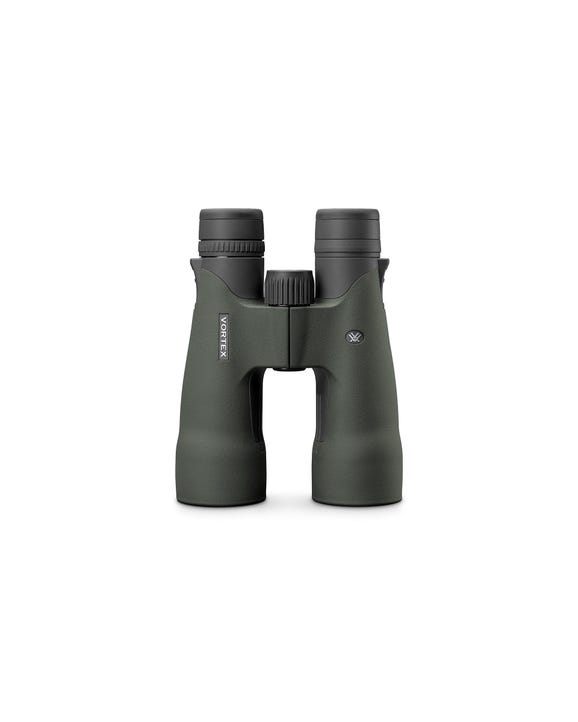
This review uses the exact U.S. RZB-1050 product page, its linked operation manual, and the SKU-specific package/parts sheet. No price, current stock claim, laboratory test, or personal ownership is asserted. The exact page-linked product image is visually shared byte-for-byte with the 12x50 page and does not disclose magnification in its pixels; Vortex does not say if the image is a photograph or rendering. See the Vortex Razor UHD 10x50 page and manufacturer manual.
Key specifications
Key details at a glance
| Magnification | 10× |
|---|---|
| Objective diameter | 50 mm |
| Real field of view | 6.5° |
| Eye relief | 18 mm |
| Close focus distance | 6.6 ft |
| Manufacturer-published weight | 36.5 oz |
More specifications and setup details
| Phase coatings confirmed | Yes |
|---|---|
| Locking diopter ring confirmed | Yes |
| Lens and prism coatings | Vortex names XR Plus anti-reflective coatings on all air-to-glass surfaces; exact page does not confirm a named ED-glass specification or dielectric coating. |
| Water and fog protection | Exact page describes waterproof, fogproof, shockproof, argon-gas-purged construction; no immersion depth or IP rating is published. Do not infer underwater suitability. |
| Tripod use | Vortex calls the model tripod adaptable and lists the Pro Binocular Adapter separately; no adapter appears in the exact package contents. |
| Published weight note | Vortex exact page and linked Razor UHD manual agree at 36.5 oz. |
| Manufacturer-rated waterproof | Yes |
| Integrated laser rangefinder | No |
| Onboard ballistic solution display | No |
| Tripod adapter in package | No |
Use the exact model’s instructions for operating limits, supplied equipment and version differences.
Sources for this review
Sources for this assessment
- Vortex U.S. exact product page, Razor UHD 10x50, SKU RZB-1050
- Vortex linked Razor UHD binocular operation manual, 7-page English PDF
- Vortex SKU-specific Razor UHD 10x50 XVIEW parts and in-box accessories sheet
- Exact page-linked official Vortex product gallery image; pixels do not identify magnification
- Dated exact SKU and exact-title ProductName queries; no hit is not recall clearance
- Official Vortex U.S. binocular category row vortex-us-category-cycle47-p1-r5, inspected on page 1

Choose your optical trade-off first.
Choose viewing purpose first, then magnification, objective size, scene width and any fit, weather or mounting constraint. A direct-Sun requirement is separate: only exact manufacturer-confirmed solar binoculars can pass it.