
On this page
Your needs, this model
Does it fit your priorities?
Does a lower-power, wider-scanning 42 mm view suit your moving subjects?
RZB-2101 is the 8x42 choice in this current group and lists 388 ft/1,000 yd, wider than the 10x42 sibling.
Explore this need in the finder →Can your carry limit accommodate the published 24.2 oz weight?
The exact page lists 24.2 oz; a strict limit below that must reject it rather than round down.
Explore this need in the finder →Is explicitly confirmed ED glass essential rather than an HD/APO label?
The exact RZB-2101 page describes HD/APO technology but does not name ED glass; unknown does not satisfy an essential ED requirement.
Explore this need in the finder →The current Vortex Razor HD 8x42, SKU RZB-2101, is the calmer, wider-scanning member of this four-size HD group. Its published 388-foot field at 1,000 yards and 24.2-ounce weight make it a plausible premium 8x42 for wildlife and hunting walks where fast acquisition matters more than maximum reach. It is not the older RZR-0842 generation that still appears in some archived listings; the SKU is the important distinction.
What the 8x42 changes in the view
At eight power, this configuration shows a broader scene than its 10x42 sibling: Vortex lists 388 feet per 1,000 yards and 7.4 degrees, compared with 362 feet and 6.9 degrees for the RZB-2102 10x42. That extra field can make it easier to acquire a moving animal or keep a bird in sight while panning. The lower power also asks less of an unbraced hand than 10x or 12x, though no conventional binocular can eliminate motion. If distant antler detail or a small target takes priority, the 10x42 trades some scene width for greater apparent size. Both have 42 mm objectives and nearly the same published body dimensions; the 8x42 is 24.2 ounces, only 0.6 ounce below the 10x42. The 42 mm objective and 8x power yield a calculated 5.25 mm exit pupil. That is a geometry calculation, not a brightness test: coatings, glass, pupil size, fit and viewing conditions also matter, and Vortex does not publish a transmission test on the product page. The large objective does not promise a bright image in every dusk situation. For a smaller exit pupil and longer reach, consider the 10x42; for 50 mm objectives, the Razor HD 10x50 and 12x50 are the direct family alternatives, with a narrower stated scene.
Glasses, fit and the published numbers
The exact page lists 17.5 mm eye relief, an interpupillary range of 55–75 mm, twist-up eyecups and a locking diopter on the right eyepiece. Those are useful starting points, not a guarantee that every glasses wearer will see the full field. The eyecups and the placement of your glasses can change usable relief, so check the view while wearing the eyewear you intend to use. This model's eye relief is a listed value, not a measured personal fit result.
The published 7.0-by-5.1-inch dimensions and 24.2-ounce weight describe a full-size roof-prism instrument, not a pocket pair. The Razor HD page specifies a magnesium chassis, XR Plus coatings on air-to-glass surfaces, phase correction, APO optical technology and argon purging; it calls the body waterproof, fogproof and shockproof but gives no IP code or immersion depth. The page does not name an ED-glass specification. “HD” or “APO” should not be converted into a confirmed ED answer; if ED is essential, this exact model does not satisfy that requirement on the evidence reviewed.
Set it up once, then use the center wheel
The linked five-page Razor HD manual gives a two-step focus procedure: focus the left eye with the center wheel, then unlock and set the right-eye diopter, and push the ring down to lock it. It also explains setting interpupillary distance until the two barrels form one image without shading, and recommends lowering the eyecups for eyeglasses. This is practical rather than glamorous advice: a correctly set diopter avoids repeated compensation with the main wheel, and a poor IPD setting can make even expensive optics uncomfortable. The manual says to remove grit before wiping and use an optical brush, air or lens-safe cloth rather than clothing that could scratch a coated surface.
Mounting and package limits
The current page and SKU sheet list a GlassPak binocular harness/case, comfort neck strap, rainguard, tethered 42 mm objective caps and lens cloth. The instrument is tripod-adaptable, but the product page lists the Pro Binocular Adapter separately and the sheet does not show that adapter as an in-box item. So a supplied-adapter need is a no; a supported stationary observation plan is possible only if you add the compatible adapter and a suitable support. There is no built-in stabilization claim. The manual also warns not to look at the Sun through binoculars; this is ordinary daytime/night-sky glass, not solar equipment.
Who this configuration fits
Choose the RZB-2101 if your priorities are eight-power steadiness, a 42 mm objective and the widest stated field in the Razor HD 42 mm pair. Choose the 10x42 if you accept a tighter view for greater apparent detail. Choose a 10x50 when a 50 mm objective and 10x reach suit the outing; choose the 12x50 only if its extra magnification matters more than the narrowest field and shortest eye relief in the group. A strict sub-24-ounce carry limit excludes this 24.2-ounce model; do not round the manufacturer figure down.
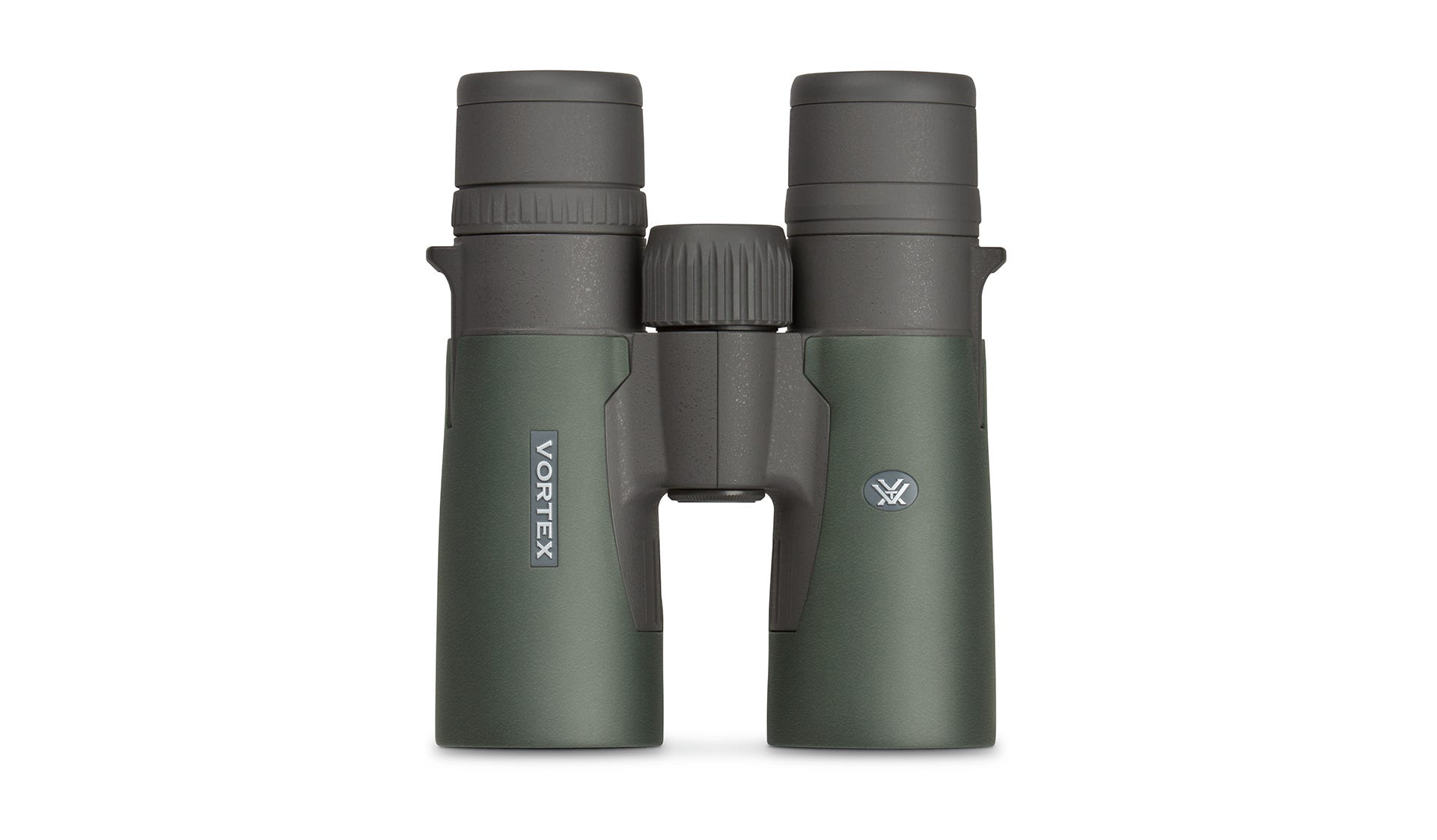
This review uses the current exact U.S. page and RZB-2101 parts sheet, plus the five-page operation manual linked from the product page. It is not a lab test, ownership report or live-stock statement. The archived manufacturer front view is shared with the 10x42 page and carries no readable power marking; the image is therefore page-associated Razor HD family photography, not visual proof of magnification. Vortex does not disclose photograph-versus-render status. See the Razor HD 8x42 page, linked operation manual, and SKU parts sheet.
Key specifications
Key details at a glance
| Magnification | 8× |
|---|---|
| Objective diameter | 42 mm |
| Real field of view | 7.4° |
| Eye relief | 17.5 mm |
| Exit pupil | 5.25 mm |
| Close focus distance | 6 ft |
More specifications and setup details
| Manufacturer-published weight | 24.2 oz |
|---|---|
| Phase coatings confirmed | Yes |
| Locking diopter ring confirmed | Yes |
| Lens and prism coatings | Exact page describes XR Plus anti-reflective coatings on all air-to-glass surfaces, phase correction for roof prisms, and APO optical technology. It does not name an ED-glass designation for this exact SKU. |
| Water and fog protection | The exact page says waterproof, fogproof, shockproof and argon-gas-purged. It gives no IP rating or immersion depth; do not infer underwater suitability. |
| Tripod use | Exact page says tripod adaptable and lists the Pro Binocular Adapter separately; package list and XVIEW sheet do not identify the adapter as included. |
| Published weight note | Exact U.S. page lists 24.2 oz; this is the manufacturer-published figure, not a weighed specimen. |
| Manufacturer-rated waterproof | Yes |
| Built-in image stabilization confirmed | No |
| Integrated laser rangefinder | No |
| Onboard ballistic solution display | No |
| Tripod adapter in package | No |
Use the exact model’s instructions for operating limits, supplied equipment and version differences.
Sources for this review
Sources for this assessment
- Vortex U.S. exact product page, Razor HD 8x42, SKU RZB-2101
- Vortex linked five-page Razor HD operation manual; exact product pages link this manual; contents are general operation, not current SKU numerical specifications.
- Vortex RZB-2101-specific XVIEW parts/in-box accessory sheet; confirms model and SKU family.
- Official image file directly linked by exact Razor HD U.S. product page; visually reviewed; power marking absent or image is family-use photography.
- Dated CPSC ProductName queries for exact SKU RZB-2101 and exact model title; no hit is not recall clearance.
- Official Vortex U.S. binocular category page 2, item 3; manually reconciled to exact product page and RZB SKU.

Choose your optical trade-off first.
Choose viewing purpose first, then magnification, objective size, scene width and any fit, weather or mounting constraint. A direct-Sun requirement is separate: only exact manufacturer-confirmed solar binoculars can pass it.