
On this page
Your needs, this model
Does it fit your priorities?
Do you want 10x reach while keeping the 42 mm size and at least a 6° field?
RZB-2102 lists 10x, 42 mm objectives and 6.9°/362 ft at 1,000 yd; its 8x sibling has a wider field but less magnification.
Explore this need in the finder →Must close focus be six feet or less for nearby wildlife?
The exact page lists six feet; the 50 mm siblings list ten feet.
Explore this need in the finder →Must a tripod adapter be included, rather than purchased separately?
The page calls it tripod adaptable, but lists the Pro Binocular Adapter separately and does not include it in the package list.
Explore this need in the finder →The Vortex Razor HD 10x42 with current SKU RZB-2102 is the reach-oriented 42 mm option in this Razor HD group. Its product page lists 362 feet of scene at 1,000 yards, six-foot close focus and a 24.8-ounce weight. It is a sensible match when ten power is important but a 50 mm body is not; it is not a substitute for the different older RZR-4210-HD generation that appears in archived product pages.
Reach without moving to a 50 mm objective
The 10x42 gives more apparent subject size than the 8x42, while its 6.9-degree field and 362-foot linear field are narrower than the 8x42's 7.4 degrees and 388 feet. That trade is straightforward: the RZB-2102 can help separate distant detail, but it is less forgiving when quickly locating a moving subject or sweeping across a broad ridge. Both 42 mm models have the same 5.9-by-5.1-inch dimensions and nearly the same listed weight—24.8 versus 24.2 ounces—so your decision is mostly about power, scene width and how steady you hold the instrument, not a major size penalty.
The page's six-foot close-focus specification is more useful for nearby detail than the 10-foot figure on either 50 mm sibling. It does not make these close-focusing macro optics; it simply means the manufacturer claims focus down to a nearer distance than the 50 mm models. If close wildlife or objects in a garden matter, this is a family-specific reason to prefer 10x42 over 10x50. The 8x42 also lists six feet but gives a wider view and lower power.
Check eye relief and field access before committing
Vortex lists 16.5 mm eye relief, 55–75 mm interpupillary distance, adjustable twist-up eyecups and a locking right-eye diopter. If you wear glasses, the eye-relief figure is a starting point only. Try the binocular with your own glasses and the eyecups in the position you expect to use; an advertised millimeter value cannot establish whether your glasses leave enough room to see the full field. If your fit requires at least 17 mm on published figures, this model should not pass that essential filter.
At 42 mm and 10x, the calculated exit pupil is 4.2 mm. This describes the geometry of the exit beam, not measured low-light performance. The manufacturer's exact product page describes an HD optical system, APO optical technology, XR Plus anti-reflective coatings, phase correction, magnesium chassis, ArmorTek exterior protection and argon purging. It also calls the body waterproof, fogproof and shockproof. No IP rating or water-immersion depth is published. The page does not explicitly identify ED glass; do not infer it from “HD” or APO branding. If ED is a must-have rather than a preference, this profile should remain out of the result until exact evidence confirms that specification.
Focus, diopter and cleaning are part of the fit
The manual linked on the RZB-2102 page describes setting the center focus for the left eye first, then adjusting the right-eye diopter and locking the ring. It also asks the user to set interpupillary distance to avoid a shaded or doubled view. This matters if several people share the binocular: the central wheel is the everyday control only after each person's diopter has been set. The eyecups twist up for use without glasses and down for glasses, according to the manual. For cleaning, clear dust and grit before wiping and use an optical brush, air or a non-abrasive lens cloth; a sleeve can scratch the glass.
Tripod support and what's actually included
The current package list names the GlassPak binocular harness, rainguard, tethered objective covers, comfort neck strap and lens cloth. The exact 42 mm parts sheet lists the harness/case, 42 mm tethered caps and the Razor HD manual. Although the page says tripod-adaptable, Vortex lists its Pro Binocular Adapter separately; the package list and parts sheet do not show the adapter included. You can plan a supported view only if you budget for the compatible adapter and support; an in-box adapter requirement is not met. There is no listed built-in image stabilization, so a mount can help during long stationary viewing but is not supplied stabilization.
Who should favor the 10x42?
Pick it when distant detail and a 42 mm carry size outrank the broadest possible field. Choose the 8x42 when moving targets, scanning or a lower-power handheld view matter more. Choose the 10x50 if you want to keep 10x while moving to the larger objective and accept a 10-foot rather than six-foot close-focus claim; the 12x50 is a still narrower, higher-power alternative. This current RZB-2102 is listed at 24.8 ounces, so it misses a strict 24-ounce ceiling but fits a 25-ounce limit. Do not use an older RZR-4210-HD weight or 330.8-foot field as if those values belonged to this current SKU: the archived older page identifies a different model number and materially different published specifications.
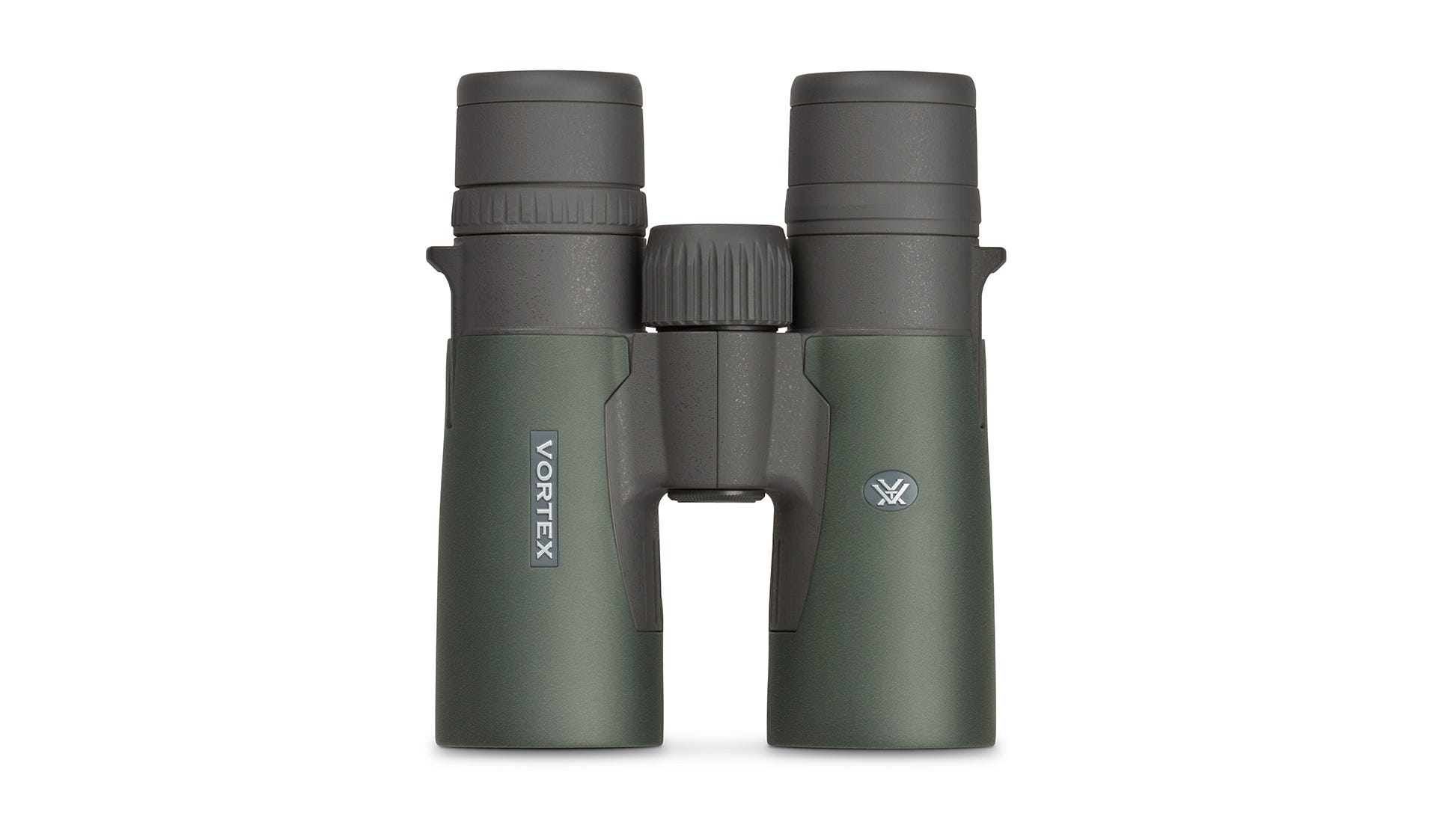
The review is based on the exact U.S. RZB-2102 page, the linked 42 mm parts sheet and the linked Razor HD operation manual. It makes no ownership, field-test or laboratory claim and does not promise live retailer stock. The primary product cutout is the same page-linked image file used by the 8x42 sibling; no magnification or SKU is legible, and Vortex does not state whether it is a photograph or a rendering. See the Razor HD 10x42 page, linked operation manual, and SKU parts sheet.
Key specifications
Key details at a glance
| Magnification | 10× |
|---|---|
| Objective diameter | 42 mm |
| Real field of view | 6.9° |
| Eye relief | 16.5 mm |
| Exit pupil | 4.2 mm |
| Close focus distance | 6 ft |
More specifications and setup details
| Manufacturer-published weight | 24.8 oz |
|---|---|
| Phase coatings confirmed | Yes |
| Locking diopter ring confirmed | Yes |
| Lens and prism coatings | Exact page describes XR Plus anti-reflective coatings on all air-to-glass surfaces, phase correction for roof prisms, and APO optical technology. It does not name an ED-glass designation for this exact SKU. |
| Water and fog protection | The exact page says waterproof, fogproof, shockproof and argon-gas-purged. It gives no IP rating or immersion depth; do not infer underwater suitability. |
| Tripod use | Exact page says tripod adaptable and lists the Pro Binocular Adapter separately; package list and XVIEW sheet do not identify the adapter as included. |
| Published weight note | Exact U.S. page lists 24.8 oz; this is the manufacturer-published figure, not a weighed specimen. |
| Manufacturer-rated waterproof | Yes |
| Built-in image stabilization confirmed | No |
| Integrated laser rangefinder | No |
| Onboard ballistic solution display | No |
| Tripod adapter in package | No |
Use the exact model’s instructions for operating limits, supplied equipment and version differences.
Sources for this review
Sources for this assessment
- Vortex U.S. exact product page, Razor HD 10x42, SKU RZB-2102
- Vortex linked five-page Razor HD operation manual; exact product pages link this manual; contents are general operation, not current SKU numerical specifications.
- Vortex RZB-2102-specific XVIEW parts/in-box accessory sheet; confirms model and SKU family.
- Official image file directly linked by exact Razor HD U.S. product page; visually reviewed; power marking absent or image is family-use photography.
- Dated CPSC ProductName queries for exact SKU RZB-2102 and exact model title; no hit is not recall clearance.
- Official Vortex U.S. binocular category page 2, item 2; manually reconciled to exact product page and RZB SKU.

Choose your optical trade-off first.
Choose viewing purpose first, then magnification, objective size, scene width and any fit, weather or mounting constraint. A direct-Sun requirement is separate: only exact manufacturer-confirmed solar binoculars can pass it.