
On this page
Your needs, this model
Does it fit your priorities?
Does the binocular itself need to measure target distance with a laser?
Yes. SKU LRF-RGR3000 combines 10x42 observation with HCD/LOS laser distance readings; the published 3,000-yard reflective maximum is a conditional ceiling, not a guaranteed target range.
Explore this need in the finder →Is an on-board ballistic wind/drop solution essential, rather than a range readout?
This Ranger manual lists HCD and LOS ranging but not the Talon HD 10K BAL profile-based solution. Do not choose it if BAL data is essential.
Explore this need in the finder →Is a 6-foot optical close-focus limit useful for nearer subjects?
The optical close-focus figure is 6 ft. That is separate from the laser minimum range of 6 yd, so close optical viewing does not mean it can range a nearby feeder.
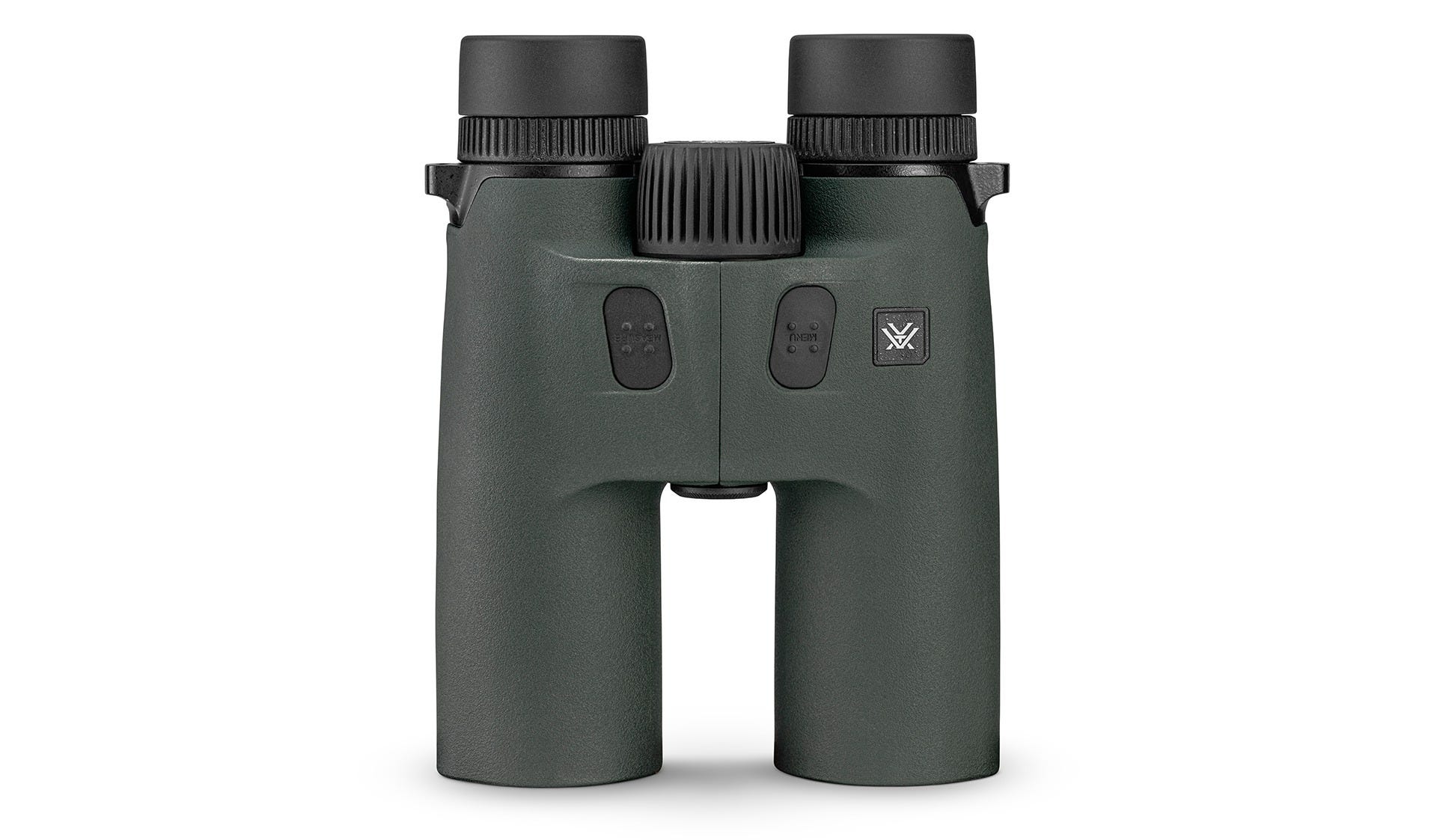
Explore this need in the finder →The Vortex Ranger HD 3000 10x42 combines conventional 10x binocular viewing with a laser rangefinder in one body. That combination is useful when distance readings are part of the same outing as glassing; it is unnecessary weight and battery dependence if you only want a pair for birds, events or travel. This is a source-based assessment of the exact U.S. SKU LRF-RGR3000, not a hands-on ranging test.
A full-size 10x42 with a purpose-built compromise
The optical side is a fixed 10x42 with a listed real field of 6.4 degrees, or 335 feet at 1,000 yards. Eye relief is listed at 17 mm, and close focus at 6 feet. The latter is the closest optical viewing distance; it is distinct from the laser's 6-yard minimum ranging distance. A six-foot focus spec does not turn this into a macro viewer, and the laser will not return a measurement closer than six yards according to the manual.
At 32.4 ounces with the CR123 battery installed, it is a substantial carry for a 10x42. That is lighter than Vortex's reviewed Talon HD 10K 10x42, which is listed at 40.8 ounces with its battery, but still heavier than passive 10x42 binoculars. The Ranger is the more sensible choice only if the integrated distance function is valuable enough to justify the extra mass. The exact product page and manual disagree slightly on interpupillary distance: the page lists 55–74 mm while the manual lists 56–75 mm. Because that affects eye alignment, neither range is used as a hard-fit promise here; try the actual unit if your interpupillary fit is a concern.
Read the ranging limits as target-dependent ceilings
Vortex lists maximum ranges of up to 3,000 yards on reflective targets, 1,800 on trees and 1,500 on deer. These are manufacturer ratings, not independent field results or a promise that every object will range at those distances. The manual explains that size, surface reflectivity, color, angle and visibility affect the return. It warns that rain, snow and fog can make ranging harder, and that a tripod can help when trying to hold on a small, distant target.
Three target modes change what the device selects: Normal favors the strongest return; First reports the closest object, useful when a smaller target sits in front of a more reflective background; Last reports the farthest return, for a target beyond intervening brush or other objects. Scan mode continues measuring while the Measure button is held. These controls address different ranging situations, but none removes the dependence on a clean line of sight and a usable laser return.
HCD is not a ballistic calculator
The selectable range displays are HCD and LOS. HCD shows horizontal-component distance with slope compensation; LOS shows actual line-of-sight range and slope angle. The distinction matters: an angle-corrected distance is still a distance reading, not bullet-drop or wind data. The Ranger's exact page and manual do not list a ballistic BAL mode or an onboard ballistic profile solver. If profile-based wind and drop display is essential, compare a different configuration, such as the more elaborate Talon HD 10K 10x42. If you need only a measured range, the Ranger avoids that model's extra data system and is lighter on the published specification.
A red OLED display offers five brightness settings, and distances can be shown in yards or meters. The display and laser require power. The manual specifies one CR123 battery, which the package list says is included; Vortex does not publish a runtime figure on the exact page. If the cell is depleted, the electronic functions are unavailable. The source materials do not describe an optical-only fallback procedure, so do not assume the ranging screen will remain usable without a battery.
Budget for setup, not just the glass
The manual walks through separate adjustments for center focus, right-eye diopter and reticle focus, then alignment of interpupillary distance and eyecups. Once each eye and the reticle are focused, the center wheel handles ordinary optical focusing. This is more setup than a simple passive binocular because the range display must also be focused and its menu modes learned. Adjustable twist-up eyecups support use with or without glasses, but 17 mm of stated eye relief cannot guarantee that every frame will see the full field.
The product page calls the body waterproof, fogproof and shockproof, and says it is nitrogen-purged and O-ring sealed. No immersion depth or IP rating is given, so underwater use is not established. The page calls it tripod adaptable and the manual identifies a tripod-adapter socket, but the listed box contents include no tripod or adapter. Confirm the adapter connection separately rather than assuming the necessary support hardware is bundled. A GlassPak harness, neck strap, lens cloth, tethered objective covers, rainguard and CR123 battery are listed in the package.
Who should choose it?
Choose the Ranger HD 3000 if one instrument must provide binocular observation and on-board laser distance readings, and HCD/LOS modes meet your needs. It is a focused hunting-oriented tool, not a universally better 10x42. If you do not need distance measurement, a passive 10x42 such as the reviewed Vortex Razor HD 10x42 is lighter on its published specification and avoids battery and menu dependence. If you do need a ballistic display, the Talon HD 10K 10x42 adds that capability but weighs more and involves more setup. Before choosing between these tools, decide whether your essential task is just to see, to range, or also to calculate with a verified profile.
The manual warns against viewing the Sun, staring into the laser beam, aiming the controls at an eye or disassembling the unit; follow its safety instructions. See the exact Vortex Ranger HD 3000 10x42 product page and manufacturer manual for current product and operating details.
Key specifications
Key details at a glance
| Magnification | 10× |
|---|---|
| Objective diameter | 42 mm |
| Real field of view | 6.4° |
| Eye relief | 17 mm |
| Close focus distance | 6 ft |
| Manufacturer-published weight | 32.4 oz |
More specifications and setup details
| Lens and prism coatings | Exact page states fully multi-coated lenses and describes anti-reflective coating on all air-to-glass surfaces; it does not name ED glass or roof-prism coatings, which remain unknown. |
|---|---|
| Water and fog protection | Exact product page calls the unit waterproof, fogproof and shockproof, and says nitrogen gas purged and O-ring sealed. No immersion depth or IP rating is stated. |
| Tripod use | Vortex calls it tripod adaptable; the manual identifies a tripod-adapter socket and says tripod support can help range small targets. Neither the exact package list nor page confirms an adapter or tripod in the box; do not infer a connector model. |
| Published weight note | Manual lists 32.4 oz (918.5 g) with battery. This is a manufacturer-published instrument value, not a measured sample or full carry-system weight. |
| Manufacturer-rated waterproof | Yes |
| Power source | CR123 |
| Integrated laser rangefinder | Yes |
| Onboard ballistic solution display | No |
| Maximum reflective-target range (manufacturer) | 3000 yd |
| Maximum tree range (manufacturer) | 1800 yd |
| Maximum deer range (manufacturer) | 1500 yd |
| Minimum range (manufacturer) | 6 yd |
| Tripod adapter in package | No |
Use the exact model’s instructions for operating limits, supplied equipment and version differences.
Sources for this review
Sources for this assessment
- Exact U.S. product page identifies Ranger HD 3000 10x42, SKU LRF-RGR3000, specifications, features, package and image gallery
- Vortex U.S. Ranger binocular family page lists one product, Ranger HD 3000 10x42
- Original archived U.S. category page 2 row 4 observed Ranger HD 3000 10x42; retrieved copy was byte-identical to existing cycle47 archive and that original is reused
- Fifteen-page exact product manual; final page identifies revision M-00390-1
- Exact page-linked image filename identifies Ranger HD 3000 42; source image captured from the original base asset without resizing
- Dated exact-SKU ProductName query returned an empty array; narrow query, not recall clearance
- Dated exact-name ProductName query returned an empty array; narrow query, not recall clearance

Choose your optical trade-off first.
Choose viewing purpose first, then magnification, objective size, scene width and any fit, weather or mounting constraint. A direct-Sun requirement is separate: only exact manufacturer-confirmed solar binoculars can pass it.