
On this page
Your needs, this model
Does it fit your priorities?
Would you choose 10x50 over 10x42 for a larger objective?
The DB-216 exact page and SKU sheet document a fixed 10x50 profile, distinct from the 10x42 DB-215.
Explore this need in the finder →Do you accept a 30.5-ounce instrument limit?
The manufacturer lists DB-216 at 30.0 oz; the 30.5 cap fits while a 29.5 cap does not.
Explore this need in the finder →Is 17 mm the minimum listed eye relief you need?
The DB-216 page and table give 17 mm. It meets an inclusive 17 mm condition and fails 17.5 mm; this does not ensure personal glasses fit.
Explore this need in the finder →The Vortex Diamondback HD 10x50 (U.S. SKU DB-216) is the family’s full-size 10-power choice for someone who prefers a larger front objective to the lighter 10x42. Vortex lists a 315-foot field at 1,000 yards, 17 mm eye relief and 30-ounce instrument weight. The difference is not a simple claim that 50 mm is “brighter”; it is a package of aperture, field, fit and carrying consequences.
A larger objective with a 10x view
Keeping magnification at 10x while moving from 42 to 50 mm gives this model a calculated exit pupil of 5 mm rather than the 4.2 mm of a 10x42. That is geometry from objective divided by power, not a laboratory measurement of transmission or perceived brightness. A larger objective can be useful when viewing conditions are dim, but it also asks you to carry a bigger instrument. The DB-216 measures 6.6 by 5.3 inches and weighs 30 ounces according to the manufacturer; the 10x42 DB-215 is 5.7 by 5.1 inches and 21.3 ounces. For regular hiking or long neck-carry, that 8.7-ounce difference matters.
The listed real field is 6 degrees, or 315 feet at 1,000 yards. It gives a slightly narrower scene than the 10x42 DB-215’s 6.3 degrees, while its 10x view remains easier to hold than the 12x50 DB-217’s higher-power view for many users. A broad view helps when following a moving subject or locating an animal against clutter. A focused look across an open meadow or a dusk walk can make the larger objective worth considering, but neither situation eliminates hand shake or guarantees detail that the light and your eyes cannot provide.
Eye relief and carry configuration
Seventeen millimeters of listed eye relief is longer than the 15 mm on the DB-215 and 14 mm on the DB-217. That is a useful point to investigate if you wear glasses, though it still does not guarantee that your face and eyewear will see the full field. The manual’s eyecup and diopter setup is straightforward: establish eye spacing, set the diopter to one eye, then focus both barrels together for distance. The manufacturer lists a 60–75 mm interpupillary range and six-foot close focus. Test both against your face and your intended near viewing.
The exact page and DB-216-specific parts sheet identify a GlassPak harness, neck strap, tethered objective covers, eyepiece rainguard and lens cloth. The kit gives a carrying option, not a guarantee about how the harness sits over your clothing. A tripod adapter is not in the listed box. Although the binocular is tripod adaptable, a stable support requires the correct separately sourced adapter; confirm fit before planning a mounted setup. No electronics, batteries or built-in stabilization are listed.
Coatings, weather and limits
Vortex lists its HD Optical System, fully multi-coated lenses, dielectric prism coatings, phase correction and ArmorTek exterior protection. These are manufacturer descriptions, not independent comparative test results; the exact page does not explicitly call out ED glass. The instrument is described as argon-purged, O-ring sealed, waterproof, fogproof and shockproof. Vortex does not publish an IP rating or a depth/duration limit, so use this as a weather-protected outdoor optic, not as an underwater tool. Do not infer that a protected body can be submerged safely.
The care instructions matter more than marketing words after dusty or wet use: remove grit before cleaning coated glass, use suitable lens-cleaning materials, and store the instrument dry. The linked manual is identified as M-00253-0 by the product page and in-box source sheet, while the PDF footer reads M-00253-1. Its HD-family specification table agrees with the exact page, but the label discrepancy is unresolved. The manual’s direct Sun warning applies to ordinary binoculars like this one.
Choose it for the outing you actually have
The DB-216 is a good candidate for a person who regularly wants 10x reach, values a 50 mm objective and can tolerate 30 ounces. It suits a vehicle-based nature outing, a fixed overlook or a walk where a harness carries the mass comfortably. It is less compelling for someone who wants a light all-day pair. Choose DB-215 10x42 when lower carry weight and a fractionally wider field matter more; choose 8x42 DB-214 for the widest listed field in the 42 mm pair and an easier scan. The DB-217 12x50 offers more apparent enlargement, but its 14 mm eye relief and narrower 5.2-degree field are meaningful trade-offs.
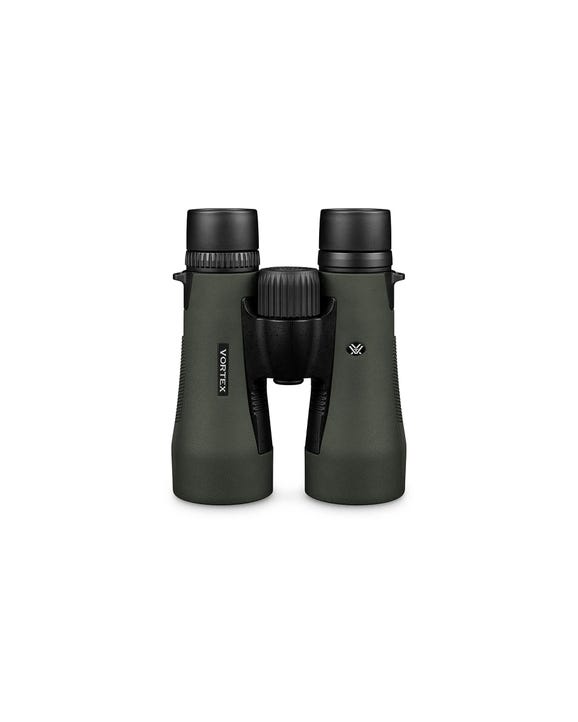
Do not select the 10x50 based on a vague “low-light” label alone. Compare the actual exit-pupil geometry, your steadiness, eye relief and weight ceiling, then try the view if possible. The current exact-page “Where to Buy” link does not verify retail stock. Its product photograph is linked from the model page and was archived as original bytes, but Vortex does not disclose whether it is a photograph or a rendering. The image’s 50 mm configuration is established by the exact DB-216 page and SKU document rather than image pixels.
Key specifications
Key details at a glance
| Magnification | 10× |
|---|---|
| Objective diameter | 50 mm |
| Real field of view | 6° |
| Eye relief | 17 mm |
| Exit pupil | 5 mm |
| Close focus distance | 6 ft |
More specifications and setup details
| Manufacturer-published weight | 30 oz |
|---|---|
| Phase coatings confirmed | Yes |
| Lens and prism coatings | Vortex lists fully multi-coated lenses, dielectric prism coatings, phase correction, ArmorTek exterior-lens protection and its HD Optical System. The exact page does not explicitly identify ED glass. |
| Water and fog protection | Vortex describes the exact HD model as waterproof, fogproof and shockproof, argon-purged and O-ring sealed. The page supplies no IP code, immersion depth or duration; underwater use is not established. |
| Tripod use | A tripod is not listed as included. Adapter availability is SKU-specific; exact DB-218 page/XVIEW list an adapter, other exact HD SKU box lists do not. |
| Published weight note | Manufacturer-listed instrument weight only; not independently measured and excludes carrying kit. |
| Manufacturer-rated waterproof | Yes |
| Built-in image stabilization confirmed | No |
| Integrated laser rangefinder | No |
| Onboard ballistic solution display | No |
| Tripod adapter in package | No |
Use the exact model’s instructions for operating limits, supplied equipment and version differences.
Sources for this review
Sources for this assessment
- Official Vortex U.S. exact product page, Vortex Diamondback HD 10x50, SKU DB-216
- Official Vortex SKU-specific DB-216 parts and in-box XVIEW sheet
- Official Vortex-linked Diamondback HD owner manual, page/in-box label M-00253-0; PDF footer M-00253-1
- Official Vortex gallery image linked from the exact DB-216 page; archived native product-image asset
- Official Vortex U.S. binocular category page 2, item 12; item manually matched to exact product page

Choose your optical trade-off first.
Choose viewing purpose first, then magnification, objective size, scene width and any fit, weather or mounting constraint. A direct-Sun requirement is separate: only exact manufacturer-confirmed solar binoculars can pass it.