
On this page
Your needs, this model
Does it fit your priorities?
Do you want 10x magnification in a 42 mm body?
The exact DB-215 page and XVIEW identify fixed 10x42. The 8x42 sibling is a different optical configuration.
Explore this need in the finder →Is a 21.5-ounce instrument ceiling acceptable?
DB-215 is listed at 21.3 oz, within 21.5 and not within 21.0. The cap is on the instrument, not the harness.
Explore this need in the finder →Do you need at least 15 mm stated eye relief?
DB-215 lists 15.0 mm. It meets 15, not 15.5 mm; try it with your own glasses.
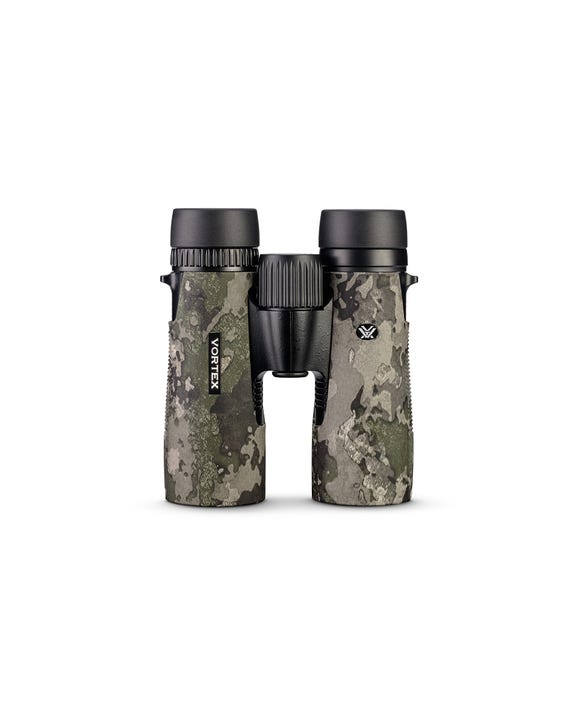
Explore this need in the finder →The Vortex Diamondback HD 10x42 (U.S. SKU DB-215) is a conventional middle ground: ten-power magnification, a 42 mm objective, a 330-foot field at 1,000 yards and a manufacturer-listed instrument weight of 21.3 ounces. It is neither a tiny travel binocular nor a large dusk-focused instrument. The reasons to choose it are the balance of a broad-enough real field, manageable carry and the exact package options tied to several 10x42 finish SKUs.
Ten power for reach, without an unusually narrow scene
At 10x, distant subjects look larger than in an 8x binocular, while the 6.3-degree real field is wider than the 10x50 DB-216’s 6 degrees and much wider than the 12x50 DB-217’s 5.2. That field can make it easier to sweep a trail edge or reacquire a bird after it moves. The 8x42 DB-214 is still the wider-scanning option at 7.5 degrees, with a slightly longer 17 mm eye relief and a 21.8-ounce listed weight. If your first priority is finding fast-moving birds rather than inspecting detail, that difference may favor 8x.
Vortex gives the DB-215 a five-foot close-focus distance, so it is more useful for nearby flowers or an insect on a branch than the 14-foot DB-218 15x56. The listed interpupillary range is 55–73 mm, a fit dimension rather than an assurance that every face will align comfortably. Fifteen millimeters of eye relief is shorter than the DB-214’s 17 mm and can be a limiting point for some glasses wearers. Use the eyecups in the manual’s prescribed position and check the complete field through your actual glasses before deciding.
Read the kit by SKU, not by family name
The plain DB-215 package lists the GlassPak binocular harness, comfort neck strap, tethered objective covers, rainguard and lens cloth. It does not list a tripod adapter. The exact manufacturer pages also show several 10x42 variants that share the 10x42 optical specification but differ in finish and supplied kit: DB-215-OBL is Mossy Oak Bottomland; DB-215-USA250 is an anniversary configuration with a special GlassPak package; DB-215-BRN is brown; and DBCAMO-205-3 is the TrueTimber VSX finish. The brown SKU page lists a GlassPak harness, while the TrueTimber page specifies a Deluxe Carrying Case. The Bottomland source sheet identifies a Mossy Oak manual and the anniversary sheet documents its own package. These are not separate optical-power recommendations, but a buyer should match the package and appearance to the exact SKU rather than assume one listing’s contents apply to all.
The ordinary DB-215 is described as tripod adaptable, but a compatible adapter is not in its box list. If mounted viewing is essential, establish the adapter model and compatibility before checkout. Do not confuse the adapter included with 15x56 DB-218 or anniversary accessories with this SKU’s kit.
Optical and weather claims
The exact page lists an HD Optical System, fully multi-coated lenses, dielectric prism coatings, phase correction and ArmorTek protection. It describes the body as argon-purged, O-ring sealed, waterproof, fogproof and shockproof. The manufacturer does not publish an IP rating, a submersion depth or duration, and its exact page does not explicitly claim ED glass. A shopper whose essential requirement is a published ED designation or immersion rating should treat that requirement as unconfirmed, not infer it from “HD” or weather-resistant wording. The binocular has center focus and adjustable eyecups; it is a passive optical device, with no battery or integrated laser rangefinder.
The shared Diamondback HD manual explains how to set eye spacing and the right-barrel diopter before using the center focus for distance changes. Its file is listed as M-00253-0 on the page and SKU sources but its footer says M-00253-1. The numerical 42 mm values match the manufacturer page, but the revision label remains a source discrepancy. The manual also includes a no-Sun warning and basic coated-lens care. Remove dust before wiping; a tethered cap does not protect exposed glass from gritty cleaning.
Who should shortlist the 10x42
This is a sensible starting candidate for general wildlife, travel and sports viewing if 10x magnification, a moderate 21.3-ounce body and the GlassPak harness suit you. It is easier to carry than the 10x50 or 15x56 while retaining more reach than 8x choices. Move to 8x42 for wider scanning and longer listed eye relief; move to 10x50 if the larger objective and 17 mm relief justify added mass; consider the 10x32 or 8x32 when pack size and weight matter more. A bright printed field number cannot predict comfort, so test focus, eyecup position and binocular fit.
Vortex’s product page routes to “Where to Buy,” which is not a stock check. The exact DB-215 photograph is a page-linked original; the manufacturer does not disclose photo-versus-render status. This assessment addresses exact U.S. SKUs and published specifications rather than personal ownership or lab results. Never point ordinary binoculars at the Sun.
Key specifications
Key details at a glance
| Magnification | 10× |
|---|---|
| Objective diameter | 42 mm |
| Real field of view | 6.3° |
| Eye relief | 15 mm |
| Exit pupil | 4.2 mm |
| Close focus distance | 5 ft |
More specifications and setup details
| Manufacturer-published weight | 21.3 oz |
|---|---|
| Phase coatings confirmed | Yes |
| Lens and prism coatings | Vortex lists fully multi-coated lenses, dielectric prism coatings, phase correction, ArmorTek exterior-lens protection and its HD Optical System. The exact page does not explicitly identify ED glass. |
| Water and fog protection | Vortex describes the exact HD model as waterproof, fogproof and shockproof, argon-purged and O-ring sealed. The page supplies no IP code, immersion depth or duration; underwater use is not established. |
| Tripod use | A tripod is not listed as included. Adapter availability is SKU-specific; exact DB-218 page/XVIEW list an adapter, other exact HD SKU box lists do not. |
| Published weight note | Manufacturer-listed instrument weight only; not independently measured and excludes carrying kit. |
| Manufacturer-rated waterproof | Yes |
| Built-in image stabilization confirmed | No |
| Integrated laser rangefinder | No |
| Onboard ballistic solution display | No |
| Tripod adapter in package | No |
Use the exact model’s instructions for operating limits, supplied equipment and version differences.
Sources for this review
Sources for this assessment
- Official Vortex U.S. exact product page, Vortex Diamondback HD 10x42, SKU DB-215
- Official Vortex SKU-specific DB-215 parts and in-box XVIEW sheet
- Official Vortex-linked Diamondback HD owner manual, page/in-box label M-00253-0; PDF footer M-00253-1
- Official Vortex gallery image linked from the exact DB-215 page; archived native product-image asset
- Official Vortex U.S. binocular category page 3, item 2; item manually matched to exact product page
- Official exact finish/package product page for covered DB-215 10x42 configuration DB-215-OBL
- Official exact finish/package product page for covered DB-215 10x42 configuration DB-215-USA250
- Official exact finish/package product page for covered DB-215 10x42 configuration DB-215-BRN
- Official exact finish/package product page for covered DB-215 10x42 configuration DBCAMO-205-3
- Official Vortex DB-215-USA250 SKU-specific XVIEW sheet for the 250th-anniversary package

Choose your optical trade-off first.
Choose viewing purpose first, then magnification, objective size, scene width and any fit, weather or mounting constraint. A direct-Sun requirement is separate: only exact manufacturer-confirmed solar binoculars can pass it.