
On this page
Your needs, this model
Does it fit your priorities?
Do you specifically prefer the extra enlargement of 10x in a 28 mm body?
DB-211 is the fixed 10x28 configuration; the manufacturer lists a 273-foot real field, narrower than the sibling 8x28.
Explore this need in the finder →Is a 13.5-ounce listed instrument weight your carry ceiling?
Vortex lists 13.3 oz for DB-211. It meets 13.5 oz and is 0.4 oz lighter than the 8x28 on published figures; that is instrument weight only.
Explore this need in the finder →Do you need at least 16 mm of stated eye relief?
The exact page lists 16.0 mm. That meets 16 mm but not 16.5 mm; test with your own glasses.
Explore this need in the finder →The Vortex Diamondback HD 10x28 (U.S. SKU DB-211) favors a little more magnification in a small 28 mm format. Its exact U.S. page lists a 5.1-degree real field (273 feet at 1,000 yards), 16 mm eye relief, six-foot close focus and a 13.3-ounce instrument weight. It is the lighter, narrower-viewing sibling to the 8x28—not a 10x42 substitute for someone prioritizing twilight viewing or an expansive scene.
More enlargement, less scene
Ten power makes a distant feature appear larger than the 8x28's eight power, which can help when identifying stationary details from a path, boat or viewing platform. The trade is immediately visible in the specification: Vortex gives the 10x28 a 273-foot linear field at 1,000 yards, compared with 332 feet for the 8x28. When a bird is moving or a subject is hidden in busy branches, the narrower field can make acquisition and reacquisition less forgiving. Higher power also makes small hand movements more apparent; neither model has confirmed built-in stabilization.
At 13.3 ounces the 10x28 is slightly lighter than the 8x28's listed 13.7 ounces, but weight should not decide this pair by itself. Both bodies are listed at 4.6 by 4.5 inches and have a 28 mm objective. The 10x28's exit pupil is 2.8 mm by straightforward division of the objective by magnification; that calculated geometry is not a measurement of delivered brightness. A 28 mm objective keeps the whole arrangement compact, but its limited aperture makes it a less natural choice for extended low-light observation than a larger objective, assuming you are willing to carry the larger binocular.
Eye relief and personal fit
The published 16 mm eye relief is shorter than the 8x28's 18 mm. If you wear glasses, that difference deserves a real fit check: twist the eyecups down as the manual recommends and look for a complete, comfortable field rather than treating millimeters as a guaranteed result. The manufacturer's interpupillary range is 57–73 mm, slightly narrower at the minimum than the 8x28's 55–72 mm. Those are adjustment ranges, not a complete measure of face fit. If one barrel's image seems shaded or the two images will not merge for you, another model is a better choice even if the headline power looks attractive.
Six feet of listed close focus supports nearby outdoor observation, not photography or microscope-style magnification. The center focus adjusts both barrels together after you set the right-eye diopter to your vision. Vortex's linked manual describes that sequence, then the remaining focus wheel can be used for different viewing distances. The same nine-page manual lists the 10x28 in its model specification table and gives a ±3 diopter range for this 28 mm configuration.
Weather claims, operation and maintenance
The manufacturer lists an HD Optical System, fully multi-coated lenses, dielectric prism coatings, phase correction and ArmorTek exterior-lens protection. These are stated design features, not independent comparative test results, and the page does not explicitly label this exact SKU as using ED glass. A strict ED requirement therefore remains unconfirmed. Vortex describes the instrument as argon-gas purged, O-ring sealed, waterproof, fogproof and shockproof, but does not give an IP rating, depth or time limit. This supports outdoor weather use; it is not an underwater specification.
For care, the manual advises removing dust or grit before wiping and using products designed for coated lenses. Its warning against viewing the Sun applies to ordinary binoculars like this one. The document is linked as M-00253-0 from the exact product page and included-items sheet, although the PDF footer reads M-00253-1; that manufacturer label mismatch is left unresolved rather than silently “corrected.”
Included kit and mounting limits
The exact-page list and DB-211-specific parts sheet show a soft 28 mm case, tethered objective covers, neck strap, rainguard, lens cloth and the Diamondback owner manual. They do not include a tripod adapter, even though the instrument has an adapter socket and is described as tripod adaptable. Confirm the separately sold adapter and fit before planning supported viewing. This package is case-based rather than the larger GlassPak harness arrangement listed on some full-size Vortex binoculars.
When to choose it instead
The DB-211 suits bright-day travel, sports and occasional long-distance viewing when compact carry and extra enlargement outweigh field width. Choose its 8x28 sibling if locating moving subjects, seeing more surrounding scene or longer stated eye relief matters more. Choose a larger 32 or 42 mm configuration if low-light use is an essential part of the brief, and compare your real carry tolerance rather than assuming a lighter front lens alone solves it. A 10x28 is not a shortcut around the narrower, more motion-sensitive view of higher power.
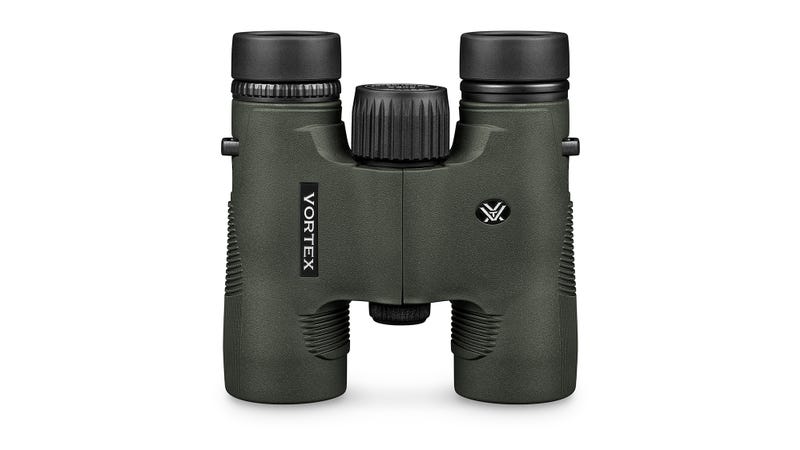
Its strongest case is therefore specific: you want 10x detail in a roughly 13-ounce, weather-protected instrument, you accept a 273-foot field, and the 16 mm eye relief works for your own eyes. It is a weak fit if 6 degrees of real field, at least 17 or 18 mm eye relief, a broad image for scanning, an ED label, an included tripod adapter or a larger low-light exit pupil is essential. The exact page currently routes to “Where to Buy,” which does not establish retailer inventory. The manufacturer-linked front photo is shared with the 8x28 and carries no power marking; the exact SKU is established by page and DB-211 sheet, not by the image itself. Vortex does not disclose photo-versus-render status. This is source-grounded analysis, not an ownership report or lab test.
Key specifications
Key details at a glance
| Magnification | 10× |
|---|---|
| Objective diameter | 28 mm |
| Real field of view | 5.1° |
| Eye relief | 16 mm |
| Exit pupil | 2.8 mm |
| Close focus distance | 6 ft |
More specifications and setup details
| Manufacturer-published weight | 13.3 oz |
|---|---|
| Phase coatings confirmed | Yes |
| Lens and prism coatings | Vortex lists fully multi-coated lenses, dielectric prism coatings, phase correction, ArmorTek exterior-lens protection and its HD Optical System. The exact model page does not explicitly identify ED glass. |
| Water and fog protection | Vortex describes the exact model as waterproof, fogproof and shockproof, argon-purged and O-ring sealed. It publishes no IP code, immersion depth or duration; underwater use is not established. |
| Tripod use | Vortex describes the binocular as tripod adaptable and the manual identifies a tripod-adapter socket. The exact SKU sheet does not include an adapter; adapter model/fit was not established from these materials. |
| Published weight note | Vortex-listed instrument weight only, not the case/strap system and not independently measured. |
| Manufacturer-rated waterproof | Yes |
| Built-in image stabilization confirmed | No |
| Integrated laser rangefinder | No |
| Onboard ballistic solution display | No |
| Tripod adapter in package | No |
Use the exact model’s instructions for operating limits, supplied equipment and version differences.
Sources for this review
Sources for this assessment
- Official Vortex U.S. exact product page, Vortex Diamondback HD 10x28, SKU DB-211
- Official Vortex SKU-specific DB-211 parts drawing and in-box XVIEW sheet
- Official Vortex-linked nine-page Diamondback HD operation manual; PDF footer M-00253-1 despite page/SKU filename M-00253-0
- Official Vortex front product gallery image linked from this exact SKU page; shared unmarked 28mm image
- Official Vortex U.S. binocular-category page 3, page 3, item 9; exact title and product URL manually reconciled

Choose your optical trade-off first.
Choose viewing purpose first, then magnification, objective size, scene width and any fit, weather or mounting constraint. A direct-Sun requirement is separate: only exact manufacturer-confirmed solar binoculars can pass it.