
On this page
Your needs, this model
Does it fit your priorities?
Do you want a fixed 10x42 rather than a different power or objective?
The exact page identifies Diamondback Classic 10x42 SKU D241; D5010 is a separate Classic 10x50.
Explore this need in the finder →Is the 24.4-ounce binocular within your carry cap?
The exact page lists 24.4 oz for the instrument. It meets 24.4 oz but not 24.3 oz; case and strap add mass.
Explore this need in the finder →Do you need at least 16 mm stated eye relief?
Exact page lists 16 mm, meeting 16 mm but not 16.5 mm; eyewear comfort remains an individual fit check.
Explore this need in the finder →The Vortex Diamondback Classic 10x42, U.S. SKU D241, is a distinct older-style configuration in Vortex’s Limited Distribution collection—not the Diamondback HD 10x42 and not the Classic 10x50 D5010. Its exact page lists a 345-foot field at 1,000 yards (6.6 degrees), 16 mm eye relief, five-foot close focus and a 24.4-ounce instrument weight.
A wide listed field for a ten-power pair
The 10x42 format is a practical middle ground for distant wildlife, travel and outdoor events: ten power brings more apparent reach than 8x, while a 42 mm objective remains smaller than a 50 mm instrument. The D241’s published 6.6-degree field is relatively broad for this magnification and passes a six-degree real-field requirement. The number does not say how the view performs at the edges or under changing light, and it should not be treated as an optical test result. If you follow quick-moving birds across a wide scene, compare an 8x42 as well; the Diamondback HD 8x42 lists a 7.5-degree field and 17 mm eye relief, though it is a different model and power.
The listed five-foot close focus allows nearer subjects than the six-foot minimum on the Crossfire HD 10x42 Approach GT. It still cannot focus closer than five feet by the published spec. The 57–73 mm interpupillary range may help you check whether the barrels can align for your eyes, but that measurement is not a comfort guarantee. At 24.4 ounces, the body is heavier than the 23-ounce Crossfire GT. The weight excludes the listed neck strap and case, so repeated neck carry may feel different from the bare-spec comparison.
Check eye relief and eye position
Vortex lists 16 mm eye relief for the D241. That is one millimeter more than the Crossfire GT’s 15 mm and one millimeter less than the Classic 10x50 D5010’s 19 mm. A millimeter on a specification sheet cannot predict the view through a particular pair of glasses; the shape of the eyecups, frame clearance and your eye position matter. If glasses fit is essential, try the exact instrument rather than inferring comfort from a published number.
The exact product page describes soft tapered eyecups, fully multi-coated optics, phase-corrected prisms, rubber armor, waterproof and fogproof construction. Those terms are not equivalent to an IP rating or a stated underwater depth and time. The page does not publish such numerical water limits, nor does it explicitly claim ED glass, dielectric coatings or a specific gas purge. Do not borrow more detailed claims from a similarly named Diamondback HD model. The D241 is passive optical viewing; no battery, stabilization or integrated rangefinder appears in the product description.
What arrives and how the manual helps
The exact D241 box list names a rainguard eyepiece cover, tethered objective covers, comfort neck strap and Deluxe custom-molded carry case. It does not list a tripod adapter, and the exact page does not establish a tripod-mounting plan. If a tripod is part of your essential use, ask Vortex about compatibility rather than applying an adapter claim from a sibling model.
The D241 page links the same five-page Diamondback Classic manual previously archived from the exact D5010 page. That shared manual covers eyecup and interpupillary adjustment, center focus and diopter setup, lens care and a direct-Sun warning; it does not supply the D241’s numeric specifications. The page also does not publish the diopter’s numeric range. Use the exact product page for the 10x42 measurements and the manual for basic operating and care procedures. Do not point this ordinary binocular at the Sun.
How it differs from the Classic 10x50
The two Classics answer different carry and viewing priorities. D241 is 10x42, 345 feet/6.6 degrees, 16 mm eye relief, five-foot close focus and 24.4 ounces. The separately listed D5010 is 10x50, 283 feet/5.4 degrees, 19 mm eye relief, nine-foot close focus and 31 ounces. The larger D5010 has a larger calculated exit pupil, but that geometric value alone is not a measured brightness comparison. Choose D241 when a lighter body, a wider listed field or the nearer focus limit matters; consider D5010 only if its 50 mm format and longer published eye relief justify its weight and narrower field for your use. Neither Limited Distribution listing proves a retailer has stock today.
When this model makes sense
Shortlist the D241 if a published 6.6-degree field and five-foot close focus suit your outings, 16 mm eye relief is enough for you in person, and a 24.4-ounce binocular is an acceptable carry. It matches 10x and 42 mm requirements, and it is explicitly described as waterproof and fogproof, but it cannot meet a 16.5 mm eye-relief minimum or a 24-ounce maximum-weight cap. Vortex currently directs the Limited Distribution page to “Where to Buy”; that is not a verified local inventory or a price quote. Compare it directly with the Crossfire HD Approach GT 10x42: the GT is lighter and includes a GlassPak harness, while the Classic lists a slightly wider field, a one-foot closer focus and one millimeter more eye relief.
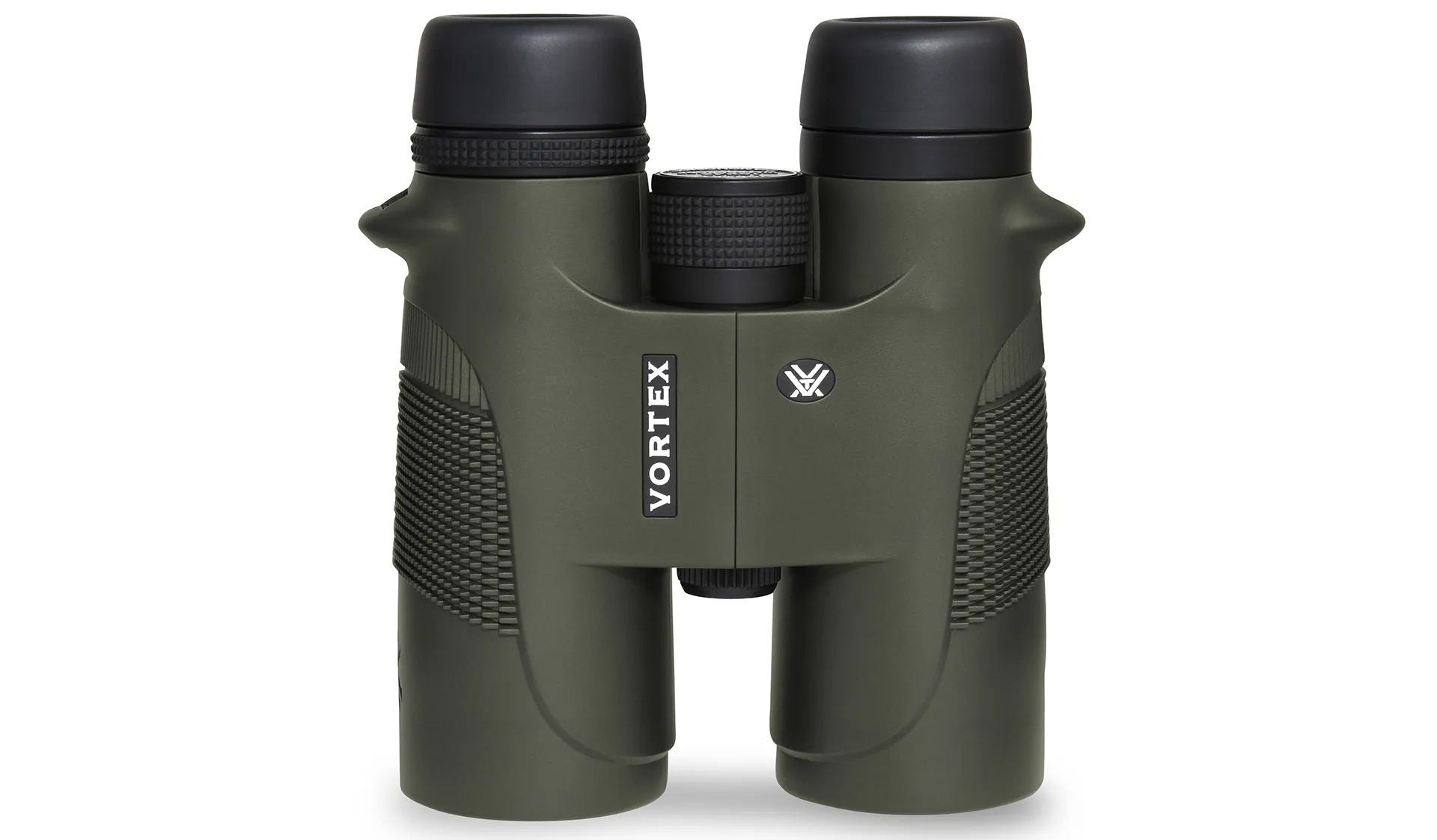
The original manufacturer image linked from the exact D241 page shows an olive-green Diamondback-marked binocular. Pixels do not establish the 10x42 power or D241 SKU, and Vortex does not identify the image as photograph or rendering. This is a source-based assessment, not personal ownership or laboratory testing.
Manufacturer source: exact Diamondback Classic 10x42 D241 product page; the page links the already archived Diamondback Classic owner manual.
Key specifications
Key details at a glance
| Magnification | 10× |
|---|---|
| Objective diameter | 42 mm |
| Real field of view | 6.6° |
| Eye relief | 16 mm |
| Exit pupil | 4.2 mm |
| Close focus distance | 5 ft |
More specifications and setup details
| Manufacturer-published weight | 24.4 oz |
|---|---|
| Phase coatings confirmed | Yes |
| Lens and prism coatings | Exact page lists fully multi-coated optics and phase-corrected prisms; ED, dielectric and gas-purge claims are not explicitly stated. |
| Water and fog protection | Exact Classic page describes waterproof/fogproof construction and rubber armor but provides no IP code or numerical immersion limit; gas-purge method is not specified. |
| Tripod use | Exact page does not establish tripod compatibility or list an adapter; do not plan supported use without confirmation. |
| Published weight note | Manufacturer-listed instrument weight; excludes case and neck strap; not independently measured. |
| Manufacturer-rated waterproof | Yes |
| Built-in image stabilization confirmed | No |
| Integrated laser rangefinder | No |
| Onboard ballistic solution display | No |
| Tripod adapter in package | No |
Use the exact model’s instructions for operating limits, supplied equipment and version differences.
Sources for this review
Sources for this assessment
- Official Vortex exact U.S. product page for Diamondback Classic 10x42, SKU D241; Limited Distribution
- Official Vortex Limited Distribution page 9, item 9, SKU D241
- Official Diamondback Classic manual linked from D241 page; reused from exact D5010 archive, printed footer BIN-DBK-12A
- Official Vortex product image linked from exact U.S. page; original downloaded and visually inspected

Choose your optical trade-off first.
Choose viewing purpose first, then magnification, objective size, scene width and any fit, weather or mounting constraint. A direct-Sun requirement is separate: only exact manufacturer-confirmed solar binoculars can pass it.