
On this page
Your needs, this model
Does it fit your priorities?
Do you want a fixed 8x42 with a 7.5-degree published scene?
The exact U.S. page and SKU sheet identify Vortex Crossfire HD 8x42 (CF-4311) as a fixed 8x42 configuration.
Explore this need in the finder →Does the 17 mm stated eye-relief figure and 23.8-ounce instrument limit fit your requirements?
Vortex lists 17.0 mm eye relief and 23.8 oz instrument weight; the case and harness add to the carry system, and the number does not guarantee your personal glasses fit.
Explore this need in the finder →Must tripod-adapter compatibility be confirmed, or must the adapter actually be included?
The exact page confirms tripod adaptability, but the listed package does not include an adapter. It meets a confirmed-support need only when a separate adapter is acceptable; it does not meet an adapter-in-the-box requirement.
Explore this need in the finder →The Vortex Crossfire HD 8x42, U.S. model CF-4311, is the wide-scanning member of this four-size family. Vortex lists a 7.5-degree real field (393 feet at 1,000 yards), 17 mm eye relief, a six-foot close-focus distance and a 23.8-ounce instrument weight. This is a source-based assessment of those published details and the linked family instructions, not a hands-on optical test.
Why choose 8x42 instead of 10x or 12x?
Eight power gives up some apparent reach compared with the 10x42 and 12x50 versions, but the quoted real field is the widest of the four: 393 feet at 1,000 yards, or 7.5 degrees. That broader scene can make it easier to scan habitat, reacquire a moving subject, or take in a large view without moving the binocular as much. The product page does not establish that the image is brighter or sharper than a competing pair; those outcomes depend on more than magnification and objective diameter. The useful decision is simpler: if finding and following subjects is more important than maximizing apparent size, the 8x choice has a sensible specification advantage.
The field also clears the finder’s six-degree broad-scene threshold, whereas the 12x50’s 5.2-degree field does not. It does not meet a seven-degree minimum. Compare the 10x42 if you favor a little more reach and can accept a 6.2-degree, 325-foot field. On the published figures, this 8x42 is 0.8 ounce heavier than the standard 10x42, so do not assume that lower power automatically means a lighter instrument.
Fit, close focus and carry weight
Vortex lists 17 mm of eye relief and an interpupillary range of 57–74 mm. The family manual describes twist-up eyecups and setting the interpupillary distance until the view becomes one circular image. These numbers can filter a shortlist, but they cannot guarantee that glasses users will see the full field comfortably: frame shape, eye position and facial fit matter. If glasses are essential, try the actual binocular with the glasses you wear rather than relying on the printed relief figure.
The six-foot close-focus figure is shared across all four Crossfire HD sizes. It is not a close-up specialist’s 2- or 3-foot limit; choose a product with a shorter published minimum if viewing nearby details is central to your use. At 23.8 ounces, CF-4311 is a full-size pair rather than a pocket optic. The weight is the binocular alone; the GlassPak case and harness, neck strap and other included pieces add to what you carry.
Optics and weather claims in context
Vortex describes an HD optical system using selected glass elements, fully multi-coated lenses, a true open hinge and adjustable eyecups. The manufacturer says the selected elements are intended to reduce chromatic aberration and improve color fidelity, edge-to-edge sharpness and light transmission. Those are manufacturer descriptions, not measurements from an independent comparison. The page does not identify this exact configuration as using ED glass or confirm phase-correction treatment; neither term should be inferred from “HD” or “fully multi-coated.”
The exact page says the binocular is nitrogen-purged and O-ring sealed and labels it waterproof, fogproof and shockproof. No IP code or numeric immersion depth and duration appears in the reviewed sources. Treat the environmental language as a product claim, not permission to submerge the binocular, pressure-wash it or expose it to conditions beyond its instructions. The model is a passive optical instrument with no battery, image stabilization or integrated rangefinder.
Package, mounting and care
The listed box contents are a GlassPak binocular harness and case, comfort neck strap, tethered objective covers, rainguard and lens cloth. They address carrying and basic protection, but the page’s 23.8-ounce figure does not include that kit. CF-4311 is tripod adaptable, yet a tripod adapter is not in the listed package; budget and verify the separate compatible adapter if hands-free support is essential. A tripod itself is not listed as included.
The family manual explains center focusing, then setting the right-eye diopter, adjusting the eyecups and spacing, attaching the tether straps, and cleaning coated lenses. It advises blowing grit away before wiping and using products intended for coated optical surfaces. Its safety warning is unambiguous: these ordinary binoculars are not intended for looking at the Sun or another intense light source. Use dedicated solar-viewing equipment for that task.
Who should shortlist the CF-4311?
Choose this exact 8x42 if broad scene coverage, 17 mm listed eye relief and the familiar full-size format matter more than 10x reach. It passes a six-degree field requirement, a 17 mm eye-relief floor and a 23.8-ounce ceiling, but fails a 23-ounce cap and a seven-degree field minimum. For more magnification in a 42 mm body, compare CF-4312; for a larger objective with 10x power, the CF-4313 carries a notably higher listed weight. A 12x50 is the more specialized distant-detail option, with a narrower published field and more demanding steadiness needs.
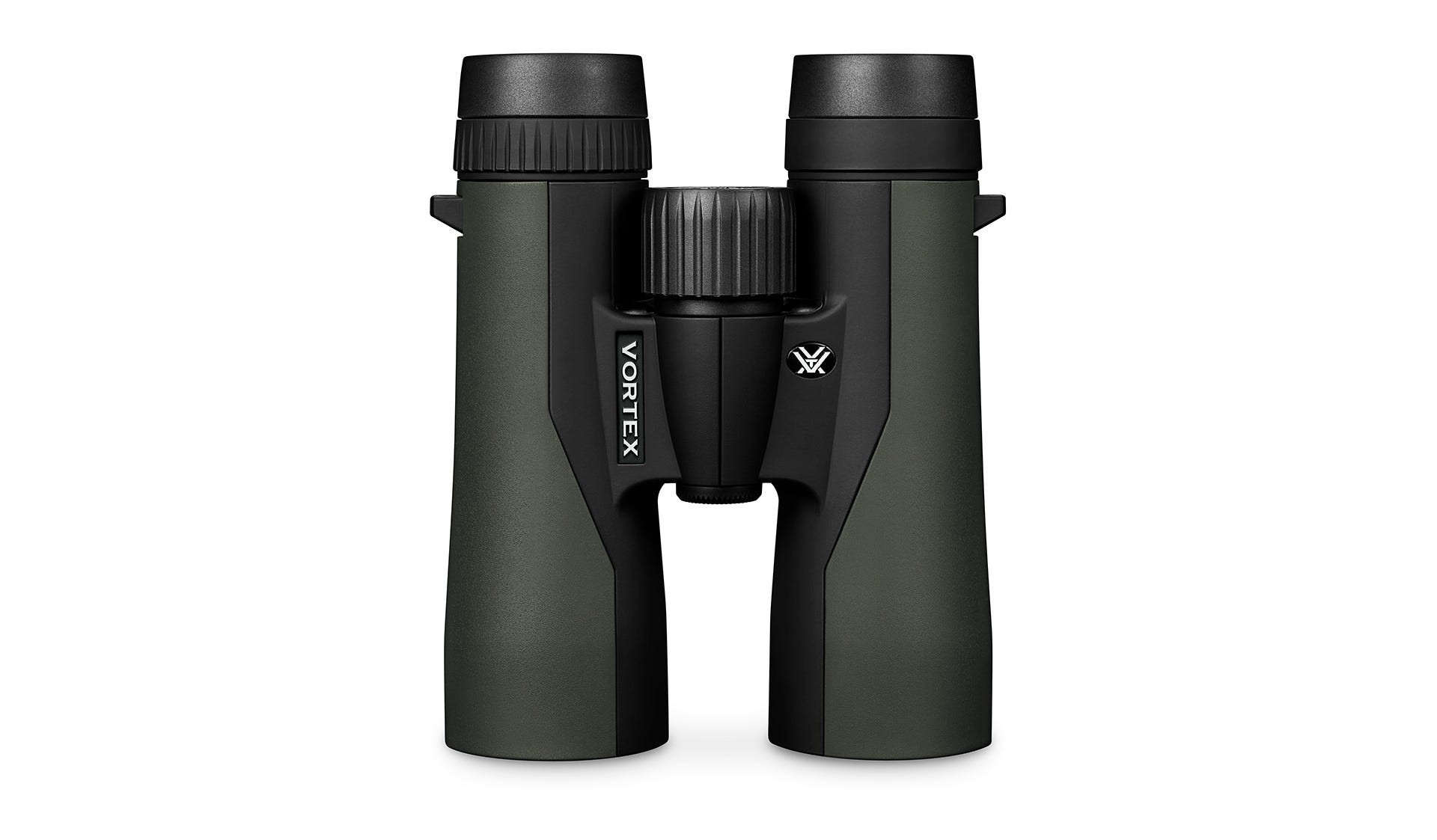
The standard green-and-black product image is linked from the exact CF-4311 page, but the same image bytes are used on the CF-4312 page and the picture does not reveal the power marking. The manufacturer does not disclose whether it is a photograph or rendering. SKU and magnification therefore come from the exact product documentation, not visual guesswork. Vortex lists CF-4311 in its current U.S. Crossfire HD family; that does not establish a retailer’s live stock or price. The assessment does not claim ownership, field testing or a measured performance result.
Manufacturer sources: Crossfire HD 8x42 product page, its CF-4311 specification sheet and the linked Crossfire HD manual.
Key specifications
Key details at a glance
| Magnification | 8× |
|---|---|
| Objective diameter | 42 mm |
| Real field of view | 7.5° |
| Field width at 1,000 m | 119.8 m |
| Eye relief | 17 mm |
| Close focus distance | 6 ft |
More specifications and setup details
| Manufacturer-published weight | 23.8 oz |
|---|---|
| Lens and prism coatings | Exact Vortex page identifies fully multi-coated lenses. It does not confirm ED glass or phase treatment for this SKU. |
| Water and fog protection | Manufacturer page says nitrogen-purged and O-ring sealed and uses waterproof/fogproof/shockproof language. No numeric IP/depth/duration is provided; do not infer submersion limits. |
| Tripod use | Exact product page says tripod adaptable; a tripod adapter is not listed in the included package. Confirm the separate compatible adapter if support is essential. |
| Published weight note | Vortex-listed instrument-only ounces; case, harness and included accessories add carry weight. No independent weighing was performed. |
| Manufacturer-rated waterproof | Yes |
| Built-in image stabilization confirmed | No |
| Integrated laser rangefinder | No |
| Onboard ballistic solution display | No |
| Tripod adapter in package | No |
Use the exact model’s instructions for operating limits, supplied equipment and version differences.
Sources for this review
Sources for this assessment
Choose your optical trade-off first.
Choose viewing purpose first, then magnification, objective size, scene width and any fit, weather or mounting constraint. A direct-Sun requirement is separate: only exact manufacturer-confirmed solar binoculars can pass it.