
On this page
Your needs, this model
Does it fit your priorities?
Do you want a fixed 10x50 rather than a 10x42 or 12x50?
The exact U.S. page and SKU sheet identify Vortex Crossfire HD 10x50 (CF-4313) as a fixed 10x50 configuration.
Explore this need in the finder →Does the 17 mm stated eye-relief figure meet your floor, and is 30.4 oz within your instrument-only ceiling?
Vortex lists 17.0 mm eye relief and 30.4 oz instrument weight; the case and harness add to the carry system, and the number does not guarantee your personal glasses fit.
Explore this need in the finder →Must tripod-adapter compatibility be confirmed, or must the adapter actually be included?
The exact page confirms tripod adaptability, but the listed package does not include an adapter. It meets a confirmed-support need only when a separate adapter is acceptable; it does not meet an adapter-in-the-box requirement.
Explore this need in the finder →The Vortex Crossfire HD 10x50, SKU CF-4313, keeps the family’s 10x magnification but moves to a 50 mm objective. The exact U.S. page lists a 6.1-degree real field (320 feet at 1,000 yards), 17 mm eye relief, six-foot close focus, 60–76 mm interpupillary distance and 30.4-ounce instrument weight. The larger objective is a format choice, not a guarantee of a brighter observed image.
What changes from the 10x42?
Magnification remains 10x, so the two versions are easier to compare than a change from 8x to 12x. The 50 mm model lists 17 mm eye relief rather than 15 mm on CF-4312 and shifts the interpupillary range from 58–75 mm to 60–76 mm. Its published field narrows slightly, from 325 feet to 320 feet at 1,000 yards, equivalent to 6.1 rather than 6.2 degrees. These are modest differences on paper; face and eyeglass fit still need an in-person check.
Carry weight is the major practical separation. CF-4313 is listed at 30.4 ounces, 7.4 ounces above the 23.0-ounce 10x42, before either case or harness is added. The body is also listed as 6.7 by 5.3 inches rather than 6.0 by 5.2. Choose the 10x42 if your pack-weight ceiling is strict. Consider the 10x50 if the larger objective and longer stated eye relief are relevant enough to justify a bulkier instrument. The manufacturer does not quantify a low-light advantage in a way that establishes a performance guarantee for your eyes, lighting or conditions.
Field, stability and close focus
The 6.1-degree field clears the finder’s six-degree broad-scene option, but only narrowly, and does not reach seven degrees. The 8x42 is the better-spec’d starting point if fast scanning is the top priority; it lists 7.5 degrees, or 393 feet at 1,000 yards. Higher magnification gives the subject more apparent size, but it also makes movement from hands more apparent. Ten power is still a common handheld format, yet steadiness and viewing duration are personal; the model page does not provide stabilization.
Vortex lists a six-foot close focus. This is the same limit shown for all four sizes and rules out a short-focus requirement of five feet. The 17 mm stated eye relief is useful when comparing glasses-friendly candidates, but it is not a personal comfort test. Use the manual’s twist-up eyecups and interpupillary adjustment, then decide based on whether your full view remains visible with your usual glasses.
Optical and environmental claims
The product page describes an HD Optical System with selected elements, fully multi-coated lenses, a true open hinge, center focus and adjustable eyecups. It claims the glass elements are optimized to reduce chromatic aberration and improve color fidelity, edge-to-edge sharpness and light transmission. Treat that as the manufacturer’s account of design intent rather than independent measurement. The exact listing does not confirm ED glass or phase-correcting prism treatment. “HD” and “fully multi-coated” are not substitutes for those more specific disclosures.
Vortex lists nitrogen purging and O-ring sealing and describes the binocular as waterproof, fogproof and shockproof. No IP code, water depth or test duration is provided in the reviewed sources. Waterproof language does not mean underwater use or a safe washdown; follow the manual and keep the lens surfaces clean with products intended for coated optics. CF-4313 is a passive optical model, without a battery, integrated laser rangefinder or stabilization system.
Mounting, included pieces and manual
The exact page calls the binocular tripod adaptable. The adapter is not among the listed in-box pieces, so distinguish compatibility from what is supplied. If you want a supported position, plan for a separately sourced adapter and check its fit; if you need an adapter included with the unit, this package is not confirmed to satisfy that need. The page lists a GlassPak case and harness, comfort neck strap, tethered objective covers, rainguard and lens cloth. The 30.4-ounce figure applies to the binocular itself, not to the entire carry kit.
The shared Crossfire HD manual includes a table for CF-4313, explaining its 10x50 field, 17 mm relief, six-foot close focus, 60–76 mm IPD, 6.7 by 5.3 inch dimensions and 30.4-ounce mass. It explains focusing the left barrel with center focus and then setting the right-eye diopter, as well as the eyecups, straps, tethers, lens cleaning and storage. It cautions against viewing the Sun through ordinary binoculars. The product page’s linked filename discrepancy is preserved in the source notes: one link says M-00252-0 while the identical PDF’s printed footer is M-00402-0.
Who should choose CF-4313?
This is a sensible candidate if you have decided on 10x power, value the 50 mm size and 17 mm stated eye relief, and do not have a carry cap below 30.4 ounces. It fails a 30-ounce instrument limit, a seven-degree field requirement and an included-adapter requirement; it meets the six-degree field choice and 17 mm eye-relief floor. Compared with CF-4314, it offers 10x rather than 12x and a wider listed field (6.1 vs 5.2 degrees), while weighing 0.9 ounce more on the manufacturer’s figures. That small listed mass difference should not outweigh the large change in power and field if broad scanning is more important.
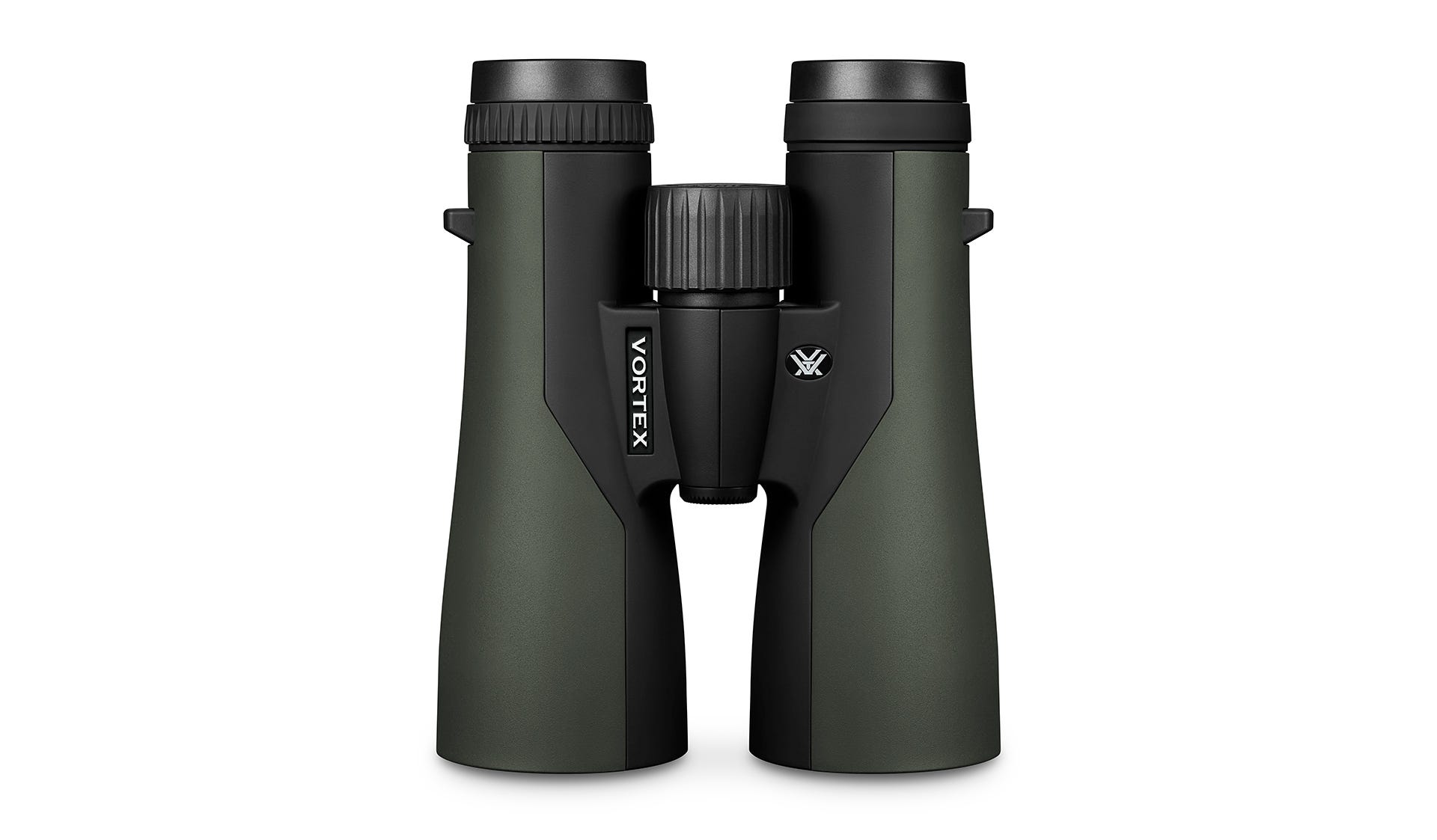
The standard 50 mm image linked from CF-4313 is identical to the image Vortex links from CF-4314 and does not visibly establish magnification. Its exact page and SKU sheet provide that identity; Vortex does not say if the image is a photograph or rendering. The official current-family page records this size, but not live retail stock or price. This review compares manufacturer material and offers no personal test or measured brightness judgment.
Manufacturer sources: Crossfire HD 10x50 product page, its CF-4313 specification sheet and the linked Crossfire HD manual.
Key specifications
Key details at a glance
| Magnification | 10× |
|---|---|
| Objective diameter | 50 mm |
| Real field of view | 6.1° |
| Field width at 1,000 m | 97.5 m |
| Eye relief | 17 mm |
| Close focus distance | 6 ft |
More specifications and setup details
| Manufacturer-published weight | 30.4 oz |
|---|---|
| Lens and prism coatings | Exact Vortex page identifies fully multi-coated lenses. It does not confirm ED glass or phase treatment for this SKU. |
| Water and fog protection | Manufacturer page says nitrogen-purged and O-ring sealed and uses waterproof/fogproof/shockproof language. No numeric IP/depth/duration is provided; do not infer submersion limits. |
| Tripod use | Exact product page says tripod adaptable; a tripod adapter is not listed in the included package. Confirm the separate compatible adapter if support is essential. |
| Published weight note | Vortex-listed instrument-only ounces; case, harness and included accessories add carry weight. No independent weighing was performed. |
| Manufacturer-rated waterproof | Yes |
| Built-in image stabilization confirmed | No |
| Integrated laser rangefinder | No |
| Onboard ballistic solution display | No |
| Tripod adapter in package | No |
Use the exact model’s instructions for operating limits, supplied equipment and version differences.
Sources for this review
Sources for this assessment
Choose your optical trade-off first.
Choose viewing purpose first, then magnification, objective size, scene width and any fit, weather or mounting constraint. A direct-Sun requirement is separate: only exact manufacturer-confirmed solar binoculars can pass it.