
On this page
More fixed power with a slightly lighter stabilized body
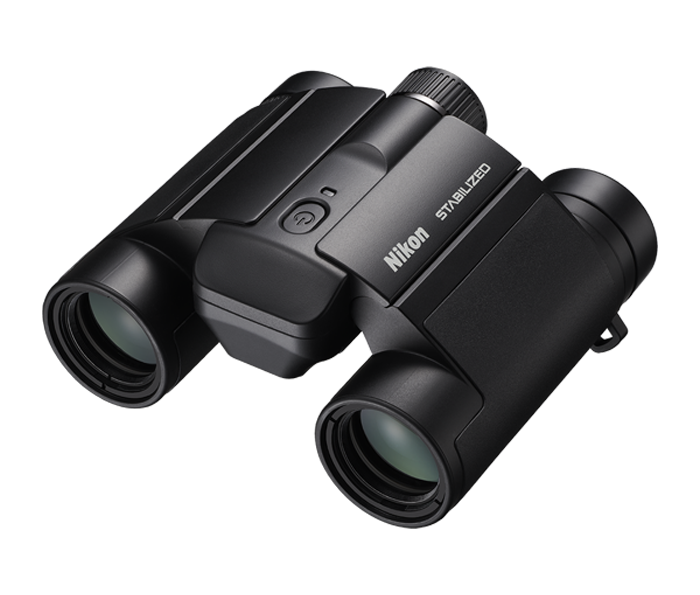
The STABILIZED 12x25 S is the higher-power sibling, with a 4.5° real field, 12.3 mm eye relief and a 13.9 oz body before the required two AA cells. Its narrower field and shorter stated eye relief are part of the tradeoff; Nikon also limits this exact model to dry-weather use.
Explore the needs this model fits
Your needs, this model
Does it fit your priorities?
Does Nikon offer a 12x option in this powered stabilized 25 mm family?
Yes. The STABILIZED 12x25 S is the higher-power model, with a 4.5° real field and 236 ft at 1,000 yd. It includes the same optical lens-shift stabilization system, but frames a narrower real scene than 10x25.
Explore this need in the finder →Will the 12x25 S meet a minimum eye-relief requirement of 12 mm?
Its published 12.3 mm figure meets that numeric minimum. This does not guarantee full-field viewing through a particular pair of glasses; compare the 10x25 S if you need more stated eye relief.
Explore this need in the finder →Can this stabilized compact meet a waterproofing requirement?
No. Nikon specifies a non-waterproof body and says to keep it dry. The powered stabilization feature does not make it suitable for rain or spray.
Explore this need in the finder →The Nikon STABILIZED 12x25 S is a pocket-scale binocular built around one specific priority: making a 12x handheld view easier to follow through powered optical stabilization. It uses the same 25 mm objectives and stabilization system as the 10x25 S, but its higher magnification brings a tighter real field, a smaller exit pupil and less eye relief. Consider it when a distant subject needs more apparent size.
Higher power, narrower scene
Nikon lists a 4.5° real field for the 12x25, or 236 feet across at 1,000 yards. Its apparent field is 50.5°. The matching 10x25 gives a wider 5.4° real field and 283 feet at the same distance while sharing the same apparent-field figure. The practical consequence is that the 12x can make a far-off bird, sign or landmark look larger, but you see less of the surrounding scene and have to aim more precisely. Finding a subject that moves between glances may take more practice than with the 10x model.
Stabilization is relevant here because hand movement is more visible at 12x than at lower power. The optical lens-shift mechanism is activated by pressing the power button. Nikon states that its test standard shows approximately 80% reduction in image shake from sinusoidal hand movement, within a functional angle range of −80° to +80°. That published claim is not a guarantee of perfect steadiness or a promise of sharper detail; it is not an independent comparison.
Compact optics still have compact-light limits
The 12x25 has a 2.1 mm exit pupil and a relative-brightness index of 4.4; the 10x25 has a 2.5 mm exit pupil and index of 6.3. Those figures do not predict every observer’s experience, but they show the optical compromise: increasing magnification while keeping a 25 mm objective reduces the exit pupil. Stabilization can calm apparent movement; it cannot gather more light. For evening birding, shaded woodland or a relaxed view during changing light, a larger objective binocular is likely to be a more sensible comparison than either pocket STABILIZED model.
The listed eye relief is 12.3 mm, shorter than the 10x25 S’s 14 mm. Glasses wearers should treat that as a fit warning rather than a pass/fail guarantee. The shared instruction manual says the eyecups have four positions, with full retraction intended for eyeglass use and full extension for viewing without glasses; two click stops are available between. It also describes setting interpupillary distance until the view becomes one circle, focusing the left eye with the center focusing ring and the right eye with a separate diopter-adjustment ring. Those setup controls matter, but they cannot make a short stated eye-relief figure work with every frame.
Battery and weather conditions are part of the choice
The 12x25 weighs 395 g (13.9 oz) without batteries and measures 100 mm long, 117 mm wide and 56 mm deep in Nikon’s specification table. It is 10 g lighter than the 10x25 bare, but both require two AA batteries to operate stabilization. Nikon permits AA alkaline or rechargeable Ni-MH cells and estimates approximately 12 hours of continuous alkaline operation at 20°C. The manual warns that runtime varies with environment and that the batteries supplied with the binocular are only intended for operation checks, so bring replacements for an important outing. Automatic shutoff occurs after approximately 60 minutes. The manual also says to switch off before removing batteries and to take them out when storing the instrument for an extended period.
The most decisive limitation is water. Nikon’s specification table states “Non-waterproof,” and the manual says to keep the binocular dry. Do not choose this model for rain, spray or a wet-weather route merely because it is an outdoor optic. Nikon does not establish a fogproof rating in the reviewed source set, so that detail remains unknown. The manufacturer’s listed items supplied are the binocular, eyepiece cap, strap, drawstring bag and two AA alkaline batteries; the note about short-lived test cells applies. No tripod compatibility or adapter is established in the inspected sources, so the recommended use here is handheld and dry.
Choosing between this and the 10x25 S
Stay with the 12x25 if viewing distant, relatively stationary subjects is your recurring need and the smaller scene is acceptable. It offers 20% more nominal magnification than 10x, but that does not mean 20% more useful information: focus, atmospheric conditions, target movement and how well the view fits your eyes all matter. Pick the 10x25 instead if you want a broader scene, a larger exit pupil and a little more eye relief. It is the easier starting point for general scanning and glasses fit, while the 12x is a narrower tool for users who value a tighter view.
If weather resistance and passive operation matter more than powered stabilization, compare a conventional waterproof compact such as the Nikon TRAILBLAZER II 10x25. That model is not an optical match—it has a different field, body and eye relief—but its weather sealing changes where it can be used. If brighter viewing or more comfortable glasses fit outrank pocket size, move up to a 30 mm or 42 mm design and check its exact weight and eye relief. The right alternative is determined by which limitation you cannot accept.
Verdict
The STABILIZED 12x25 S is a compact solution for a narrow combination of needs: 12x reach with a powered hand-shake reduction system in a dry-weather instrument. It is not an all-weather pocket binocular, and its small exit pupil, 4.5° real field and 12.3 mm eye relief can be poor fits for dusk, fast scanning or glasses. Consider the 10x25 sibling first unless the additional magnification is a clear priority. This review interprets Nikon’s published specification and shared manual; it does not represent a personal field trial or a laboratory test. See Nikon’s STABILIZED 12x25 S product page and the shared instruction manual.
Key specifications
Key details at a glance
| Magnification | 12× |
|---|---|
| Objective diameter | 25 mm |
| Real field of view | 4.5° |
| Apparent field of view | 50.5° |
| Field width at 1,000 m | 79 m |
| Eye relief | 12.3 mm |
More specifications and setup details
| Exit pupil | 2.1 mm |
|---|---|
| Close focus distance | 9.8 ft |
| Manufacturer-published weight | 13.9 oz |
| Lens and prism coatings | The inspected sources do not confirm ED glass, phase correction, dielectric coating or multi-coating for this exact model; those details remain unknown. |
| Water and fog protection | Nikon’s model specifications say Non-waterproof and the manual says keep dry. A fogproof rating is not stated in the inspected sources; it remains unknown. |
| Published weight note | Nikon publishes 395 g / 13.9 oz without batteries. Two AA cells are required for stabilization, so this is not the complete powered carry weight. |
| Package contents | The manual lists the binocular, eyepiece cap, strap, drawstring bag and two AA alkaline batteries. Retailer-specific bundles are not established by this manufacturer manual; do not infer additional accessories from product photography. |
| Manufacturer-rated waterproof | No |
| Built-in image stabilization confirmed | Yes |
| Image-stabilization method | Optical lens shift |
| Power source | Two AA-size alkaline (LR6) or rechargeable Ni-MH cells |
| Approximate battery runtime | 12 h |
| Batteries required to power stabilization | Yes |
Use the exact model’s instructions for operating limits, supplied equipment and version differences.
Sources for this review
Sources for this assessment
- Nikon USA exact US STABILIZED 12x25 S product page, product 16783
- Nikon US binocular catalogue filtered to Stabilization; page displays the current 10x25 S and 12x25 S rows
- Nikon US STABILIZED series announcement and specifications
- Nikon global STABILIZED 10x25 S / 12x25 S family page
- Nikon STABILIZED 10x25 S / 12x25 S instruction manual (292-page multilingual PDF; English pp. 18–38)
- CPSC exact ProductName recall query for STABILIZED 12x25 S
Choose your optical trade-off first.
Choose viewing purpose first, then magnification, objective size, scene width and any fit, weather or mounting constraint. A direct-Sun requirement is separate: only exact manufacturer-confirmed solar binoculars can pass it.
Your needs, this model
Compact binoculars with image stabilization
Choose it when: Choose the 12x25 S if more fixed magnification and a slightly lower instrument-body mass are the preferred tradeoff. Nikon confirms image stabilization for this exact model as well as for the 10x sibling.
Compact binoculars with image stabilization →Choosing 12x binoculars: stabilization or a larger objective
Choose it when: Choose this exact 12x25 when built-in stabilization in a compact body is a central requirement. Its 4.5° real field and 12.3 mm eye relief are published specifications; its body mass excludes the two AA cells required for stabilization.
Choosing 12x binoculars: stabilization or a larger objective →