
On this page
Your needs, this model
Does it fit your priorities?
Does the P7 10x50 give the wider real scene in this four-model group?
Yes. Nikon lists a 6° real field, 105 m at 1,000 m, 55.3° apparent field, 5 mm exit pupil and 19.3 mm eye relief. The P7 12x50 raises magnification to 12x but its real field is 5.6° and eye relief 16.4 mm.
Explore this need in the finder →Does this exact P7 10x50 have a locking diopter ring?
Yes. The US product page confirms the lock. It is a feature that can help retain a chosen diopter setting; it is not image stabilization and does not guarantee the setting never needs checking.
Explore this need in the finder →Can I count on ED glass or a tripod adapter being in the standard package?
Neither is safe to assume. The P7 US sources reviewed do not establish ED glass, and the optional TRA-3 is not confirmed as a box item. The finder treats both essential requirements as unknown rather than a yes.
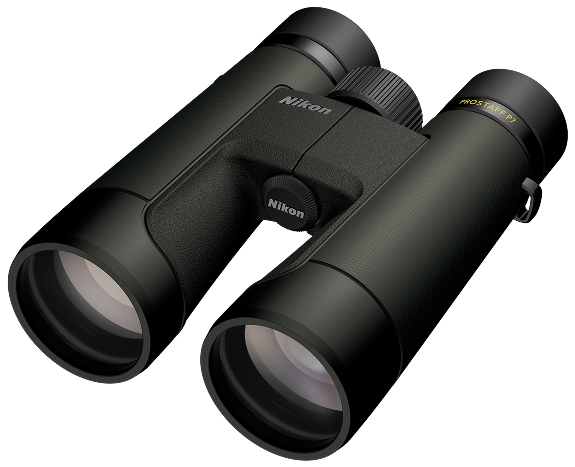
Explore this need in the finder →The PROSTAFF P7 10x50 is the group’s lighter 10x option: 22.2 oz by Nikon’s corrected published figure, with a 6° real field, 19.3 mm eye relief and a locking diopter ring. It is worth considering for scanning and glasses fit, or when those P7 handling features matter more than an ED-glass specification that Nikon does not establish for this exact 50 mm model.
Why this 10x model is easier to scan on paper
Nikon lists 105 metres at 1,000 metres and a 6° real field. The P7 12x50 keeps a 50 mm objective but the field becomes 98 metres and 5.6°; its higher magnification also makes hand movement more visible. The 10x P7 provides a 55.3° apparent field, compared with 60.8° for the 12x. Thus the 10x captures a wider actual scene, while the 12x presents a more expansive-looking view through the eyepiece. For someone searching a tree line or shifting between moving birds, real scene width may be the more useful starting point.
At 10x, the exit pupil is 5 mm and the stated eye relief 19.3 mm. Those values can make the eye position a more forgiving place to start than the 12x figure of 4.2 mm and 16.4 mm. They cannot guarantee a comfortable image: glasses, eyecups, face shape and how well the barrels meet your eyes still matter. If you rely on glasses, test the model with the pair you actually wear.
P7’s confirmed handling features
The standout practical distinction is the locking diopter ring. The exact P7 50 mm manual gives the operating sequence: focus the left eye with the center wheel, extend the right eyecup and diopter ring to release the lock, pull the ring up to adjust the right eye, then push it down to lock. This protects the setting from accidental rotation; it does not freeze central focus for every subject or choose the right setting for a new observer.
Nikon also confirms an oil- and water-repellent coating on both objective and eyepiece lenses. It is intended to resist smudges and make cleaning easier, not to make the optics scratch-proof or self-cleaning. Remove loose grit gently before touching the glass. The body and roof prisms receive the listed multilayer, phase-correction and dielectric coatings; those design details are not a substitute for an independent comparison of brightness or edge performance.
One material point remains intentionally open: the P7’s 50 mm product page and launch material do not establish ED glass. The M5 release does name ED for its 50 mm models. A source that does not mention ED is not the same as a source confirming the P7 lacks it, so this review does not claim either negative. If confirmed ED is essential, the M5 is the only model in this group that clears that documented requirement.
A full-size body, not a pocket pair
The P7 10x50 measures 169 × 133 × 58 mm. Nikon’s February 2026 table lists 630 g / 22.2 oz. The US detail page currently shows “630 oz” in its weight field; the highlighted summary and launch release state the correct 22.2 oz value. This is a light listing relative to the M5 and 12x siblings in this group, but the instrument is still a pair of full-size 50 mm binoculars, not something to slip into a jacket pocket.
It close-focuses to a published 14.8 feet. That helps define the near limit but will not make the model a macro instrument. At the other end, 10x helps with distant views, but 50 mm objectives do not make a wide scene or steady handholding automatic.
Rain, storage and the optional support
Nikon specifies a waterproof depth of 1 metre for up to 10 minutes and a nitrogen-filled, fog-resistant body, while the family page says it is not intended for underwater use. That is appropriate for ordinary outdoor exposure, not diving or strong jets of water. The exact P7 manual says to wipe moisture promptly, dry after seaside use with a fresh-water-dampened cloth, avoid sudden temperature changes, and store dry. Remove dust with a blower before cleaning lenses; aggressive rubbing can do more harm than a speck.
Nikon says the 50 mm P7 can attach to a tripod using the optional TRA-3. The exact manual's standard supplied-items list names binocular, eyepiece cap, two objective caps, strap and soft case, but not the adapter. Since the US seller could offer a bundle, confirm its box list if you need a ready-to-mount setup; the finder does not treat compatibility as included hardware.
How it compares with the other three
Against the M5 10x50, the P7 10x50 keeps the same listed 6° real field, 55.3° apparent field, 105 m at 1,000 m, 5 mm exit pupil and 19.3 mm eye relief. It is 22.2 oz against the M5’s corrected 22.6 oz. Choose the M5 if the confirmed ED-glass claim matters more; choose this P7 if you want its locked diopter and named water-repellent lenses. Nikon does not provide a test here that makes either image universally better.
The P7 12x50 offers higher magnification and a 60.8° apparent field, with a narrower true scene and shorter eye relief. It remains a better fit for a fixed distant view than quick scanning. If the 10x50 is still too unsteady for your hands, consider a lower magnification product rather than assuming that another feature within this family will stabilize it. Compare the actual optics in person whenever possible and verify exact package contents with the seller.
Exact-model operating reference: Nikon Download Center — PROSTAFF P7 10x50/12x50 instruction manual listing (English text included in the PDF).
Key specifications
Key details at a glance
| Magnification | 10× |
|---|---|
| Objective diameter | 50 mm |
| Real field of view | 6° |
| Apparent field of view | 55.3° |
| Field width at 1,000 m | 105 m |
| Eye relief | 19.3 mm |
More specifications and setup details
| Exit pupil | 5 mm |
|---|---|
| Close focus distance | 14.8 ft |
| Manufacturer-published weight | 22.2 oz |
| Phase coatings confirmed | Yes |
| Locking diopter ring confirmed | Yes |
| Lens and prism coatings | The P7 family page and 2026 launch release confirm multilayer coating on all lenses and prisms, dielectric and phase-correction prism coatings, and oil/water-repellent treatment on the objective and eyepiece lenses. Nikon's 50 mm P7 documentation inspected here does not name ED glass, so that feature remains unknown rather than false. |
| Water and fog protection | Nikon rates the body waterproof to 1 m / 3.3 ft for up to 10 minutes, states nitrogen filling and fog resistance, and says this series is not intended for underwater use. This is not diving equipment. |
| Tripod use | Nikon identifies the TRA-3 as an optional tripod adapter. It is not named in the model manual's supplied-items list; because this archive is the Japanese Download Center model-family record and US retail bundles may differ, a particular US package's adapter inclusion remains unknown. |
| Published weight note | The Nikon US product page displays 630 oz in a weight field, an apparent unit-label error. Its feature summary says 22.2 oz and the February 2026 launch table reports 630 g / 22.2 oz; this assessment uses 22.2 oz, not 630 oz. |
| Package contents | The exact model-family manual lists Binocular ×1, Eyepiece cap ×1, Objective lens caps ×2, Strap ×1, Soft case ×1 as items supplied. It does not name the optional TRA-3 adapter. Since US retailer bundle variations are not established by the Japanese Download Center manual, adapter inclusion in a particular US box remains unknown; confirm the seller's exact package. |
| Manufacturer-rated waterproof | Yes |
Use the exact model’s instructions for operating limits, supplied equipment and version differences.
Sources for this review
Sources for this assessment
- Nikon USA PROSTAFF P7 10x50 product page
- Nikon US launch announcement and four-model 50 mm comparison
- Nikon USA PROSTAFF P7 family feature page
- Nikon general binocular instructions, 936C_3_2107, English pp. 7–10
- Nikon Download Center PROSTAFF P7 10x50_12x50
- Nikon PROSTAFF P7 10x50/12x50 Instruction Manual, 1039C_1_2601
- CPSC Recall Retrieval API exact product-name query
- CPSC Recall Retrieval API exact product-name query
- CPSC Recalls API information
- Nikon USA Service Advisories index
- Nikon USA selected-binocular service advisory, 2023 (updated 2024)
- Nikon USA Sport & Recreational Optics strap advisory, 2022
- CPSC Recall Retrieval Web Services Programmer’s Guide
Choose your optical trade-off first.
Choose viewing purpose first, then magnification, objective size, scene width and any fit, weather or mounting constraint. A direct-Sun requirement is separate: only exact manufacturer-confirmed solar binoculars can pass it.