
On this page
Your needs, this model
Does it fit your priorities?
Does the 10x42 combine 10x power with the P7 family’s widest apparent field?
Yes. Nikon lists a 62.9 degree apparent field for the 10x42; its real field is 367 ft at 1,000 yd. Apparent and real field are different specifications.
Explore this need in the finder →Can the P7 10x42 meet a 22 oz maximum instrument-weight choice?
Yes. Its Nikon-published instrument weight is 21.2 oz, below 22 oz before straps or any additional carried items. The 8x42 is slightly lighter; neither figure includes a carry system.
Explore this need in the finder →Does the 10x42 have the documented P7 locking diopter and rain-rated construction?
Yes. Its exact product page confirms the locking ring and waterproof/fogproof construction; the manual limits water exposure to the stated rating and rules out underwater use.
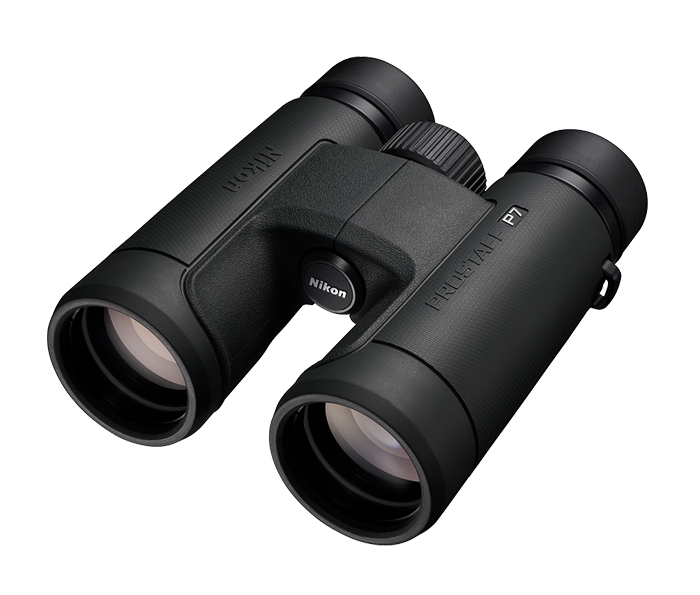
Explore this need in the finder →The PROSTAFF P7 10x42 is Nikon’s full-size option here for viewers who want 10x magnification but still value a relatively broad published field: 367 feet at 1,000 yards and a 62.9-degree apparent field. It weighs 21.2 oz and measures 5.9 in long. Its 4.2 mm exit pupil is between the smaller 10x30 and the larger 8x42, while 15.7 mm of eye relief makes eyewear fit worth checking before purchase.
Ten power with a full-size objective
Compared with the P7 8x42, 10x42 makes distant objects appear larger, while the published real field narrows only slightly—from 377 feet to 367 feet at 1,000 yards. The 10x42’s apparent field is notably wider on paper at 62.9 degrees versus 53.4 degrees for the 8x42. These two field measures describe different aspects of the view; a wide apparent field does not mean that more surrounding landscape is visible than with the 8x42.
The extra magnification makes small hand movements more visible as well. If you are panning across nearby tree cover, finding a bird quickly or watching while walking, the 8x42’s lower power may feel easier. For mostly stationary observation where bringing a distant animal closer matters more, the 10x42 has the useful reach. Nikon’s specs do not prove that either size will appear steadier to every user; grip, posture and fatigue matter.
More forgiving than 10x30, but still a 10x view
The 42 mm objective gives this model a 4.2 mm exit pupil, compared with 3.0 mm in the compact P7 10x30. Nikon’s relative-brightness indices are 17.6 and 9.0 respectively. The larger figure is a manufacturer calculation, not a guarantee of twilight detail. The 10x42 also weighs 21.2 oz, 4.6 oz more than the 10x30, and the body is 1.0 in longer. It is more substantial in a pack even though the magnification is identical.
Eye relief is 15.7 mm. This is only 0.3 mm longer than the 10x30’s 15.4 mm; it is not the model in this group to choose solely for generous eye relief. The P7 8x42 gives 20.2 mm. Nikon directs glasses wearers to set the turn-and-slide eyecups fully retracted, with intermediate click positions available. That instruction is a starting point, not a guarantee that every eyeglass frame will preserve the complete field. Try the actual fit if possible.
Confirmed P7 features and unknowns
The 10x42 uses central focusing and a right-eye diopter ring that can be locked after individual adjustment. Nikon confirms phase-correction and dielectric coatings on the roof prisms, plus an oil- and water-repellent treatment on objective and eyepiece lenses. The coatings and locking ring are concrete differentiators from the documented P3 10x42, but they are not independent proof of brighter or sharper images. The exact P7 page and manual do not establish ED glass; that fact stays unknown rather than false. A buyer who requires confirmed ED should choose another model whose documentation names it.
Close focus is approximately 9.8 ft, compared with 8.2 ft on the 30 mm P7 models. This supports relatively nearby observation but does not make the instrument a macro lens. Its interpupillary distance adjusts across 56–72 mm according to the 30/42 mm family manual, another fit dimension to test for the actual user.
Weather protection and standard items
Nikon’s manual rates the binocular as waterproof to 1 m / 3.3 ft for ten minutes and fogproof with a nitrogen-filled construction. It cautions against underwater use and strong water pressure. Those limits suit ordinary rain and damp trails; they do not authorize rinsing with a hard jet or using the binocular for diving. Wipe moisture off before moving its focus or eyecup parts. The manual lists a binocular, one eyepiece cap, two objective caps, soft case and neck strap. It does not establish tripod compatibility or an included adapter for the 30/42 mm model, so this review treats mounting as unconfirmed.
When a different P7 is a better match
Choose the 10x42 over the 10x30 when the larger exit pupil and a slightly wider real field are worth the weight and length. Choose the 8x42 if you value the longest eye relief in this group, a larger exit pupil or easier handheld scanning more than extra magnification. Pick the 8x30 for the broadest real field and shorter carry. A same-size Nikon P3 10x42 also merits comparison: the P7’s documented coatings, repellent surfaces and locking diopter are the relevant differences, not a promise that it wins every view. The P7 size guide summarizes the four trade-offs.
Exact-model specifications: Nikon PROSTAFF P7 10x42 product page. Setup and family instructions: Nikon Download Center PROSTAFF P7 manual listing.
Key specifications
Key details at a glance
| Magnification | 10× |
|---|---|
| Objective diameter | 42 mm |
| Real field of view | 7° |
| Apparent field of view | 62.9° |
| Field width at 1,000 m | 122 m |
| Eye relief | 15.7 mm |
More specifications and setup details
| Exit pupil | 4.2 mm |
|---|---|
| Close focus distance | 9.8 ft |
| Manufacturer-published weight | 21.2 oz |
| Phase coatings confirmed | Yes |
| Locking diopter ring confirmed | Yes |
| Lens and prism coatings | The exact Nikon USA page confirms phase and dielectric prism coatings and describes multilayer-coated optics; Nikon’s P7 line page states that both objective and eyepiece lenses have oil- and water-repellent surfaces. These descriptions do not confirm ED glass for this exact configuration. |
| Water and fog protection | Nikon’s 30/42 mm family manual rates this size waterproof to 1 m / 3.3 ft for up to 10 minutes and fogproof with nitrogen filling. It is not intended for underwater use, and the manual warns against strong water pressure. |
| Tripod use | The inspected exact US page, 30/42 mm instruction manual and P7 family page do not establish tripod compatibility, an adapter model or adapter-in-box status. No tripod operating plan is asserted. |
| Published weight note | Nikon’s exact US page and 2022 family table agree on this model’s published mass; the published figure is not an independent measurement. |
| Package contents | The Nikon English P7 30/42 mm manual lists one binocular, one eyepiece cap, two objective lens caps, one soft case and one neck strap. No adapter is listed. Seller-added US bundle contents are not established by that standard items list. |
| Manufacturer-rated waterproof | Yes |
Use the exact model’s instructions for operating limits, supplied equipment and version differences.
Sources for this review
Sources for this assessment
Choose your optical trade-off first.
Choose viewing purpose first, then magnification, objective size, scene width and any fit, weather or mounting constraint. A direct-Sun requirement is separate: only exact manufacturer-confirmed solar binoculars can pass it.