
On this page
Your needs, this model
Does it fit your priorities?
Does the P3 10x42 have the largest apparent-field figure among these four sizes?
Yes. Nikon lists 62.9°, just above the 8x30’s 62.6°. That does not make its real scene the widest; the 8x30 covers 456 ft and this 10x42 covers 367 ft at 1,000 yd.
Explore this need in the finder →Does it keep more field width than the P3 10x30 at 10x?
Yes, narrowly: 367 ft compared with 346 ft at 1,000 yd. It also has a 4.2 mm exit pupil rather than 3.0 mm, but the 10x30 remains lighter according to Nikon’s current individual pages.
Explore this need in the finder →Can it meet a weatherproof requirement without being treated as underwater equipment?
Yes. The manual gives a 1 m / 3.3 ft, 10-minute waterproof rating and fog resistance, but says not to use the binocular underwater or under strong water pressure.
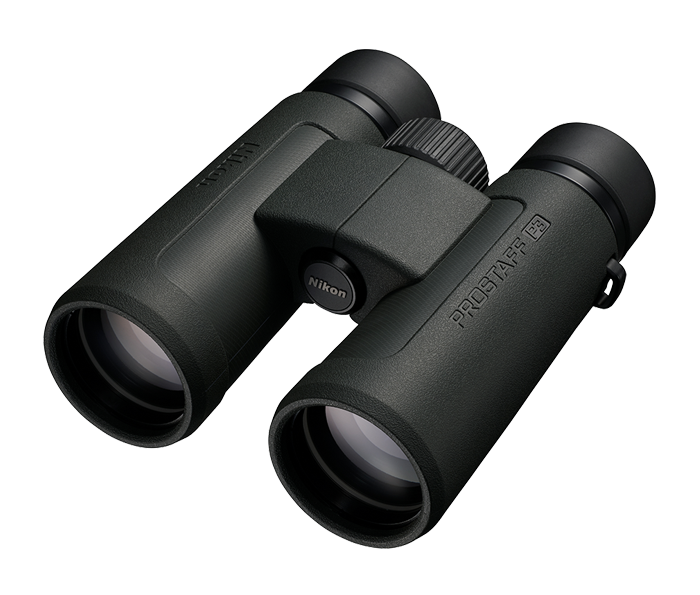
Explore this need in the finder →Nikon’s PROSTAFF P3 10x42 combines a full-size 42 mm objective with the lineup’s highest apparent-field figure: 62.9°. Its true field is 367 feet at 1,000 yards, narrower than the 8x42’s and much narrower than the compact 8x30’s. It is the P3 for someone who wants 10x magnification and a broad-looking eyepiece view, not the model to pick for the lightest carry or the most forgiving eye point.
A wider apparent view, not the widest landscape
The apparent field describes how large the view seems through the eyepiece; it is not the same as how much of the landscape the barrels capture. Nikon lists this model at 62.9° apparent and 7.0° real, with 367 feet at 1,000 yards. The P3 8x30 has the larger real field at 456 feet, the P3 8x42 covers 377 feet, and the 10x30 346 feet. Thus the 10x42’s specification supports a wide-looking view for a 10x model without making it the broadest scene scanner in this family.
The 10x magnification makes distant objects appear larger than in the 8x models, a reasonable trade for viewing details from a fixed overlook or across a sports field. It also magnifies hand movement and narrows the scene relative to the 8x alternatives. If you often acquire birds in cluttered branches or track fast movement, compare the 8x42’s 377-foot field and steadier power. The 10x42’s apparent-field number should not be read as stabilization or easier subject acquisition in every situation.
The 42 mm compromise in exit pupil and eye relief
The 10x42 produces a 4.2 mm exit pupil; the 8x42 provides 5.3 mm. The published relative-brightness index is 17.6 against 28.1 for the 8x42. Those values are not lab measurements of image quality, but they show the simple effect of holding the objective size while increasing magnification. The larger P3 8x42 may offer a more forgiving eye position and a larger exit pupil; the 10x42 supplies more reach. Neither comparison proves one will be brighter or clearer in all lighting conditions.
Eye relief is 15.7 mm—close to the 10x30’s 15.4 mm and materially shorter than the 8x42’s 20.2 mm. If you wear glasses, check whether you can see the complete field with the eyecups fully retracted. The manual describes multi-click turn-and-slide cups, so the intermediate stops can help refine eye position. A glasses wearer who cannot maintain the full image should reconsider the 8x42 or personally test the 10x42; a published number alone cannot establish fit.
Instrument weight and the older launch-table conflict
The individual US product page gives a weight of 585 g / 20.6 oz and body dimensions of 5.9 × 5.1 inches. Nikon’s 2022 launch table instead lists 600 g / 21.2 oz. This 15 g difference appears in two official sources, so it is retained rather than resolved by guessing. The current P3 collection repeats 20.6 oz. The 10x42 is still close to the P3 8x42’s current-page 20.3 oz, but heavier than the two 30 mm designs. A shoulder strap, case and caps are not included in Nikon’s instrument-weight figure.
The P3 uses a roof-prism layout with center focus. Nikon describes multilayer-coated lenses and silver-alloy reflective coating on the roof-prism mirror surfaces; the line’s body is rubber-armored fiberglass-reinforced polycarbonate. The exact pages do not establish ED glass, phase correction, dielectric coating, a locking diopter, water/oil-repellent objective and eyepiece surfaces, or adapter-compatible tripod mounting. The separate right-eye diopter control is documented, but do not mistake it for the P7’s locking diopter. If those features are must-haves, the finder treats them as unknown rather than quietly awarding a pass.
Where it can go, and what is in the manual’s box list
Nikon rates the P3 waterproof to 1 m / 3.3 ft for up to 10 minutes and fogproof, with nitrogen filling. The manufacturer says not to use it underwater or subject it to strong water pressure. This is a useful weather-resistant design for hiking, camping and birding, not a dive instrument. Wipe moisture away before operating the focus ring or eyecups. The English P3 manual lists a binocular, one eyepiece cap, two objective caps, a soft case and neck strap. It does not list a tripod adapter or document tripod compatibility; do not assume one is included or that a listing photo shows the contents of a package.
Choose the 10x42 only if its priorities fit
The 10x42 makes sense if you want 10x reach, prefer a 42 mm objective to the P3 10x30, and like its 62.9° apparent field. Its 9.8-foot close-focus distance is not as short as the 30 mm models’ 8.2 feet; if nearby feeders or butterflies are a frequent subject, inspect that limit before buying. Choose the 10x30 for a lighter 10x alternative and a smaller body, but accept its 3.0 mm exit pupil and tighter field. Choose the 8x42 for the longest eye relief and larger exit pupil, or 8x30 for widest scene and lower carry weight. Start with steady handling and eye fit, then compare the exact specs in the P3 guide.
Exact-model evidence: Nikon PROSTAFF P3 10x42 specifications, the Nikon P3 launch table, and the Nikon P3 instruction-manual listing.
Key specifications
Key details at a glance
| Magnification | 10× |
|---|---|
| Objective diameter | 42 mm |
| Real field of view | 7° |
| Apparent field of view | 62.9° |
| Field width at 1,000 m | 122 m |
| Eye relief | 15.7 mm |
More specifications and setup details
| Exit pupil | 4.2 mm |
|---|---|
| Close focus distance | 9.8 ft |
| Manufacturer-published weight | 20.6 oz |
| Lens and prism coatings | Nikon describes multilayer-coated lenses and a highly reflective silver-alloy coating on roof-prism mirror surfaces for the P3 line. The exact P3 sources do not document ED glass, phase correction, dielectric coating or oil/water-repellent objective and eyepiece coatings; those details remain unknown. |
| Water and fog protection | The exact P3 manual rates the models waterproof to 1 m / 3.3 ft for up to 10 minutes, fogproof and nitrogen-filled. Nikon says they are not for underwater use and warns against strong water pressure. |
| Published weight note | The current exact US page and manual report 585 g / 20.6 oz, while Nikon’s 2022 launch table reports 600 g / 21.2 oz. Preserve this 15 g official-source discrepancy. |
| Manufacturer-rated waterproof | Yes |
Use the exact model’s instructions for operating limits, supplied equipment and version differences.
Sources for this review
Sources for this assessment
Choose your optical trade-off first.
Choose viewing purpose first, then magnification, objective size, scene width and any fit, weather or mounting constraint. A direct-Sun requirement is separate: only exact manufacturer-confirmed solar binoculars can pass it.