
On this page
A 25x120 fixed-power choice on the same fork system
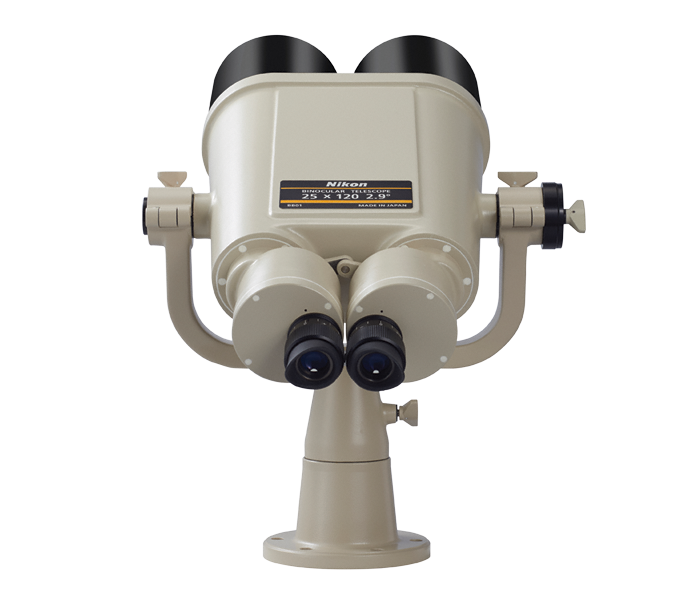
The 25x120 publishes 2.9° real / 64.7° apparent field and the same 493.8 oz body mass as the 20x120 IV, before its separate 194 oz fork and base. It is the higher fixed-power configuration, not a replacement for a portable tripod binocular; the horn eyecups require eyeglasses to be removed.
Explore the needs this model fits
Your needs, this model
Does it fit your priorities?
Does the 25x120 show a broader landscape than the 20x120 IV because its apparent field is wider?
No. It has a 64.7° apparent eyepiece field but a 2.9° real scene, slightly narrower than the 20x120 IV’s 3.0°. It gives more magnification, not a broader actual scene.
Explore this need in the finder →What additional magnification does the 25x120 provide in the 120 mm fork-mounted family?
It is the family’s 25x option. The 20x120 IV is the lower-power alternative with a wider real field, larger exit pupil, longer stated eye relief and closer minimum focusing distance.
Explore this need in the finder →How does the 25x120 minimum focusing distance compare with the 20x120 IV?
The 25x120 focuses no closer than 210 m (689 ft), farther than the 20x120 IV’s 133 m (436.4 ft). Neither is for nearby subjects; the 20x model has the nearer limit.
Explore this need in the finder →The Nikon 25x120 is a 14 kg (493.8 oz) binocular telescope for a securely mounted observing position, not a portable 25-power binocular. It shares the 120 mm objectives and 5.5 kg fork mount of the 20x120 IV, but raises magnification to 25x. That gives a wider apparent eyepiece field, while the actual scene is slightly narrower and the exit pupil, eye relief and near focus are all smaller or farther than on its sibling.
Plan the installation before the optics
Nikon’s exact US listing names product 16644 the 25x120 Binocular Telescope With Fork Mount. The body alone weighs 14 kg, and the fork mount weighs another 5.5 kg. There is no standard tripod shoe for carrying this as a conventional binocular: the included fork must be attached to a substantial base, or the optional Nikon pillar stand and adapter must be purchased separately. The manual specifies six matching 12 mm (half-inch) holes and bolts or nuts to secure the fork to a base. It warns users to take care when lifting the heavy body onto the mount, tighten the clamps and check that the body is secure before viewing.
That installation requirement is the central suitability question. It can make sense for a fixed astronomical location or a dedicated overlook where the mount can remain installed and the large binocular does not need to be carried between viewpoints. A boat or marine setting also needs a safe, rigid mounting plan; a waterproof rating alone does not make a fourteen-kilogram telescope appropriate for a moving deck. Confirm the full package against the exact seller part number. Nikon’s 25x120 US product page and the 2025 US catalogue show the with-fork-mount configuration, while the shared manual cautions that the fork is not included with every possible purchased set.
More magnification, less actual scene
Nikon lists 25x magnification with 120 mm objectives, a 2.9° real field and 150 feet of scene width at 1,000 yards. That is a little narrower than the 20x120 IV’s 3.0° and 156 feet. Its 64.7° apparent field is broader than the 20x model’s 55.3°, but apparent field describes the view through the eyepiece; it does not mean this model shows a wider landscape. The higher power makes the same distant subject look larger while making accurate pointing and reacquisition more important.
The 25x configuration has a 4.8 mm exit pupil and a manufacturer relative-brightness index of 23, compared with 6 mm and 36 for the 20x120 IV. Those are derived product specifications, not independent measurements of what every observer will see at night. The 25x model also has 18.9 mm of listed eye relief and a minimum focusing distance of 210 m (689 ft), compared with 20.8 mm and 133 m on the 20x. Neither has a short close-focus distance; both are made for faraway subjects.
Focus and the eyecups are unusual
This is an individual-focus design, so each eye is focused separately rather than by turning a central wheel for both barrels. The manual describes recording the index on each diopter ring for later reference. That suits an instrument that is set up for one viewing range, but is not the convenient arrangement for someone frequently switching between nearby birds and distant objects.
Most importantly for fit, Nikon’s manual says to remove eyeglasses because the instrument has horn-shaped eyecups. The 18.9 mm eye-relief specification does not override that setup instruction. If you need your prescription eyewear in place, this should not be treated as an eyeglass-friendly choice based on the number alone. Nikon provides an interpupillary adjustment range of 58–74 mm.
Weather protection has limits
The manufacturer states the binocular telescope is nitrogen-filled and waterproof to 2 m for up to 10 minutes. Nikon explicitly says not to use it underwater or direct strong running water at it; dry any moisture before adjusting moving parts. The manual recommends removing salt with a damp soft cloth and then drying the body after use near the sea. These are meaningful environmental protections for a large mounted instrument, not a reason to leave it exposed without care. It is also important not to look at the sun through it; Nikon’s instruction manual warns of serious eye injury.
Who should choose it?
Pick the 25x120 when your installed position is ready, the additional magnification matters more than the 20x model’s slightly broader real scene, and you are comfortable with its smaller exit pupil, shorter listed eye relief and much longer minimum focusing distance. The 20x120 IV is the calmer choice if scene width, eye-relief margin or nearer distant-landscape viewing matters more. If your use is mobile, you want to scan moving wildlife from hand, or you need ordinary central focus, compare a far smaller binocular instead. Nikon’s ACTION 16x50, for example, is still a large handheld instrument and benefits from an optional adapter on a tripod, but it weighs only about 33 oz and does not require a prepared fork-mount base; it is not an optical substitute for the 25x120.
This assessment relies on Nikon’s exact US product 16644 page, its current global family specifications and the shared 20x120 IV / 25x120 instruction manual. It does not claim an independent image-quality test. See the Nikon 25x120 US product page and the manufacturer instruction manual before planning an installation.
Key specifications
Key details at a glance
| Magnification | 25× |
|---|---|
| Objective diameter | 120 mm |
| Real field of view | 2.9° |
| Apparent field of view | 64.7° |
| Field width at 1,000 m | 50 m |
| Eye relief | 18.9 mm |
More specifications and setup details
| Exit pupil | 4.8 mm |
|---|---|
| Close focus distance | 689 ft |
| Manufacturer-published weight | 493.8 oz |
| Lens and prism coatings | Nikon describes proprietary multilayer coatings. Reviewed exact US and global sources do not confirm ED glass, prism phase coating or a dielectric coating; these remain unknown. |
| Water and fog protection | Nikon specifies nitrogen filling and protection against immersion to 2 m for 10 minutes. It is not for underwater use or strong running-water pressure; moisture should be dried before moving parts are adjusted. |
| Published weight note | The Nikon-listed 493.8 oz / 14 kg weight is the binocular telescope body, excluding the separately listed 5.5 kg / 194 oz fork mount and any base or optional pillar stand. |
| Package contents | The Nikon US product title identifies part 16644 as With Fork Mount. The shared manual says the fork mount may not be included in every purchased set, so verify the precise SKU/package; the optional pillar stand is separate. |
| Manufacturer-rated waterproof | Yes |
| Dedicated fork mount included | Yes |
| Support and installation | The exact US SKU is named with fork mount. The body weighs 14 kg and the fork mount 5.5 kg; the manual requires the fork to be bolted to a substantial user base at six matching 12 mm holes. The optional pillar stand and adapter are separate. |
Use the exact model’s instructions for operating limits, supplied equipment and version differences.
Sources for this review
Sources for this assessment
- Nikon USA exact product 16644, 25x120 Binocular Telescope With Fork Mount
- Nikon global 20x120 IV / 25x120 family and model-specific specification table
- Nikon 20x120 IV / 25x120 bilingual instruction manual; English PDF pages 9–15 personally read, including installation, operation and full specifications
- Archived official Nikon USA 2025 Sport Optics catalogue, binocular telescopes spread PDF p. 15 / printed p. 28
- Nikon Parts USA binocular directory first page includes current 16741 and 16644 model entries
- Official CPSC exact family-name query returned an empty JSON array on 2026-10-23
Choose your optical trade-off first.
Choose viewing purpose first, then magnification, objective size, scene width and any fit, weather or mounting constraint. A direct-Sun requirement is separate: only exact manufacturer-confirmed solar binoculars can pass it.
Your needs, this model
Choosing a 120 mm fork-mounted binocular telescope
Choose it when: Choose the 25x120 if you prefer the higher fixed magnification and wider published apparent field. The exact US part 16644 page names the fork-mount package and provides the exact variant's 25x specifications.
Choosing a 120 mm fork-mounted binocular telescope →25x binoculars: portable tripod setup or fixed fork base
Choose it when: The Nikon is the 25x choice when a fixed binocular-telescope installation and 120 mm objectives are central to the task. The exact product title names the fork-mounted configuration; its 2.9° real field is marginally wider than the SkyMaster's published 2.7°.
25x binoculars: portable tripod setup or fixed fork base →