
On this page
Your needs, this model
Does it fit your priorities?
Does the 8x42 leave a broad real scene for finding a moving subject?
Yes. Maven lists a 6.5° real field (341 ft at 1,000 yd) and a 5.3 mm exit pupil; the 10x/12x alternatives show narrower real fields.
Explore this need in the finder →Does the 8x42 meet an 18 mm minimum-eye-relief need?
Its 19.5 mm published eye relief exceeds that threshold, though individual glasses fit still needs checking.
Explore this need in the finder →Can the 8x42 be used on a tripod, and is the adapter included?
Tripod adaptability is listed; the C Series manual says the adapter is sold separately, so compatibility does not mean a complete kit.
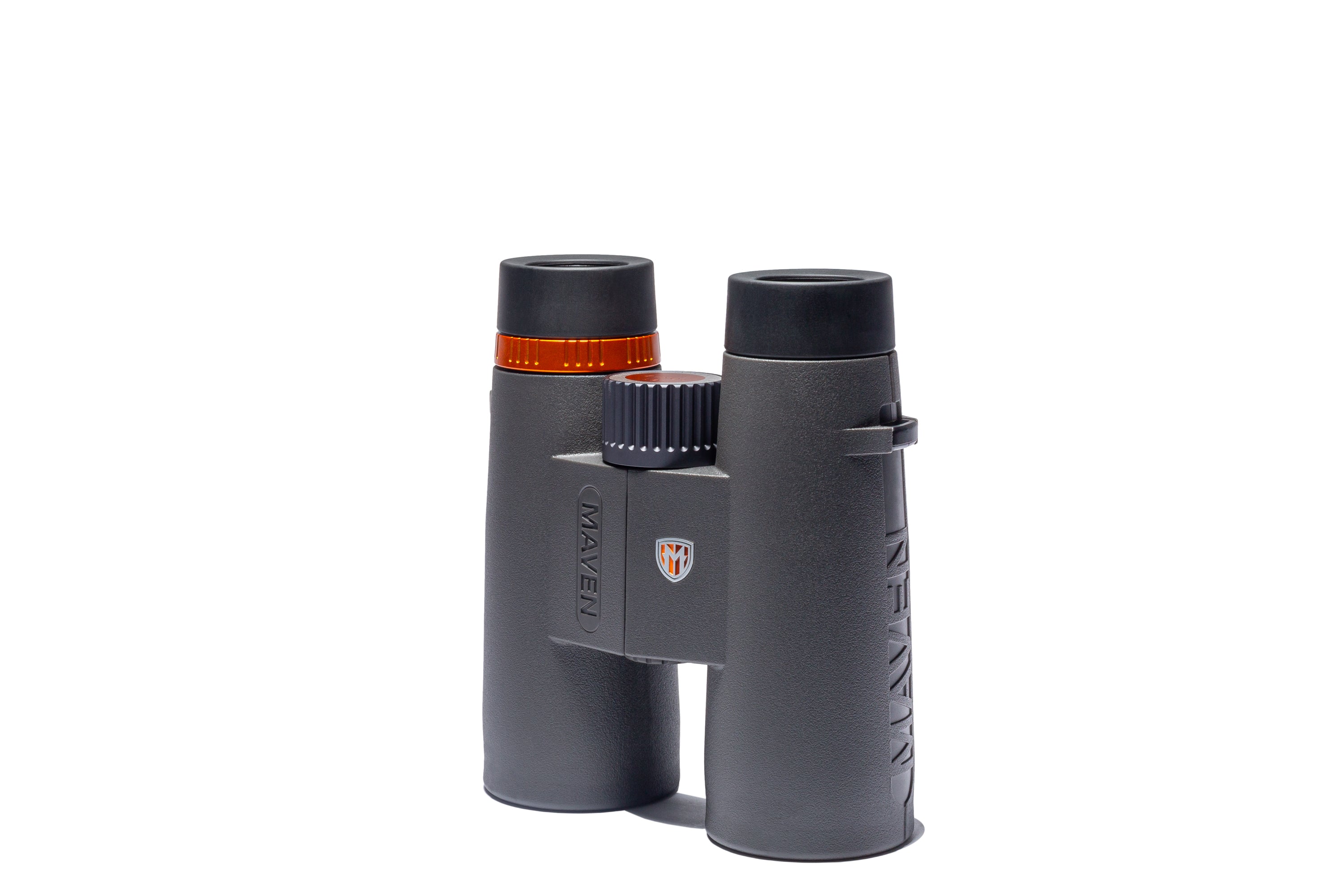
Explore this need in the finder →The Maven C.1 8x42 is the broadest-scanning member of the C.1 trio. Maven lists a 6.5-degree real field—341 feet at 1,000 yards—a 5.3 mm exit pupil and 19.5 mm of eye relief. At 24 ounces, it is a full-size roof binocular rather than a pocket optic, but its 8x power and wide published field suit viewers who would rather find and follow a moving subject than squeeze out the most enlargement.
Why the 8x view is the easiest C.1 to scan with
All three C.1 versions use 42 mm objectives, but their viewing geometry changes with magnification. The 8x has a 6.5-degree real field; the 10x narrows to 6 degrees, and the 12x to 5 degrees. Maven gives the same distinction in linear terms: 341 feet per 1,000 yards for the 8x, against 314 and 262 feet for the higher powers. On a bird moving through branches or wildlife crossing a broad clearing, that extra scene width can make it simpler to acquire the target without continually panning. Eight power also puts less apparent hand movement in the image than twelve power, though that is an optical consequence, not a measured stability test of this instrument.
The C.1 8x42 is the one choice in this family that reaches Maven’s published “wide real view” threshold of at least six degrees while also offering the largest exit pupil: 5.3 mm, compared with 4.2 mm at 10x and 3.5 mm at 12x. Those ratios help explain why the lower-power version is the more forgiving option when your eyes are not centered perfectly and when available light is fading. They do not guarantee a brighter-looking image; no independent transmission or dusk test is claimed here. If low-light viewing is central, compare full optical systems in person rather than treating the exit-pupil calculation as a complete quality rating.
A substantial body with useful eye-relief headroom
Maven lists the 8x42 at 24 ounces, 5 by 5.7 by 2.1 inches, with a 5.9-foot near-focus distance. Its general product highlight says 24.5 ounces, but the power-specific table gives 24 ounces for the 8x42; this review uses the latter row. Its 19.5 mm eye-relief figure is the longest of the three C.1 powers. That makes it the first C.1 version to consider if you use eyeglasses, but published eye relief alone cannot confirm that your frames let you see the full field. The manual’s fitting guidance is practical: set interpupillary distance so the two images merge, then extend or retract the twist-up eyecups according to whether you view with glasses. The manufacturer lists a 58–72 mm interpupillary range, so viewers outside that range should verify fit before committing.
The center-focus wheel and right-eye diopter let each viewer focus the instrument to their own eyes. The C Series manual describes focusing a distant object with the center wheel first and then refining the right side with the diopter ring. That setup matters when the binocular is shared; it does not mean the diopter locks, since the page and manual do not establish a locking mechanism. Maven lists ED objective glass, fully multi-coated lenses, phase correction and dielectric coatings on its Schmidt-Pechan roof prisms. Those are relevant construction details, not independent findings about edge sharpness, color fringing or resolution.
Weather sealing and a separate mounting purchase
Maven calls the C.1 waterproof and fog-proof, and its specification table reports a one-meter, 30-minute IPX7 pressure test. Nitrogen filling is also listed. Treat those as manufacturer ratings, not permission to view underwater or a guarantee against damage from every exposure. The package listing names a neoprene neck strap, lens caps and a double-layer microfiber storage bag. The C Series manual says the C.1 can be mounted with Maven’s tripod adapter, which is sold separately; the adapter is not one of the listed included items. This is therefore a handheld-capable binocular with optional support, not an out-of-the-box tripod kit.
For care, the manual advises removing loose grit before wiping the lenses and avoiding shirts, tissues and heavy cotton cloths that could scratch the glass. It also warns not to point binoculars at the Sun or another bright light. These simple details are more useful to an owner than a vague promise of ruggedness.
Choose another C.1 power when your priorities change
The C.1 10x42 keeps a 42 mm objective and a six-degree field while adding two-power magnification; its 60-degree apparent field is wider than the 8x42’s published 52 degrees. It weighs a half ounce more and has 16 mm eye relief. The 12x42 retains a 60-degree apparent field but reduces the real view to five degrees and eye relief to 15 mm. Those numbers make the 8x42 the straightforward choice when broad scanning, longer eye relief and easier handheld viewing matter most. Pick 10x when more detail at distance is worth a narrower scene; pick 12x when magnification is the firm priority and you can accept a smaller real field or use the separate adapter for a steadier view.
The C.1 8x42 is a sensible general wildlife or birding option when a full-size instrument is acceptable and finding a subject quickly matters more than maximum reach. It is not Maven’s compact choice: the C.2 7x28 is much lighter and smaller, but it has a 28 mm objective and the maker says it is not tripod adaptable. The 8x42 gives up that compactness for a larger objective, greater eye-relief specification and mounting compatibility. None of these published values substitutes for checking physical fit, especially if glasses or a specific interpupillary range are essential.
Maven C.1 product page · Maven C.1 specifications · Maven C Series manual. The manufacturer page offers 8x42, 10x42 and 12x42 variants and links the shared manual.
Key specifications
Key details at a glance
| Magnification | 8× |
|---|---|
| Objective diameter | 42 mm |
| Real field of view | 6.5° |
| Apparent field of view | 52° |
| Eye relief | 19.5 mm |
| Exit pupil | 5.3 mm |
More specifications and setup details
| Close focus distance | 5.9 ft |
|---|---|
| Manufacturer-published weight | 24 oz |
| ED glass confirmed for this exact model | Yes |
| Phase coatings confirmed | Yes |
| Lens and prism coatings | Maven lists ED objective glass, fully multi-coated lenses, phase correction, a dielectric reflective coating on the roof prisms and scratch/oil-resistant lens coating. These are manufacturer specifications, not independent optical measurements. |
| Water and fog protection | Maven’s C.1 specification table states IPX7 pressure-tested to 1 m for 30 minutes. That is not an underwater-viewing claim. |
| Tripod use | The exact table lists tripod adaptability. The family manual describes an optional adapter sold separately and excludes C.2, not C.1. The page lists a strap, caps and storage bag; it does not list the adapter. |
| Published weight note | Maven’s power-specific row lists 24.0 oz for the 8x42 instrument; this is not independent weighing or packed-system mass. The generic highlight says 24.5 oz while the exact power table lists 24.0 oz for the 8x42; the power-specific table is used. |
| Manufacturer-rated waterproof | Yes |
| Tripod adapter in package | No |
Use the exact model’s instructions for operating limits, supplied equipment and version differences.
Sources for this review
Sources for this assessment
- Maven U.S. C.1 binocular family product page
- Maven Shopify JSON for C.1 family
- Maven C.1 exact U.S. power-specific specification table
- Maven C Series binocular manual (8-page PDF directly linked from C.1 page)
- Maven U.S. binocular collection page (reused identical bytes)
- CPSC SaferProducts narrow exact-name query snapshot
Choose your optical trade-off first.
Choose viewing purpose first, then magnification, objective size, scene width and any fit, weather or mounting constraint. A direct-Sun requirement is separate: only exact manufacturer-confirmed solar binoculars can pass it.