
On this page
Your needs, this model
Does it fit your priorities?
Does the 10x42 retain both a six-degree real field and a 60-degree apparent field?
Yes. The exact table lists 6° / 314 ft per 1,000 yd and 60° apparent field for this power.
Explore this need in the finder →Does the 10x42 meet a 16 mm minimum eye-relief request?
Yes, the published 16 mm equals the requested minimum; the 12x42 lists 15 mm.
Explore this need in the finder →Is the 10x42 tripod adaptable if I buy the separate adapter?
Yes. The manual describes adapter use and says it is sold separately; the product page does not list it in the package.
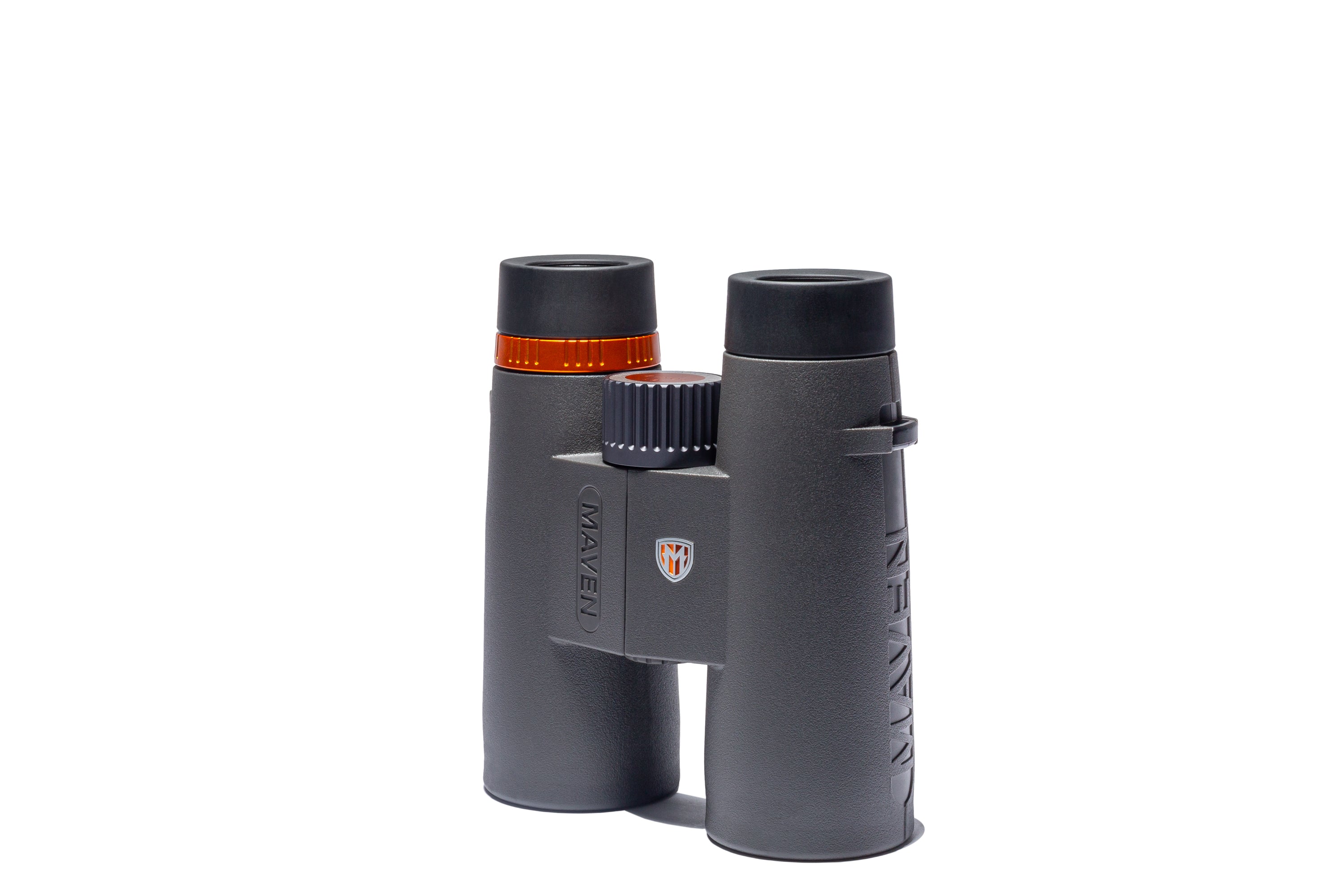
Explore this need in the finder →The Maven C.1 10x42 sits between the family’s broad-view 8x42 and its high-power 12x42. Maven lists a six-degree real field (314 feet at 1,000 yards), a 60-degree apparent field, 4.2 mm exit pupil and 16 mm eye relief. Its 24.5-ounce weight is close to the other C.1 models. This is the version to examine when you want a familiar 10x field of view without abandoning a standard 42 mm objective.
Ten power keeps detail and scene width in balance
The 10x42 has enough enlargement for observing distant wildlife or following play across a large field, but the published view remains six degrees wide. That is exactly the threshold this guide’s ordinary “wide real scene” choice asks for. It also meets the “wide apparent view” preference at 60 degrees. The C.1 8x42 offers a wider real field at 6.5 degrees but its apparent field is 52 degrees; the 12x42 shares the 60-degree apparent figure while narrowing the real view to five degrees. If your questionnaire answers ask for both a six-degree real field and at least a 60-degree apparent field, the 10x42 is the C.1 configuration that meets both published values.
That distinction is easy to miss: apparent field describes how wide the scene seems at the eyepiece, while real field describes how much of the outside scene is visible. A generous apparent number does not give the 12x42 the wider real scene. Maven’s linear figures make the difference concrete—314 feet at 1,000 yards for the 10x42 and 262 feet for the 12x42. For walking birding or wildlife viewing where a subject might move before you settle on it, the 10x can be a more forgiving compromise than the 12x. It will not be as easy to hold still as the 8x in every person’s hands; the higher power magnifies hand movement as well as distant detail.
The 42 mm objective is not a compact package
Maven lists the C.1 10x42 at 24.5 ounces and 5 by 5.7 by 2.1 inches, with a close-focus specification of 5.9 feet. The 4.2 mm exit pupil is larger than the 12x42’s 3.5 mm and smaller than the 8x42’s 5.3 mm. That makes the 10x a middle option in this family, not a guarantee of any particular dusk performance. Its 16 mm eye relief is also between the 8x42’s 19.5 mm and 12x42’s 15 mm. If you wear glasses, the 10x42 may fit, but the printed number does not settle whether your frames and viewing position will show the full field; use the twist-up eyecups to test eye placement.
The optical design is a Schmidt-Pechan roof prism with ED objective glass, phase-correction and dielectric prism coatings. Maven also lists fully multi-coated lenses, multi-position eyecups and a polymer frame. Those details help distinguish the C.1 from a bare-bones design, but they are not independent comparisons or laboratory measurements. Nothing in the product information establishes a locking diopter; the manual describes the center-focus wheel and right-eye diopter adjustment for setting the binocular to the viewer.
Mount compatibility is real, but the adapter is separate
The C.1 is listed as tripod adaptable. Maven’s manual describes removing the socket cover and threading in its tripod adapter, then attaching the adapter to a tripod. The same page says that adapter is sold separately, while the standard package listing names a neoprene strap, lens caps and double-layer microfiber bag. If your requirement is “tripod-compatible,” this configuration meets it. If you need the adapter included in the box, it does not. Distinguishing those questions prevents a compatibility claim from being mistaken for a complete support kit.
Maven’s specification table calls the instrument waterproof to an IPX7 test of one meter for 30 minutes and the product page describes it as fog-proof. Nitrogen filling is listed. These are manufacturer statements about construction; they are not an underwater-use recommendation. The manual’s cleaning guidance is more restrained: remove grit before wiping, use a suitable lens-cleaning fluid and microfiber cloth, and store the binocular in its case. It warns against pointing any binocular at the Sun or another bright light.
Where the other powers make more sense
Choose the C.1 8x42 if your priority is a broad real field, a larger exit pupil or the family’s longest published eye relief. Select the 12x42 if more magnification matters more than a broad real scene and you can support the view steadily. The 10x42 occupies the middle: it keeps the 42 mm objective, meets both of the family’s broad-view thresholds in the questionnaire, and adds more reach than the 8x without shrinking the field to the 12x’s five degrees.
For a smaller travel instrument, the Maven C.2 is the adjacent compact family, but it uses 28 mm objectives and is not tripod adaptable according to its exact page and manual. The C.1 10x42’s listed 24.5 ounces is about one and a half pounds; it is a full-size carrying choice, not a pocket binocular. If low carry weight dominates, look at a genuinely compact model rather than rounding away that difference.
As a general-purpose outdoor binocular, the 10x42 suits a viewer who expects a mixture of scanning and detail and is comfortable carrying a full-size 42 mm optic. Its numbers clarify the trade, not the final fit: check eye relief against your glasses, confirm your IPD falls within Maven’s 58–72 mm range, and decide whether you will buy a separate tripod adapter before treating mounting as part of your plan.
Maven C.1 product page · Maven C.1 specifications · Maven C Series manual. The product and specification pages list all three magnifications; the manual describes C Series focusing and separate tripod-adapter use.
Key specifications
Key details at a glance
| Magnification | 10× |
|---|---|
| Objective diameter | 42 mm |
| Real field of view | 6° |
| Apparent field of view | 60° |
| Eye relief | 16 mm |
| Exit pupil | 4.2 mm |
More specifications and setup details
| Close focus distance | 5.9 ft |
|---|---|
| Manufacturer-published weight | 24.5 oz |
| ED glass confirmed for this exact model | Yes |
| Phase coatings confirmed | Yes |
| Lens and prism coatings | Maven lists ED objective glass, fully multi-coated lenses, phase correction, a dielectric reflective coating on the roof prisms and scratch/oil-resistant lens coating. These are manufacturer specifications, not independent optical measurements. |
| Water and fog protection | Maven’s C.1 specification table states IPX7 pressure-tested to 1 m for 30 minutes. That is not an underwater-viewing claim. |
| Tripod use | The exact table lists tripod adaptability. The family manual describes an optional adapter sold separately and excludes C.2, not C.1. The page lists a strap, caps and storage bag; it does not list the adapter. |
| Published weight note | Maven’s power-specific row lists 24.5 oz for the 10x42 instrument; this is not independent weighing or packed-system mass. The generic highlight says 24.5 oz while the exact power table lists 24.0 oz for the 8x42; the power-specific table is used. |
| Manufacturer-rated waterproof | Yes |
| Tripod adapter in package | No |
Use the exact model’s instructions for operating limits, supplied equipment and version differences.
Sources for this review
Sources for this assessment
- Maven U.S. C.1 binocular family product page
- Maven Shopify JSON for C.1 family
- Maven C.1 exact U.S. power-specific specification table
- Maven C Series binocular manual (8-page PDF directly linked from C.1 page)
- Maven U.S. binocular collection page (reused identical bytes)
- CPSC SaferProducts narrow exact-name query snapshot
Choose your optical trade-off first.
Choose viewing purpose first, then magnification, objective size, scene width and any fit, weather or mounting constraint. A direct-Sun requirement is separate: only exact manufacturer-confirmed solar binoculars can pass it.