
On this page
Your needs, this model
Does it fit your priorities?
Is this exact fixed 8x42 configuration the magnification and objective you want for ordinary outdoor viewing?
The exact Leupold U.S. page identifies part 174481 as fixed 8x42 and lists 377 feet per 1,000 yards (7.2°). This establishes the format, not an independent tracking or resolution test.
Explore this need in the finder →Does the exact page’s 18.5 mm eye-relief figure clear the questionnaire’s 18.5 mm minimum step, with the listed 23.6-ounce weight and 58–78 mm hinge range also in view?
The exact page lists 23.6 ounces, 18.5 mm eye relief and 58–78 mm interpupillary distance. These are manufacturer screening figures, not a promise of comfort or glasses fit.
Explore this need in the finder →Do you require the exact page’s weather claim and standard 1/4-20 tripod port, without assuming the adapter is in the box?
Leupold describes this exact configuration as waterproof/fogproof and confirms a built-in rotatable 1/4-20 port. The listed standard accessory set does not confirm a tripod adapter; do not treat the port as bundled mounting hardware.
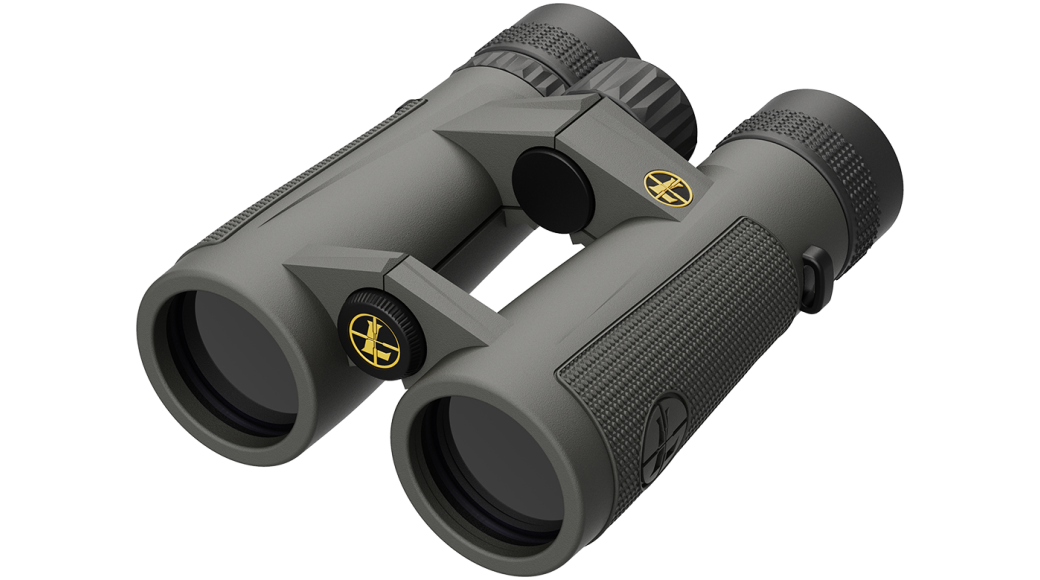
Explore this need in the finder →The BX-5 Santiam HD 8x42 is the widest-view configuration in Leupold’s five-model Santiam group. Its exact U.S. page lists 377 feet at 1,000 yards, 7.2 degrees, 23.6 ounces and 18.5 mm of eye relief. Those are useful fit and framing figures, not a substitute for looking through the binocular or proof of measured brightness.
A wide scene before extra reach
Eight power is the least magnifying choice in this BX-5 family, and it gives the widest listed field. That combination favors locating a moving bird or animal, keeping a subject in view while panning, and sharing an observation with someone beside you. Lower magnification also makes hand movement less obvious than it is at 10x, 12x or 15x. None of that is image stabilization: this is a conventional, fixed-power binocular.
The 42 mm objective keeps the body shorter and lighter than the larger BX-5 sizes. The published dimensions are 5.9 inches and 23.6 ounces before any carrying accessories. For a day when the binocular stays around your neck or in a pack, that weight is relevant, although the open-bridge shape and grip still need to suit your hands. The manufacturer’s description emphasizes that bridge style; it cannot promise a comfortable hold for every user.
Field of view, close focus and eye relief
Leupold lists a 377-foot linear field and 7.2-degree angular field at the stated distance. Compared with the Santiam 10x42, this is 36 feet more scene per 1,000 yards and a lower apparent shake penalty. The published exit pupil is 5 mm. That diameter follows from the listed objective and power; it is not a laboratory brightness score and does not tell you how well the system transmits light.
The specification table also lists a five-foot close-focus distance, the shortest listed among these five Santiam configurations. That can help when turning from distant wildlife to a nearby object, but it does not turn the binocular into a macro viewer. Eye relief is 18.5 mm, a relatively generous number in this family. Glasses wearers should still test the eyecups with their usual glasses, because nominal eye relief alone does not guarantee the full field or prevent blackouts.
Its stated interpupillary range is 58–78 mm, wider at the maximum end than the other four current configurations, which list 58–74 mm. Treat that as a screening range, not a facial-fit verdict. The Leupold owner manual explains setting the hinge until the two images merge and adjusting the center focus to your eyesight. That setup check is more useful than guessing from a spec alone.
Construction and outdoor limits
The exact page identifies an open-bridge roof-prism design, phase-coated prisms, fully multi-coated lenses, DiamondCoat 2 on exterior surfaces and Guard-Ion hydrophobic treatment. It also describes twist-up, field-replaceable eyecups, a central focus wheel, a built-in rotatable 1/4-20 tripod port and waterproof/fogproof construction. These are manufacturer descriptions; this review does not report independent resolution, color, contrast or sealing tests. The page does not identify ED glass, so “HD” should not be treated as confirmation of ED elements.
Leupold supplies a shoulder strap, case, lens covers and cleaning cloth according to the page. The same page does not confirm that a tripod adapter is in the standard package. The port therefore tells you the binocular can be mounted with the right hardware, not that you can attach it directly to a tripod without checking the accessory. The waterproof/fogproof wording is not accompanied by a numeric immersion depth or IP rating; do not infer that the binocular is intended for underwater use.
Where it sits in a real shortlist
Within the Santiam line, choose this one when the surrounding scene, lower power and modest carry weight matter more than maximum distant enlargement. The 10x42 adds reach but narrows the published field to 341 feet and lists 16.6 mm eye relief. The 10x50 keeps 10x and moves to a larger objective, but weighs 31.5 ounces and lists a 304-foot field. The 12x50 and 15x56 are more specialized for distant detail and increasingly benefit from a steady support.
For a close alternative from the same maker, compare the BX-4 Pro Guide HD Gen 2 8x42 part 184760. It also lists an approximately seven-degree field, but the exact BX-4 page gives a different 376-foot field, 24.5-ounce weight, 18 mm eye relief and 8.7-foot close focus. The Santiam is a little lighter on paper and focuses closer; that does not establish which view is optically better. If you cannot try both, decide first whether the wider field and close-focus specification matter to your outings.
The best fit is a walker or wildlife observer who values a forgiving broad view and can accept fixed 8x magnification. Before purchase, adjust the hinge and focus with the intended viewers, check the view with glasses, and decide whether you need a separate tripod adapter. The linked two-page binocular manual covers setup and lens care; use its dust-first cleaning approach rather than rubbing grit over the coatings.
Manufacturer sources: BX-5 Santiam HD 8x42 part 174481 exact U.S. product page and its linked general binocular owner manual.
Key specifications
Key details at a glance
| Magnification | 8× |
|---|---|
| Objective diameter | 42 mm |
| Real field of view | 7.2° |
| Eye relief | 18.5 mm |
| Exit pupil | 5 mm |
| Close focus distance | 5 ft |
More specifications and setup details
| Manufacturer-published weight | 23.6 oz |
|---|---|
| Phase coatings confirmed | Yes |
| Lens and prism coatings | The exact page describes phase-coated roof prisms, fully multi-coated lenses, DiamondCoat 2 exterior lens treatment and Guard-Ion hydrophobic coating. It does not identify ED glass or every coating-stack detail. No independent transmission measurement is claimed. |
| Water and fog protection | Manufacturer waterproof/fogproof wording; no exact-page numeric immersion/IP specification located. |
| Tripod use | The exact page confirms a built-in rotatable 1/4-20 port but names only the strap, case, lens covers and cloth as included accessories. It does not confirm an adapter in the box; select/check mounting hardware separately. |
| Published weight note | Exact manufacturer product-page instrument weight; carry accessories add weight. No independent weighing was performed. |
| Manufacturer-rated waterproof | Yes |
| Built-in image stabilization confirmed | No |
| Integrated laser rangefinder | No |
| Onboard ballistic solution display | No |
| Direct 1/4-20 tripod thread confirmed | Yes |
Use the exact model’s instructions for operating limits, supplied equipment and version differences.
Sources for this review
Sources for this assessment
- Leupold exact U.S. product page, part 174481
- Leupold Binocular Owner’s Manual (Rev N; generic setup/care, not configuration-specific optical evidence)
- Exact page-linked manufacturer product image URL for part 174481
- Archived Leupold U.S. binocular directory observation leupold-us-binoculars-cycle70-p1-r11
- Dated exact model/part-name public CPSC recall search; empty response only

Choose your optical trade-off first.
Choose viewing purpose first, then magnification, objective size, scene width and any fit, weather or mounting constraint. A direct-Sun requirement is separate: only exact manufacturer-confirmed solar binoculars can pass it.