
On this page
Your needs, this model
Does it fit your priorities?
Do you want a compact fixed 10x view without a weight increase over the 8x25 sibling?
The exact part 59225 page lists 10x25 and 12.7 oz, the same listed body size and mass as part 59220. Its 294 ft field is narrower than the 8x model’s 377 ft.
Explore this need in the finder →Do waterproof-described construction and a 10x25 size matter more than a six-degree field?
The exact 10x25 page says waterproof/fogproof and lists 5.6 degrees real field. It can meet an ordinary waterproof-required 10x25 request, but not a six-degree minimum real-field request.
Explore this need in the finder →Can the published 15 mm eye-relief figure and 14.1 ft focus fit your viewing screen?
The exact part 59225 page lists 15 mm eye relief and 14.1 ft close focus. Those meet a 15 mm stated eye-relief minimum and 15 ft closest-focus maximum, not a guarantee of glasses comfort.
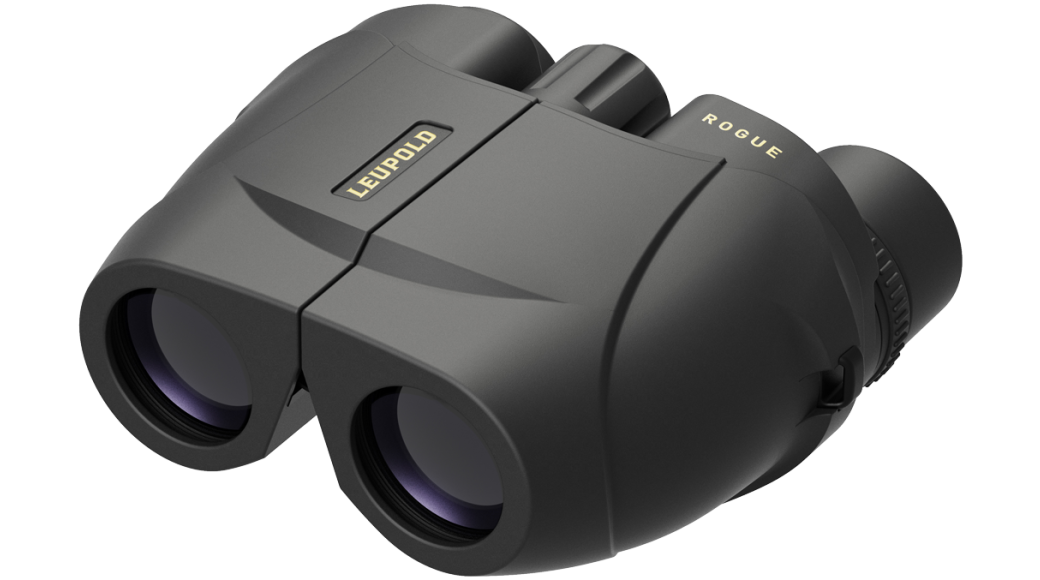
Explore this need in the finder →The Leupold BX-1 Rogue 10x25 Compact (part 59225) puts fixed 10x power into the same listed 4.3-inch, 12.7-ounce body as the 8x25 Rogue. The manufacturer lists a 294-foot field at 1,000 yards, a 5.6-degree real field and a 2.5 mm exit pupil. Compared with its 8x sibling, it gives a smaller scene and more subject scale without increasing the stated carry weight; that trade is the reason to pick this version rather than a claim that it is universally sharper.
When the added magnification helps
The exact page identifies 10x magnification, 25 mm objectives, 15 mm eye relief and 14.1-foot close focus. At the same distance, 10x makes a distant subject appear larger than 8x, which can help when reading detail across a broad open area in good daylight. The compromise appears in the published field: 294 feet at 1,000 yards versus 377 feet for the 8x25. A narrower view can take more deliberate aiming to acquire a bird, a player or a moving animal. Higher magnification also makes hand movement more apparent; this is a conventional handheld binocular, not an image-stabilized design.
The 2.5 mm exit pupil is smaller than the 8x sibling’s 3.1 mm. Both have a 25 mm objective, but the higher power spreads the available light into a smaller exit pupil. That is one reason to regard this as a bright-day travel or event instrument rather than a low-light tool. If your regular use extends into dusk, do not assume a compact 25 mm pair will serve like a 42 or 50 mm model; compare full-size options and their added bulk. If a wider scene matters more than detail at distance, the 8x25 is the more forgiving starting point.
What the compact body does—and does not—solve
Leupold lists a 12.7-ounce weight and 4.3-inch length for both Rogue 25 mm sizes. That is a small instrument to carry, but the 10x power does not remove the need to hold it steadily. The product description says a case, lens covers and lens cloth are supplied. Leupold also describes a large central focus dial, rubber armor and twist-up eyecups. Its 14.1-foot close focus is for ordinary nearby viewing rather than close-up observation; a short body should not be mistaken for a close-focus specification.
The exact page publishes 15 mm eye relief. That may help narrow choices, but it cannot predict whether your glasses and face will see the entire field comfortably. Test with your own frames if you wear them. There is an additional fit caveat: the product page’s feature text says the compact series adjusts from 50 to 70 mm interpupillary distance, while its specification table lists a 57 mm minimum and 71 mm maximum. The page does not explain the difference. We therefore do not use either value as a guaranteed fit range or a hard matcher fact; try the hinge with each intended viewer.
Construction, protection and setup
The exact page calls the BX-1 Rogue an inverted Porro-prism compact and describes its lenses as fully multi-coated. It also claims waterproof and fogproof construction. No numeric immersion depth, duration or IP rating is published on the inspected page, so treat these as weather-protection claims rather than permission to submerge the binocular. ED glass, a specific phase or dielectric prism coating, and tripod compatibility are not confirmed for part 59225 in the source material reviewed here.
The page-linked two-page Binocular Owner’s Manual covers basic interpupillary adjustment, focusing, right-eye diopter setup, eyecups and cleaning. It is a general Leupold manual rather than a 59225-specific performance document. Follow the maker’s setup and cleaning steps; avoid judging an optic while its diopter is still set for someone else. Since the product page does not list an exact tripod adapter or confirm a tripod socket for this SKU, do not buy mounting hardware on the assumption that another BX model’s port carries over.
Who should choose the 10x25?
Part 59225 makes sense when a light 25 mm binocular and greater fixed magnification are more important than a wide field or low-light reach. It can fit travel, daytime events and open-country observation where the subject is relatively stationary. For moving subjects or quick scanning, compare it with the 8x25 Rogue; both weigh and measure the same, so the decision is about view rather than carry. For dusk, long glassing sessions or support needs, compare a full-size model instead of trying to make 10x25 serve every role.
The Leupold page heading spells the title “10x25m,” but the same page’s product copy, specification table and U.S. directory row identify BX-1 Rogue 10x25mm, part 59225. The part number is the unambiguous retail identity. Search for “Leupold BX-1 Rogue 10x25 binocular part 59225”; current retailer stock and an exact ASIN were not verified. The public specifications support a comparison, not an independent image-quality, brightness or water-resistance test.
Manufacturer sources: BX-1 Rogue 10x25 exact page, part 59225 and its linked Binocular Owner’s Manual. Specifications and protection statements are manufacturer claims, not independent test results.
Key specifications
Key details at a glance
| Magnification | 10× |
|---|---|
| Objective diameter | 25 mm |
| Real field of view | 5.6° |
| Eye relief | 15 mm |
| Exit pupil | 2.5 mm |
| Close focus distance | 14.1 ft |
More specifications and setup details
| Manufacturer-published weight | 12.7 oz |
|---|---|
| Lens and prism coatings | Exact manufacturer page describes a fully multi-coated lens system. It does not specify every optical surface, ED glass or a prism phase/dielectric coating for part 59225. |
| Water and fog protection | Manufacturer waterproof/fogproof description; no numeric immersion/IP specification located. |
| Tripod use | The exact product page/manual sources do not confirm tripod compatibility, an adapter or adapter inclusion for part 59225; do not infer the BX-3/BX-4 mounting setup. |
| Published weight note | Exact manufacturer-listed bare binocular weight; case, covers, cloth and carry system add weight. No independent weighing was performed. |
| Manufacturer-rated waterproof | Yes |
| Built-in image stabilization confirmed | No |
| Integrated laser rangefinder | No |
| Onboard ballistic solution display | No |
Use the exact model’s instructions for operating limits, supplied equipment and version differences.
Sources for this review
Sources for this assessment
- Leupold exact U.S. BX-1 Rogue 10x25mm Compact product page, part 59225
- Leupold Binocular Owner’s Manual linked from the exact part 59225 page; general rather than SKU-specific
- Manufacturer gallery image linked from exact part 59225 page
- Previously archived Leupold U.S. binocular directory page 1, position 2
- Dated exact-name U.S. CPSC SaferProducts query for BX-1 Rogue 10x25

Choose your optical trade-off first.
Choose viewing purpose first, then magnification, objective size, scene width and any fit, weather or mounting constraint. A direct-Sun requirement is separate: only exact manufacturer-confirmed solar binoculars can pass it.