
On this page
Your needs, this model
Does it fit your priorities?
Do you want fixed 10x50 ED and an instrument within its listed carry limit?
Exact item 71408 is the ED configuration at 10x50 and lists 31.6 oz.
Explore this need in the finder →Does the listed 16.9 mm eye relief and broad real-field option fit?
The exact page lists 16.9 mm; selecting the finder’s broad real field (at least 6°) also fits the listed 6.5°. The field option does not distinguish this model from other products also above 6°. A 17 mm eye-relief minimum excludes the model, and the published number does not promise glasses fit.
Explore this need in the finder →Does its 9.8 ft close-focus figure and listed waterproofing meet your brief?
The exact page lists waterproof construction, but publishes no immersion depth or duration for this configuration. A maximum focus distance of 9 ft rejects the 9.8 ft spec.
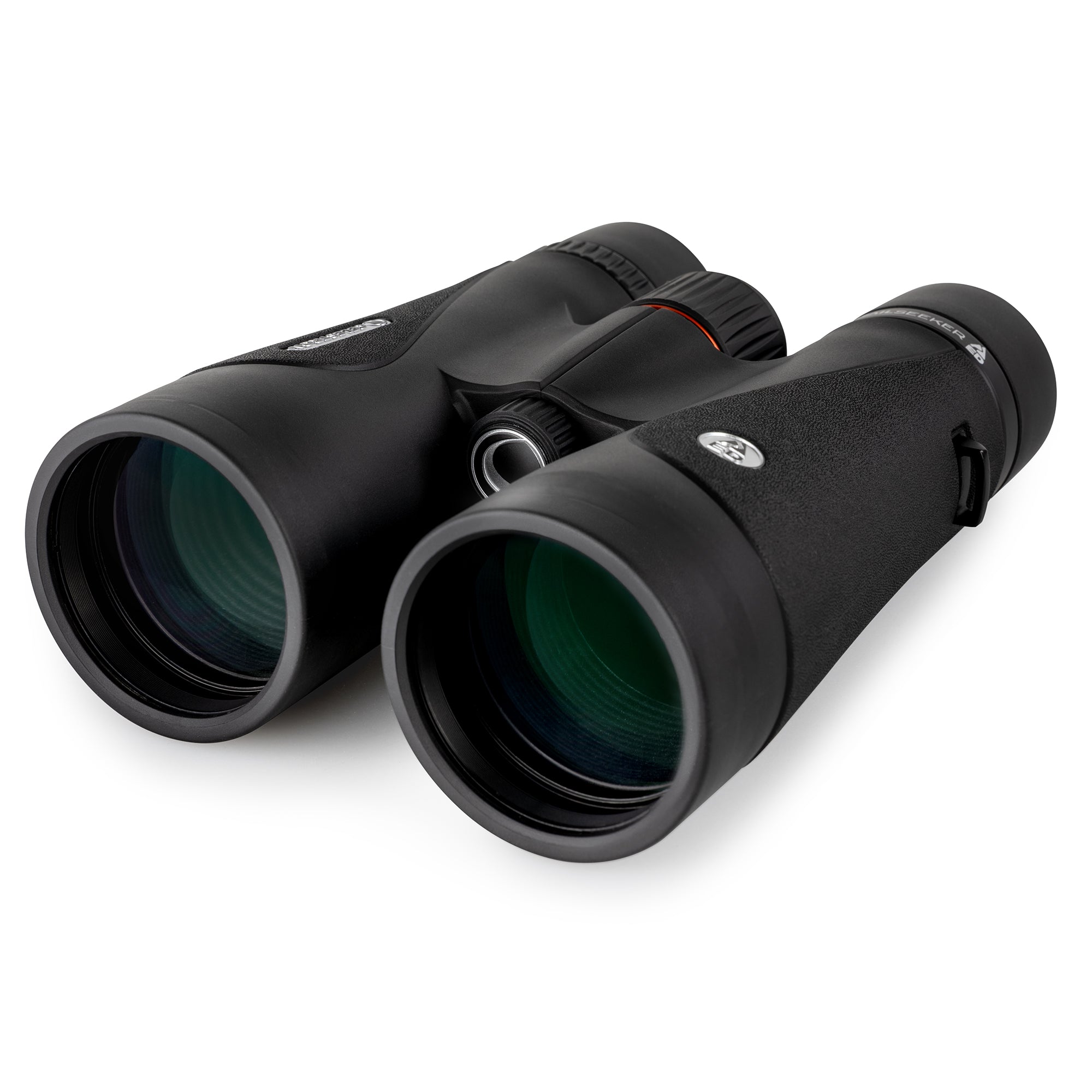
Explore this need in the finder →Celestron’s TrailSeeker ED 10x50 (item 71408) keeps 10x magnification but moves to 50 mm objectives and a 5 mm exit pupil. That puts it on the larger, heavier end of the ED family: the exact page lists 896 g (about 31.6 oz), 16.9 mm eye relief and a 9.8-foot close-focus distance. It is a candidate for someone who deliberately wants a larger objective and can carry or support the instrument—not a casual substitute for the 10x42.
What changes when the objective grows to 50 mm
The manufacturer lists 6.5° angular field and 341 feet at 1,000 yards (114 metres at 1,000 metres), plus a 5 mm exit pupil. The 10x42 ED sibling item 71407 has the same stated angular field but lists 42 mm objectives, a 4.27 mm exit pupil and 23.5 oz. A larger objective and exit pupil can matter to observers considering dimmer scenes, yet Celestron’s published numbers are not independent transmission or twilight measurements. Do not treat the page’s relative-brightness index as a guarantee of what your eyes will see.
The trade is tangible in the carry figures: the 10x50 is listed at 896 g, roughly 31.6 oz, versus 666 g / 23.5 oz for the 10x42 ED. At 10x, both magnify hand movement; the heavier 50 mm body may make a tripod more attractive for a long stationary session, and the adapter is sold separately. Its listed close focus is 9.8 feet, farther than the ED 10x42’s 8.2 feet, so a large objective does not make it the better choice for close butterfly viewing.
ED glass, coatings and published limits
The exact page identifies ED objectives and describes reduced chromatic aberration, along with phase- and dielectric-coated BaK-4 prisms and fully multi-coated optics. The ED description is a material claim, while the manufacturer’s statements about brightness and sharpness are not supported in the reviewed source set by an independent comparison test. Choose it for the exact 10x50 specification and ED feature if those fit your use; do not assume ED makes the binocular the best choice for every observer or viewing condition.
Celestron lists 16.9 mm eye relief and a 60–74 mm interpupillary range. That longer stated relief than the 10x42’s 15 mm can be relevant for glasses, but it still cannot guarantee your frame will show the full field. The TrailSeeker ED manual directs glasses users to lower the twist-up cups and explains the center focus and right-eye diopter. Test your own glasses if this fit is essential.
Weather and ownership plan
The exact item page calls the 10x50 waterproof and nitrogen-purged and describes a magnesium-alloy body with rubber armor. No immersion depth or time is stated for this configuration. That is not the same as the IPX7 1 m / 30 minute rating published on two smaller TrailSeeker ED pages; do not transfer that rating across the family. Treat waterproof as rain protection, not an invitation to submerge, pressure-wash or observe underwater.
The 10x50 page lists dimensions as 168 × 138 × 63 mm without an inch conversion or labeled axes. Its included items are loop-tethered objective caps, one-piece eyepiece covers, neck strap, harness strap, case, lens cloth, quick setup guide and a digital instruction manual. The page says a tripod adapter is sold separately. Celestron’s exact page links a 2025 TrailSeeker ED manual; its English instructions cover alignment, focus/diopter, eyecup position, tripod threads, weather care, cleaning and the Sun warning. Never look at the Sun or project its image through these binoculars.
How finder answers affect it
Choosing fixed 10x and 50 mm keeps 71408; an objective ceiling of 42 mm or a 30 oz carry limit removes it. A 16 mm eye-relief minimum accepts the published 16.9 mm, but 17 mm does not. A 10-foot close-focus maximum accepts 9.8 feet; a 9-foot limit does not. Its waterproof claim supports a basic waterproof preference, but an essential immersion-depth request is unanswered. A tripod-use plan can be supported only with a separate adapter, and a requirement that one be included rejects the package.
Who should shortlist item 71408
Shortlist the TrailSeeker ED 10x50 if the full 50 mm objective, fixed 10x power and 16.9 mm stated eye relief are worth carrying about 31.6 oz, and you accept the longer near-focus distance. It is a poor choice for lightweight travel, close focus inside 9.8 feet, a fully specified immersion rating, or an included tripod adapter. Compare the ED 10x42 item 71407 if you want the same listed field angle at lower weight and closer focus; compare ED 8x42 item 71405 if a wider 8x view and its eye-relief figure matter more than 10x reach. This article explains manufacturer-listed differences without claiming ownership, lab results or a price advantage.
Key specifications
Key details at a glance
| Magnification | 10× |
|---|---|
| Objective diameter | 50 mm |
| Real field of view | 6.5° |
| Field width at 1,000 m | 114 m |
| Eye relief | 16.9 mm |
| Exit pupil | 5 mm |
More specifications and setup details
| Close focus distance | 9.8 ft |
|---|---|
| Manufacturer-published weight | 31.6 oz |
| ED glass confirmed for this exact model | Yes |
| Phase coatings confirmed | Yes |
| Lens and prism coatings | Exact model page identifies ED objective lenses, fully multi-coated optics, BaK-4 roof prisms with phase and dielectric coatings. ED performance descriptions are manufacturer claims; no independent comparison is claimed. |
| Water and fog protection | Exact page lists waterproof construction and nitrogen fill. Exact-item immersion depth and duration are not published; do not infer underwater use. |
| Tripod use | Exact page lists tripod adaptability and says the adapter is sold separately; manual identifies threads beneath the front hinge logo plate and a separate binocular adapter. Exact adapter SKU/compatibility is not established. |
| Published weight note | Exact item page lists 896 g; 31.6 oz is a transparent unit conversion only. This is instrument weight, not packed-kit weight. |
| Manufacturer-rated waterproof | Yes |
| Tripod adapter in package | No |
Use the exact model’s instructions for operating limits, supplied equipment and version differences.
Sources for this review
Sources for this assessment
- Official Celestron US TrailSeeker collection; exact row manually rechecked in archived 18-object JSON
- Official Celestron TrailSeeker collection object; exact 71408 row and page-linked image URL personally inspected
- Celestron exact US product page, TrailSeeker ED 10x50mm Roof Binoculars, item 71408; features/specifications/package/manual link
- Official exact-product-page linked original image; original bytes and visible identity cues personally inspected
- TrailSeeker ED Binocular Manual (2025); English operations/care/safety pages personally inspected
- Official five-language TrailSeeker QSG linked from exact US page; English page 1 safety text inspected
- CPSC exact item ProductName query for 71408; empty JSON response on 2026-10-23, limited dated search

Choose your optical trade-off first.
Choose viewing purpose first, then magnification, objective size, scene width and any fit, weather or mounting constraint. A direct-Sun requirement is separate: only exact manufacturer-confirmed solar binoculars can pass it.