
On this page
A supported 7x50 for astronomy-filter use
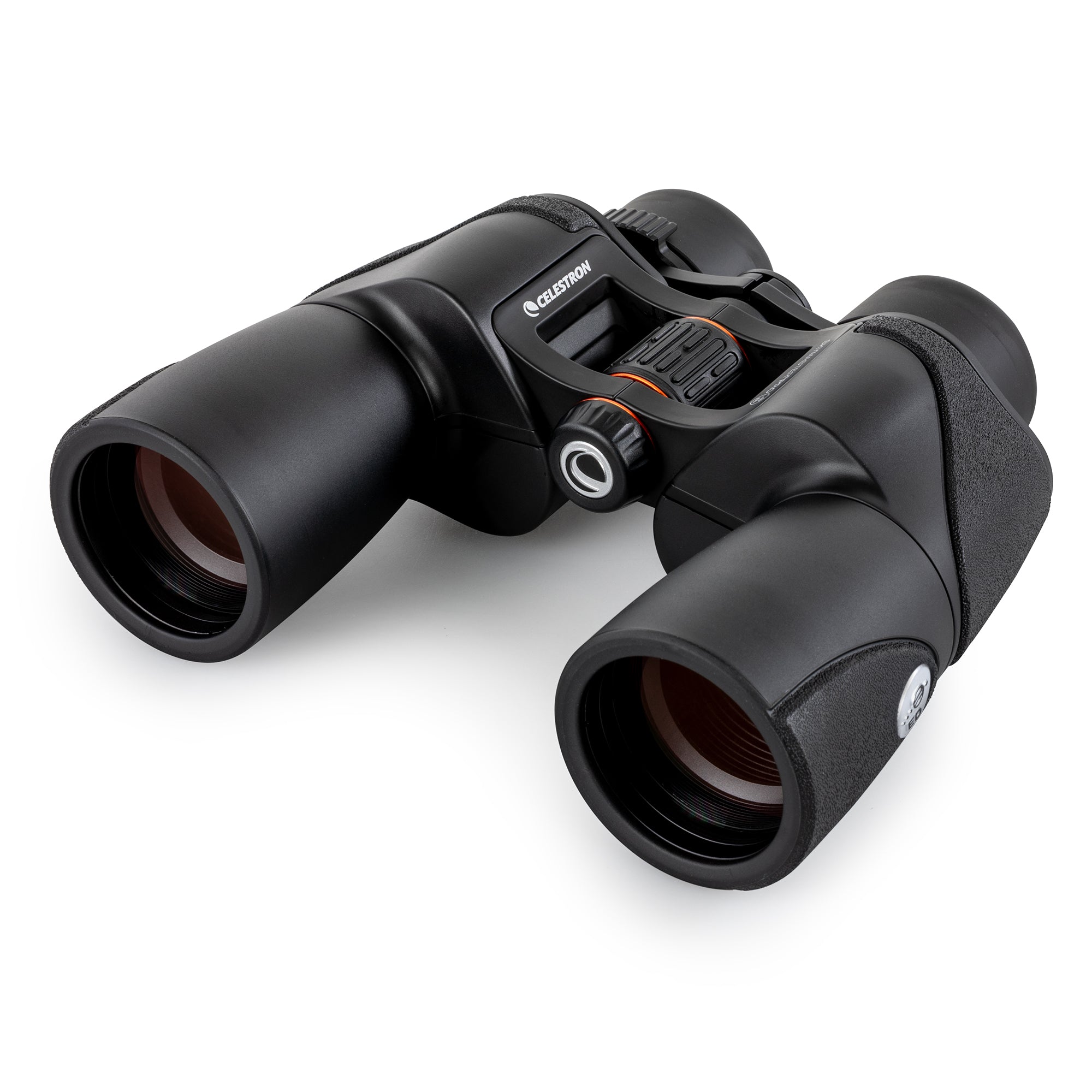
The SkyMaster Pro ED 7x50 is the large-objective 7x contrast to the pocket MIKRON: it weighs 44.3 oz, publishes a 7.8° real field and has standard 1.25-inch astronomy-filter threads. The required tripod adapter is separate and the listed 26.2 ft close focus is not for near subjects.
Your needs, this model
Does it fit your priorities?
Do I want the widest real scene and longest stated eye relief in this Pro ED family?
The 7x50 is listed at 7.8° / 409 ft at 1,000 yd and 20.8 mm of eye relief; the 15x70 and 20x80 trade away scene width and eye relief for more power.
Explore this need in the finder →Can I get a ready-to-mount tripod connection without adding hardware?
No. Item 72033 has tripod-adapter threads, but Celestron says adapter 93524 is sold separately. The 20x80 has its adapter integrated; the 7x50 does not.
Explore this need in the finder →Is its close-focus range suitable for a nearby feeder?
The published minimum is 26.2 ft, so this is a long-distance pair rather than a close-focus feeder glass.
Explore this need in the finder →The Celestron SkyMaster Pro ED 7x50 (item 72033) is the broadest, lowest-power member of this three-size family. Its 7.8° real field, 409 feet at 1,000 yards, 6.4 mm exit pupil and 20.8 mm stated eye relief suit sky scanning, distant views and viewers who want room around the subject. The body still weighs 44.3 ounces, so “handheld” does not mean effortless on a long walk.
Choose it for finding the scene, not maximum reach
At 7x, this model shows less magnification than the 15x70 or 20x80 siblings but sweeps a much wider real scene: 7.8° instead of 4.4° or 3.4°. That extra width can make it easier to locate a moving bird, scan a shoreline or move between patches of sky. Celestron describes its 7x50 as commonly used handheld for star-hopping and broad sky scans. Its relatively low power supports that plan; the nearly three-pound instrument can still tire arms, and no stabilization system is listed.
The 50 mm objectives and 6.4 mm exit pupil are a sensible pairing for twilight and night-sky use, but neither diameter nor the maker’s “relative brightness” index is a measured promise that every viewer will see more detail. The much larger pupil can also be more than the eye uses in bright daylight. If your main task is identifying a distant small subject, the 15x70 or 20x80 brings more magnification, at the cost of a narrower view and more demanding support.
Eye relief and close focus set real boundaries
Celestron lists 20.8 mm of eye relief and twist-position eyecups. That is the longest figure among the three Pro ED sizes and a useful starting point for a glasses wearer. It is not a guarantee that your glasses, brow shape and eyecup position will reveal the full field: try the pair while wearing the glasses you use. The published 26.2-foot close-focus distance is also long. This is not a good choice for a nearby feeder or close garden subjects; a conventional birding binocular with a shorter focus range will be more versatile there.
The manual gives a helpful setup order: adjust the hinge until both barrels merge into one image, set the central focus for the left eye, then use the separate diopter ring for the right eye. Recheck the ring if someone changes it. The manufacturer does not describe a locking diopter on this configuration, so do not select it for a lock requirement. With three sizes in the household, mark each observer’s setting rather than assuming one adjustment works for everyone.
Filter threads and weather protection add scope
The family uses 1.25-inch astronomy-filter-compatible eyepieces. That is a specific accessory option for visual astronomy, not a reason to add filters automatically: check that the filters are appropriate for binocular viewing and follow the manual’s instructions for both eyepieces. Celestron also specifies BaK-4 prisms, fully multi-coated XLT optics and ED objective glass. The company says ED glass reduces chromatic aberration; these are manufacturer feature claims, not the results of an independent comparison or a guarantee that color fringes disappear in every lighting condition.
The product page labels the body waterproof to IPX7 and nitrogen-filled, a useful weather-resistance feature for outdoor use. Those labels do not make it a diving instrument. Dry the body before storage and avoid forcing the focus or hinge when wet. The manual recommends keeping grit off the lenses, using a soft brush or air before wiping, and sending repairs to Celestron or an authorized repair provider rather than opening the binocular.
Mounting is optional, but the adapter is not in the standard package
For a short scan, the 7x power gives the hand-held operating plan Celestron describes. For long sessions, a tripod can reduce arm fatigue. The exact product FAQ says a tripod adapter is not included and names Celestron adapter 93524 as the separate accessory. The threaded adapter port is therefore not the same thing as ready-to-mount hardware. If your essential requirement is a tripod adapter already supplied, this model does not clear it; if optional hardware is acceptable, include its fit and added cost in the setup you plan.
Against the 15x70, the 7x50 gives up reach and 20 mm of objective diameter for a much wider real field, longer eye relief, lower instrument weight and easier scanning. Against the 20x80, it is nearly five pounds lighter and more suitable for a moving observer, while its subjects appear much smaller. For a lighter all-purpose birding pair, a mid-size roof-prism model is a better place to compare than another 50 mm Porro. Choose the 7x50 when the wide scene, long stated eye relief, water protection and astronomy threads matter more than pocketability, close focus or maximum magnification.
Used SKU U72033 keeps the 7x50 optics, not a known unit condition
The Used Outlet listing calls this item U72033 and directs readers to the regular 72033 Pro ED page for full details. It was marked out of stock on October 24, 2026. The 7x50 specification is not a different configuration, and its lower power relative to the family’s 15x70 and 20x80 sizes remains the relevant handling distinction. Celestron’s general claim that used items have been inspected, are working, and carry the same comprehensive warranty should not be mistaken for an independent, unit-specific condition report. Keep U72033 as a condition variant of this profile; it is not another current recommendation.
Exact-model details: Celestron SkyMaster Pro ED 7x50 item 72033, its Used Outlet SKU U72033 listing; shared SkyMaster Pro ED manual for items 72033, 72034 and 72035.
Key specifications
Key details at a glance
| Magnification | 7× |
|---|---|
| Objective diameter | 50 mm |
| Real field of view | 7.8° |
| Field width at 1,000 m | 136 m |
| Eye relief | 20.8 mm |
| Exit pupil | 6.4 mm |
More specifications and setup details
| Close focus distance | 26.2 ft |
|---|---|
| Manufacturer-published weight | 44.3 oz |
| ED glass confirmed for this exact model | Yes |
| Lens and prism coatings | Celestron lists fully multi-coated optics with XLT coatings. Its exact product page describes ED objective lenses and says ED glass is formulated to reduce chromatic aberration; that is a manufacturer feature statement, not a comparative independent image test. Prism-coating status is shown as N/A in the specification table; phase/dielectric coatings are not established. |
| Water and fog protection | Celestron labels the model waterproof to IPX7 and nitrogen-filled. It does not publish a model-specific depth/duration in the table reviewed; do not infer a diving use. Keep the binocular dry before storage and follow its care instructions. |
| Tripod use | Celestron exact product FAQ says tripod adapter 93524 is not included; the manual shows adapter threads for 7x50/15x70 and requires the separate adapter. |
| Manufacturer-rated waterproof | Yes |
| Tripod adapter in package | No |
Use the exact model’s instructions for operating limits, supplied equipment and version differences.
Sources for this review
Sources for this assessment
- Celestron US SkyMaster Pro ED 7x50mm Porro Binoculars product page (item 72033)
- Celestron US binocular collection page 2
- Celestron SkyMaster Pro ED manual, English section; cover lists 72033, 72034, 72035
- Celestron SkyMaster Pro ED quick setup guide, cover lists 72033, 72034, 72035
- CPSC Recalls API exact product-name query for model number 72033
- Celestron Used Outlet exact US product page for U72033
Choose your optical trade-off first.
Choose viewing purpose first, then magnification, objective size, scene width and any fit, weather or mounting constraint. A direct-Sun requirement is separate: only exact manufacturer-confirmed solar binoculars can pass it.
Your needs, this model
Binoculars with confirmed 1.25-inch astronomy-filter threads
Choose it when: It is the broad-view, lowest-mass configuration among the three confirmed filter-threaded matches.
Binoculars with confirmed 1.25-inch astronomy-filter threads →50 mm binoculars: low-power sky view or 10x reach
Choose it when: The low 7x power and published wide real field suit a broad stationary or sky view; this exact model also confirms standard astronomy-filter compatibility.
50 mm binoculars: low-power sky view or 10x reach →Choosing a 7x binocular by viewing setup
Choose it when: This is the contrasting 7x choice when the larger 50 mm setup and published astronomy-filter compatibility are useful. It publishes 20.8 mm eye relief and is tripod adaptable, so it addresses a supported viewing plan rather than pocket carry.
Choosing a 7x binocular by viewing setup →