
On this page
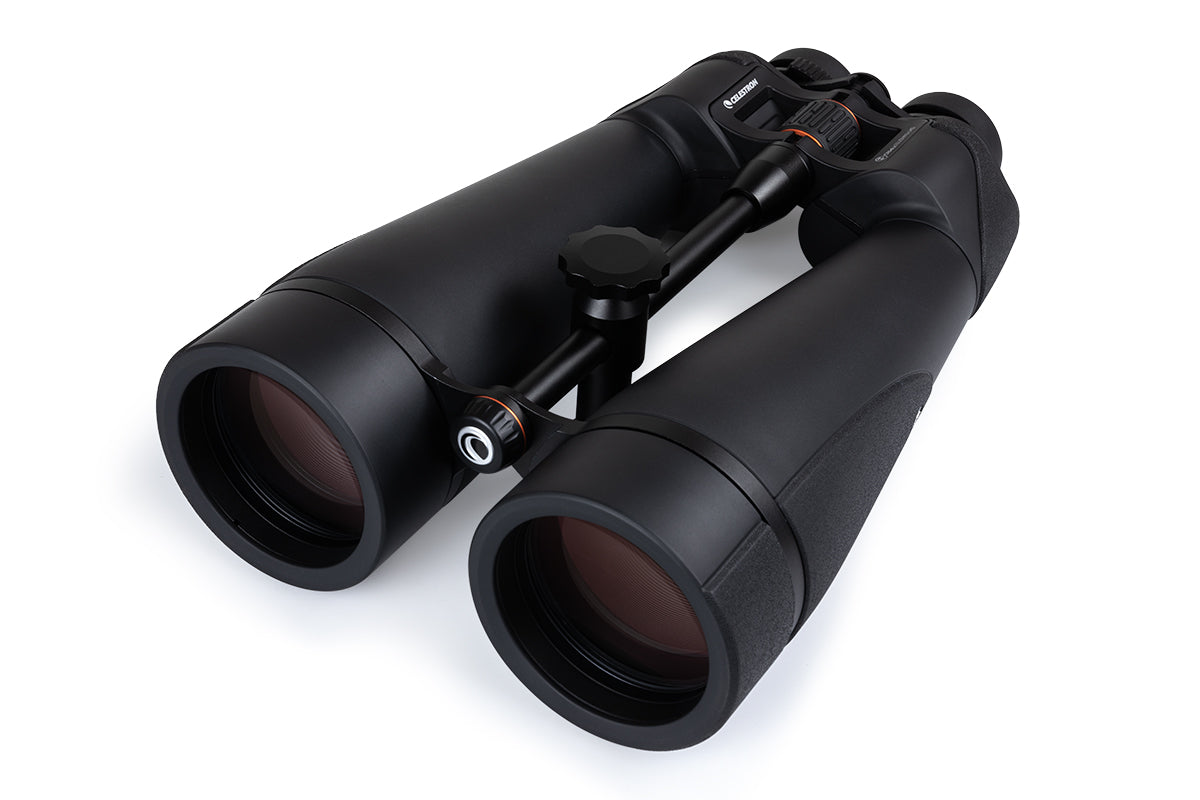
A supported 20x80 with integrated adapter rod
The SkyMaster Pro ED 20x80 is the 123.2 oz tripod-oriented member of the exact 20x result, with 3.4° real field and an integrated adapter rod. It is a large, distant-viewing instrument rather than a handheld walking pair; the tripod and any viewing base remain separate.
Your needs, this model
Does it fit your priorities?
Do I need the family’s highest reach and 80 mm objective for a distant stationary view?
Item 72035 provides 20x and 80 mm objectives. It also has the narrowest 3.4° / 178 ft real field and weighs 123.2 oz.
Explore this need in the finder →Is there a tripod adapter already attached to the 20x80?
Yes. The common manual identifies a built-in sliding tripod adapter on the 20x80 center support rod; the 7x50 and 15x70 require separate adapter 93524.
Explore this need in the finder →Can the 20x80 meet a 16 mm minimum eye-relief requirement?
No. Celestron lists 15.4 mm. A 16 mm minimum is a real fit boundary even though the model has the highest power and a built-in tripod adapter.
Explore this need in the finder →The Celestron SkyMaster Pro ED 20x80 (item 72035) is the family’s high-magnification, fixed-support option. Its 20x view, 80 mm objectives and integrated sliding tripod adapter fit a stationary astronomy or distant-land setup better than a walking kit. The trade is substantial: the binocular alone weighs 123.2 ounces, the real field is 3.4°, eye relief is 15.4 mm and close focus begins at 98.4 feet.
Decide on a stationary setup before choosing 20x
At 20x, the image enlarges distant subjects more than either the 7x50 or 15x70, but the published real field shrinks to 3.4° (178 feet at 1,000 yards). The narrowest scene in the family means it is less forgiving when you are trying to locate a moving bird, follow activity across the sky or scan a broad horizon. The 80 mm objectives and 4.0 mm exit pupil suit the maker’s astronomy-oriented positioning, while the higher power makes hand movement more visible. Celestron’s provided hardware is a center support rod with a built-in tripod adapter that slides to find a balance point, rather than an extra model to buy.
The support convenience does not make it portable: the instrument weighs 3,492 g / 123.2 oz, more than 7.5 pounds before a tripod. The useful plan is a stable mount and a viewing location where you can leave the setup assembled. It is not the default choice for a long hike, quick wildlife spotting or household use that involves passing the binocular around. If the stand is not part of your outing, the lower-power 7x50 or lighter conventional birding binocular is a better comparison.
Look closely at the eye point and near limit
Celestron lists 15.4 mm eye relief and twist-position eyecups. This is the shortest published eye-relief figure among the three sizes; glasses wearers should test before buying rather than treating the “eyeglass-friendly” family description as a guarantee. The eye distance also cannot be increased by the tripod. Adjust the interpupillary hinge until a single image forms, and then set the separate diopter ring for the observer’s eyes using the manual’s steps.
The 98.4-foot close-focus figure is a clear restriction for nearby wildlife or anything in a yard. At close distances this model cannot perform the role of a short-focus birding glass. At a distant fixed site, that limit may be irrelevant, but the trade should be explicit. The 3.4° real field, 178-foot field width and high magnification point toward a framed distant view rather than a wide scan.
ED glass, filter threads and weather resistance
The product page identifies ED objective lenses, BaK-4 prisms and fully multi-coated XLT optics. Celestron says ED glass reduces chromatic aberration; no independent test is available here to rank the image or guarantee that fringe color disappears. The 1.25-inch threaded eyepieces accept standard astronomical filters. That can be useful for a planned visual astronomy session, but compare actual filter purpose and use matched, correctly mounted filters on both sides as the manual instructs.
The manufacturer lists IPX7 waterproofing and nitrogen filling. It also supplies lens caps, eyepiece covers, a rain guard, strap, lens cloth, desiccant, case and instruction manual. Keep the lens surfaces free from grit, close the caps when stored, and do not look at the Sun or use the binocular to project sunlight. Waterproofing and a heavy body do not remove the need for normal care after a damp night outside.
Out-of-stock status does not change the identity
Celestron’s US collection page showed the exact 72035 model as out of stock when checked, while the product page still provided a model-specific record and dealer listings. Availability can change and is not a reason to omit a useful review. This assessment does not promise current stock or price; use the exact model term when checking a retailer and compare the item number, package and return conditions. The exact model search is “Celestron SkyMaster Pro ED 20x80mm Porro Binoculars 72035,” not the similar non-ED SkyMaster 20x80.
Against the 15x70, the 20x80 gives more nominal magnification and aperture, a narrower real view and nearly 50 ounces more body weight. It has the integrated tripod adapter, whereas item 72034 requires separate adapter 93524. Against the 7x50, it is a dedicated mounted instrument rather than a broad-scanning handheld option. Choose it if the 20x view, 80 mm objectives and built-in balanced support serve a real stationary plan. If you do not already have a sturdy tripod and fixed place in mind, the weight and narrow field are reasons to reconsider before buying.
The U72035 page is not a separate 20x80 design
Used Outlet SKU U72035 is the used-condition listing for the same SkyMaster Pro ED 20x80 configuration described above. Its exact US page points back to original item 72035 and was out of stock when checked on October 24, 2026. Celestron gives a general inspected-and-working assurance and says the same comprehensive warranty applies, but this does not tell us the condition of an individual pair or establish a unit-specific inspection result. The 20x80’s weight, high power, support needs, and ED designation belong to the model; a Used Outlet label neither changes them nor supplies a second optical profile.
Exact-model details: Celestron SkyMaster Pro ED 20x80 item 72035, its Used Outlet SKU U72035 listing; shared SkyMaster Pro ED manual for items 72033, 72034 and 72035.
Key specifications
Key details at a glance
| Magnification | 20× |
|---|---|
| Objective diameter | 80 mm |
| Real field of view | 3.4° |
| Field width at 1,000 m | 59 m |
| Eye relief | 15.4 mm |
| Exit pupil | 4 mm |
More specifications and setup details
| Close focus distance | 98.4 ft |
|---|---|
| Manufacturer-published weight | 123.2 oz |
| ED glass confirmed for this exact model | Yes |
| Lens and prism coatings | Celestron lists fully multi-coated optics with XLT coatings. Its exact product page describes ED objective lenses and says ED glass is formulated to reduce chromatic aberration; that is a manufacturer feature statement, not a comparative independent image test. Prism-coating status is shown as N/A in the specification table; phase/dielectric coatings are not established. |
| Water and fog protection | Celestron labels the model waterproof to IPX7 and nitrogen-filled. It does not publish a model-specific depth/duration in the table reviewed; do not infer a diving use. Keep the binocular dry before storage and follow its care instructions. |
| Tripod use | The shared manual labels the 20x80 adapter as built in and explains that it slides on the center support rod to locate a balance point. |
| Manufacturer-rated waterproof | Yes |
| Tripod adapter in package | Yes |
Use the exact model’s instructions for operating limits, supplied equipment and version differences.
Sources for this review
Sources for this assessment
- Celestron US SkyMaster Pro ED 20x80mm Porro Binoculars product page (item 72035)
- Celestron US binocular collection page 2
- Celestron SkyMaster Pro ED manual, English section; cover lists 72033, 72034, 72035
- Celestron SkyMaster Pro ED quick setup guide, cover lists 72033, 72034, 72035
- CPSC Recalls API exact product-name query for model number 72035
- Celestron Used Outlet exact US product page for U72035
Choose your optical trade-off first.
Choose viewing purpose first, then magnification, objective size, scene width and any fit, weather or mounting constraint. A direct-Sun requirement is separate: only exact manufacturer-confirmed solar binoculars can pass it.
Your needs, this model
Binoculars with confirmed 1.25-inch astronomy-filter threads
Choose it when: Choose this highest-power, largest-aperture member when a stationary 20x view and filter-threaded eyepieces matter more than carry weight.
Binoculars with confirmed 1.25-inch astronomy-filter threads →80 mm binoculars: compare three 20x80 setups
Choose it when: The Pro ED is the documented filter-threaded 80 mm option, with ED glass and an integrated balance rod for tripod mounting.
80 mm binoculars: compare three 20x80 setups →20x binoculars: tripod system or fork-mounted telescope
Choose it when: Choose this 20x80 when supported high-power viewing fits but a dedicated fork-and-base system is unnecessary. Celestron's shared manual describes the 20x80's integrated adapter rod and balance adjustment.
20x binoculars: tripod system or fork-mounted telescope →