
On this page
Your needs, this model
Does it fit your priorities?
Does this 10x42 fit a 28-ounce limit with 20 mm stated eye relief?
Yes by the published 27.1 oz weight and 20.2 mm eye-relief figure; neither includes case weight nor guarantees fit.
Explore this need in the finder →Does the 10x42 fit a waterproof requirement and a five-foot close-focus ceiling?
The exact page lists waterproof construction and 4.9 ft close focus, without a depth or duration limit.
Explore this need in the finder →Is the stated 6.5° field enough if six degrees are essential?
Yes by Celestron’s published angular field; a seven-degree minimum would not fit.
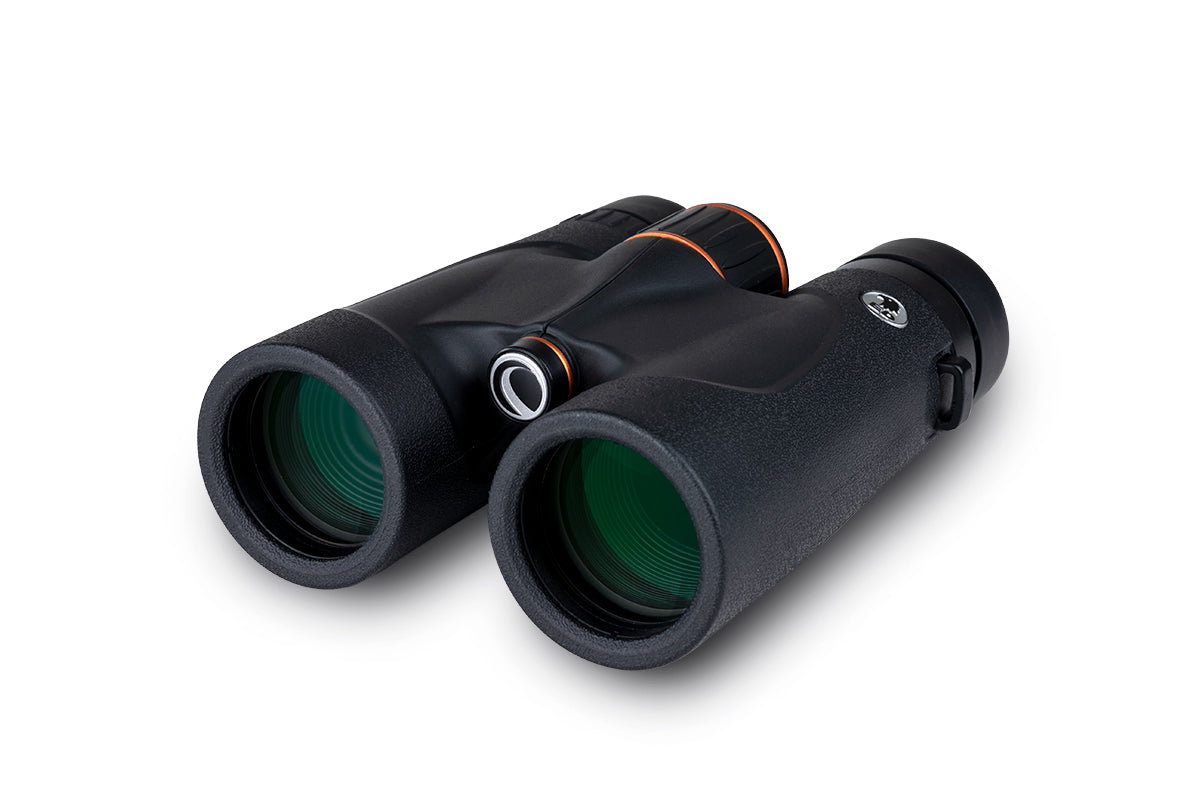
Explore this need in the finder →Celestron’s Regal ED 10x42 (item 71391) combines ten-power magnification with 42 mm roof-prism objectives. The exact U.S. page lists a 6.5° real field, 20.2 mm eye relief and 27.1 oz (768 g) instrument weight. It is currently listed by Celestron as available in the source snapshot checked 2026-10-24. The related Regal ED 8x42 has the same objective diameter and listed weight but a wider 8.0° field, larger exit pupil and more eye relief. This is a choice between two exact configurations, not evidence that one has better measured optics.
Ten power suits a different viewing rhythm
The 10x42’s listed field is 340 ft at 1,000 yards (113 m at 1,000 m), with a 4.27 mm exit pupil. Ten power shows a distant subject larger than eight power, which can help when viewing across open ground, a shoreline or a field. The trade is that small hand movements appear larger and the narrower field gives less space around a moving subject. This is why “more magnification” is not a universal upgrade for birding or walking. If you often need to acquire a fast-moving bird, the 8x42’s 420-foot listing is a meaningful difference to consider.
Celestron lists a close-focus figure of 4.9 ft. That is a maker-published minimum, not an independent measurement; it is still a useful distinction from the Cometron 7x50’s 26.2 ft. The standard 4.27 mm exit pupil is the 42 mm objective divided by ten. It does not guarantee brightness or comfort: eye placement, ambient light, vision and optical condition all affect what a person sees. The listed 20.2 mm eye relief is less generous numerically than the 8x model’s 22.5 mm. People who keep glasses on should check whether they can see the full field with eyecups down instead of treating either number as a fit promise.
Design claims and body details
The exact Regal ED page identifies ED objective glass, BaK-4 roof prisms, phase-correcting and dielectric prism coatings, and fully multi-coated optics. These are useful differentiators from lower-tier Celestron models whose pages may list only basic multi-coated optics; they remain specifications rather than independent resolution, color-fringing or contrast results. A retail comparison cannot convert the coating names into a score. The 10x42’s case, harness, neck strap, caps, lens cloth and quick-start guide are listed in the package. The hard case is described by Celestron as a woven-cloth covered case.
The case and binocular together are not represented by the 27.1 oz figure; that is the instrument weight. If weight is a strict hiking limit, allow for the case, strap and any extra support separately. Celestron lists the binocular as tripod adaptable, while its family manual illustrates a separate adapter; the product’s included-items list does not name one. A tripod-ready socket therefore is not the same as a tripod adapter being in the carton. If your plan requires tripod use, check the exact accessory and package before purchase.
Focus, eyecups and weather limits
The five-language Regal ED manual gives an initial sequence: set the interpupillary distance until the two circles merge, focus on a distant target with the central wheel while the left eye is open, then set the right-eye diopter and use the center wheel for later focusing. Twist the eyecups down with glasses and up without them, then check eye placement before judging sharpness. A correct diopter setting avoids asking one eye to compensate for the other. The quick-start sheet repeats the essential setup and Sun warning.
The exact page lists waterproof construction and nitrogen filling. It gives no rated immersion depth or duration, so this is not an underwater instrument. The protection wording is relevant to weather exposure, but avoid leaving it wet or relying on it as a sealed submersible. The manual also advises keeping the lenses capped when not used, storing them away from heat and cleaning only after loose dust is removed. Never look at the Sun through these binoculars.
How to choose it in a shortlist
This model is a plausible match for a person who specifically wants a 10x42, accepts a roughly 27-ounce instrument and values the manufacturer’s ED/coating package. A questionnaire requiring 10x, 42 mm, a maximum weight of 28 oz and at least 20 mm stated eye relief can include it. Raising the eye-relief floor to 21 mm should exclude it, even if another user with a different face and eyeglasses could see comfortably. A six-degree real-field requirement passes on the listed 6.5°; a seven-degree requirement does not.
For more context, the Regal ED 8x42 is the steadier-to-follow, wider-field sibling and lists 22.5 mm eye relief at the same mass. If lower power and a large nominal pupil matter, the Cometron 7x50 is a different Porro design, but its longer close focus, short 13 mm eye relief and non-waterproof construction create clear constraints. If you need less weight than either Regal, compare exact 8x32 or 10x32 models, accepting smaller objectives and checking their own field and weather claims. Do not assume a shared brand name transfers the ED glass, coatings or package accessories between families.
No bench measurements or ownership experience are claimed here. Evaluate eye position, focus travel and image comfort in person when those determine the choice. For a used instrument, confirm the diopter and hinge work, inspect for haze or fungus, and verify which caps and accessories are actually present.
Exact identity/specifications: Celestron Regal ED 10x42 item 71391. Operation/care: Regal ED manual and quick-start guide.
Key specifications
Key details at a glance
| Magnification | 10× |
|---|---|
| Objective diameter | 42 mm |
| Real field of view | 6.5° |
| Field width at 1,000 m | 113 m |
| Eye relief | 20.2 mm |
| Exit pupil | 4.27 mm |
More specifications and setup details
| Close focus distance | 4.9 ft |
|---|---|
| Manufacturer-published weight | 27.1 oz |
| ED glass confirmed for this exact model | Yes |
| Phase coatings confirmed | Yes |
| Lens and prism coatings | Celestron lists ED objective glass, BaK-4 roof prisms, phase-correcting and dielectric prism coatings, and fully multi-coated optics. These are manufacturer design claims, not independent optical test results. |
| Water and fog protection | Celestron lists waterproof construction and nitrogen filling; no immersion depth or duration is published. Do not infer underwater use. |
| Tripod use | Celestron marks this model tripod-adaptable. The family manual requires a separate binocular adapter; it is not in the exact model’s package list. |
| Published weight note | Celestron lists 27.1 oz (768 g) instrument weight; no independent scale measurement is claimed. |
| Manufacturer-rated waterproof | Yes |
| Tripod adapter in package | No |
Use the exact model’s instructions for operating limits, supplied equipment and version differences.
Sources for this review
Sources for this assessment
- Celestron binocular collection Shopify products response, 94 exact objects under limit=250
- Celestron exact U.S. product page, item 71391
- Regal ED five-language binocular family manual; English operating and care sections inspected.
- Regal ED five-language printed quick-start sheet; English setup and warning panel
- CPSC exact ProductName query for item 71391; empty response only
Choose your optical trade-off first.
Choose viewing purpose first, then magnification, objective size, scene width and any fit, weather or mounting constraint. A direct-Sun requirement is separate: only exact manufacturer-confirmed solar binoculars can pass it.