
On this page
Your needs, this model
Does it fit your priorities?
Does the ED 8x42 meet an 8x, 42 mm, wide-field and ED-essential path?
Yes. The page confirms 8x42, 7.5° real field and ED objectives.
Explore this need in the finder →Does the ED 8x42 fit an 18 mm eye-relief minimum?
No. Celestron lists 17.8 mm, below that threshold.
Explore this need in the finder →Can the ED 8x42 use a supplied tripod adapter?
Tripod adaptation is supported, but the page does not list the required adapter in the box.
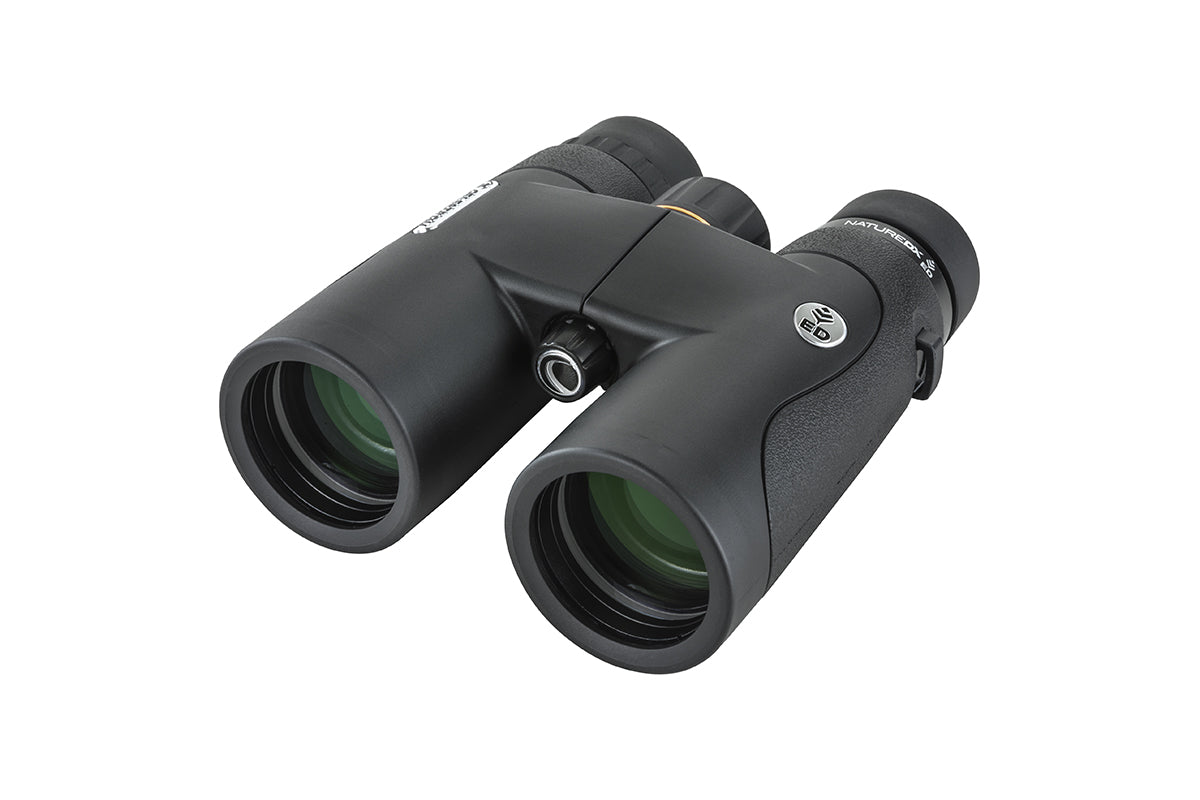
Explore this need in the finder →Celestron Nature DX ED 8x42 item 72332 is the wide-view ED configuration: 8x magnification, a 42 mm objective, a 7.5° real field, 5.25 mm exit pupil and 17.8 mm stated eye relief. The manufacturer lists the body at 24.9 oz. It is a sensible candidate for someone who wants a general-purpose 8x42, explicit ED glass and a broad scene, and can carry a full-size binocular. The ED label is a real model distinction, not a measured promise that it will outperform every standard alternative in all conditions.
Wide scene first, magnification second
The 7.5° field is wider than the 5.9° Nature DX ED 10x42 and the 5.5° standard 12x56. At 8x, the frame also puts less angular enlargement on a small hand tremor than a ten- or twelve-power view. Those qualities help when finding moving wildlife or looking across a shoreline. Celestron reports 393 ft at 1,000 yards and 129 m at 1,000 m. The published field pair does not exactly normalize to the same distance: the foot figure works out to roughly 131 m at 1,000 m, so keep the maker’s raw pair and compare the 7.5° angle rather than treating 129 m as a precision normalized width.
The 5.25 mm exit pupil follows the 42 mm aperture and 8x magnification. Celestron states that its Extra-Low Dispersion objective lenses reduce defects such as color fringing and lists fully multi-coated optics with phase-coated BaK-4 prisms. These are useful construction details. The maker’s description is not independent testing, and the ED badge alone cannot guarantee a particular viewer’s impression of color, contrast, edge sharpness or brightness. If ED is not an essential constraint, compare standard Nature DX 8x42 items 71332 and 72322 rather than presuming their image is poor.
Full-size fit and close focusing
At 24.9 oz, item 72332 is nearly seven ounces heavier than the 18 oz 8x32 item 71330. The larger 42 mm objective and 5.25 mm exit pupil are reasons to consider the full size, but they do not erase the carry difference. Celestron lists a 6.5 ft close-focus distance, 56–74 mm interpupillary range and ±3 diopter adjustment. Eye relief is 17.8 mm, only slightly longer than the standard 8x42 figures; “eyeglass friendly” is not a personalized fit guarantee. Set the twist-up cups to suit your glasses and verify the whole circular field before choosing by the number alone.
The Nature DX ED manual describes a useful setup procedure: match the hinge spacing to your pupils, focus a distant object with the center wheel while viewing through the left side, and then adjust the right-eye diopter separately. Once set, the center wheel handles ordinary focus. A question about reaching focus near the published 6.5 ft should distinguish that specification from perfect binocular close-focus performance for every individual eye.
Weather and tripod limits
The exact page lists waterproofing, nitrogen fill and tripod adaptability. It does not state an immersion depth or time. Do not convert this into an underwater rating. For tripod use, the standard package list does not include the necessary binocular adapter; it must be acquired separately. A handheld 8x42 plan is simpler for normal walks, while an adapter and stable support are more sensible if the observation will be long and stationary. The listed contents are a strap, objective caps, rainguard, padded nylon canvas case, lens cloth and instruction manual; bundles can vary by seller and used condition.
The manual’s safety and care instructions apply to the ED family: keep the lens caps with the instrument, store it in a cool, dry place and remove grit before cleaning glass. Celestron warns not to look at the Sun through the binocular or use it to project sunlight. Those limits are separate from its ED construction and weather rating.
Fit the model to the answers
Choose 8x, 42 mm and confirmed ED if each is essential. A 6° real-field requirement retains the 7.5° value; a 10x answer removes it. A 25-ounce limit accepts its listed 24.9 oz, while a strict 24-ounce cap does not. A 17 mm stated eye-relief floor accepts the table’s 17.8 mm, but an 18 mm requirement does not. A 7 ft close-focus ceiling fits 6.5 ft. Waterproofing is stated; ED is confirmed; adapter-in-box and underwater use are not. A matching system should not fill unknown fields optimistically.
The ED 10x42 item 72333 shares the 42 mm objective and 24.9 oz weight but trades down to a 5.9° field and 14.3 mm eye relief for ten-power reach. The lighter 8x32 item 71330 keeps a wide 7.4° field and a 4 mm exit pupil but does not confirm ED. This 8x42 is the balanced, full-size option when a broad scene and the ED specification matter more than minimizing pack weight; test the eye position and support plan before treating it as an automatic upgrade.
Used Outlet listing U72332 is a condition variant
Celestron’s Nature DX collection also exposed the exact manufacturer listing Used Nature DX ED 8x42 listing U72332. Its item number U72332 links back to this same optical configuration, so it is covered here as a used-condition listing rather than a different magnification or a separate recommendation profile. The archived page showed out of stock on 2026-10-24. Its general Used Outlet text describes the maker’s inspection and warranty policy, not a unit-specific optics, alignment, accessory or condition report; do not assume a particular used specimen is available or in a stated condition.
Exact identity and specifications: Celestron Nature DX ED 8x42 item 72332. Setup, care and safety: Celestron Nature DX ED binoculars series manual.
Key specifications
Key details at a glance
| Magnification | 8× |
|---|---|
| Objective diameter | 42 mm |
| Real field of view | 7.5° |
| Eye relief | 17.8 mm |
| Exit pupil | 5.25 mm |
| Close focus distance | 6.5 ft |
More specifications and setup details
| Manufacturer-published weight | 24.9 oz |
|---|---|
| ED glass confirmed for this exact model | Yes |
| Phase coatings confirmed | Yes |
| Lens and prism coatings | Celestron identifies ED objective lenses, fully multi-coated optics and phase-coated BaK-4 roof prisms. ED is a manufacturer-described design intended to reduce chromatic aberration; no independent performance measurement is inferred. |
| Water and fog protection | Celestron lists waterproof construction and nitrogen fill. The exact page gives no depth or duration for submersion; do not treat this as an underwater-use specification. Keep caps on and store the instrument dry per the series manual. |
| Tripod use | The exact product page calls the model tripod adaptable; the family manual shows an adapter between the binocular thread and a photographic tripod. The adapter is required and not in the manufacturer-listed package contents. |
| Published weight note | Celestron publishes 24.9 oz (705 g). Dimensions are the published numeric tuple; where the imperial tuple conflicts, the dossier records the conflict and leaves interpreted inches unknown. These are manufacturer values, not independent packed-weight measures. |
| Manufacturer-rated waterproof | Yes |
| Tripod adapter in package | No |
Use the exact model’s instructions for operating limits, supplied equipment and version differences.
Sources for this review
Sources for this assessment
- Celestron Nature DX US collection page 1; exact linked model row observed
- Celestron exact Nature DX US product page, item 72332
- Celestron Nature DX ED five-language manual; English setup and care inspected
- CPSC exact item-number ProductName query for 72332; empty array on 2026-10-23
- Used - Nature DX ED 8x42mm Roof Binoculars exact Celestron Used Outlet listing
Choose your optical trade-off first.
Choose viewing purpose first, then magnification, objective size, scene width and any fit, weather or mounting constraint. A direct-Sun requirement is separate: only exact manufacturer-confirmed solar binoculars can pass it.