
On this page
Your needs, this model
Does it fit your priorities?
Does the 72322 page document an 8x42 with a wide real field and weather protection?
Yes. Its exact item page lists an 8x42, 7.4° real field and waterproof construction.
Explore this need in the finder →Does this 8x42 meet a 17 mm stated eye-relief minimum when a 25 oz carry ceiling is acceptable?
Celestron publishes 17.5 mm eye relief and 24.9 oz for item 72322; the values meet those limits but do not guarantee an eyeglass fit.
Explore this need in the finder →Does the exact 8x42 meet a seven-foot close-focus maximum?
Yes. The page lists 6.5 ft close focus, inside the seven-foot maximum; a closer target is not supported.
Explore this need in the finder →Celestron’s Nature DX 8x42 item 72322 is the heavier of two exact 8x42 listings in the standard Nature DX line. The product page gives the same principal optical figures as item 71332—8x, 42 mm, 7.4° real field, 388 ft at 1,000 yards, 5.25 mm exit pupil and 17.5 mm eye relief—but lists a larger 142 × 128 × 56 mm body at 24.9 oz. That difference matters when a carry-weight limit is firm.
Its use case is the broad 8x scene
Eight power is a practical choice when you need to locate an animal in brush, track a moving subject or watch across open water without giving up the surroundings. Celestron’s 7.4° real field and 388-foot published width support that sort of scanning. The 42 mm objectives make this a full-size outdoor binocular; the listed mass is about a pound and a half before accessories. It is not a compact for a small day bag simply because the roof-prism body is narrower than a traditional Porro shape.
There is no variable zoom. If a smaller distant subject is more important than scene width, the Nature DX 10x42 gives 10x magnification but narrows the listed field to 5.8° and shortens stated eye relief to 14 mm. A higher power can make it easier to inspect a distant detail when you can hold the image steadily; it cannot compensate for heat shimmer, poor focus or movement of the subject. For birding that mixes close woodland and distant open-field views, the exact 6.5 ft closest focus remains a useful boundary to check against where you expect to watch.
Why the 72322 body is a distinct configuration
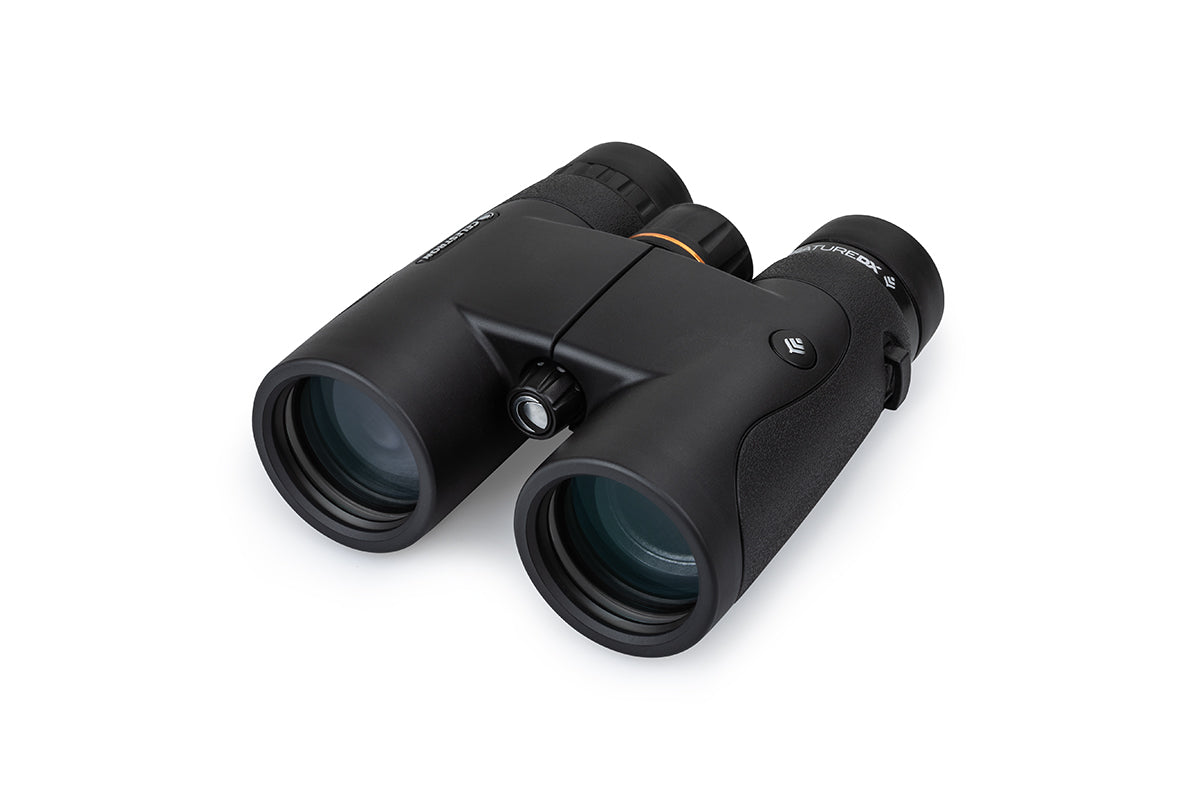
It is tempting to treat 72322 as interchangeable with item 71332 because the names and optical numbers on Celestron’s pages match. Do not ignore the published mechanical specifications: 72322 is 24.9 oz and 142 × 128 × 56 mm; 71332 is 22.2 oz and 135 × 126 × 52 mm. Celestron does not tell shoppers why the body dimensions and weight differ, so there is no evidence here to assign a generation date, claim a revised optical train or call the difference merely a packaging change. The image is linked from the exact page, but its photography-versus-render status is not stated and is not a technical test.
Both exact pages state waterproof construction, nitrogen fill, phase-coated BaK-4 prisms, fully multi-coated optics and tripod adaptability. Both list a neck strap, objective caps, rain guard, padded nylon canvas case, lens cloth and instruction manual. The manufacturer’s shared English manual covers Nature DX operation rather than distinguishing these two product numbers, so the separate item-level specification pages are the basis for weight and size.
Fit is a personal check, not a number alone
Celestron lists 17.5 mm eye relief, twist-up eyecups with several positions, 56–74 mm interpupillary distance and a ±3 diopter adjustment range. The manual shows how to set the central focus and right-eye diopter separately and recommends lowering the eyecups for glasses. That provides a reasonable starting point for glasses wearers, but the stated relief cannot guarantee a complete, comfortable field through every frame. At a shop or return window, use your usual glasses, set the hinge and eyecups, then check for black edges without pressing your lenses against the binocular.
The model is listed as waterproof and nitrogen-filled, but Celestron does not publish a test depth and duration here. Treat it as a weather-resistant pair, not equipment for submersion. The care section recommends protecting it from impacts, putting the caps on when it is not in use and removing dust before wiping the optics. Keep the official safety warning in mind: do not look at the Sun through binoculars.
Support and finder choices
The body can accept a tripod adapter, but the manual shows an adapter as the connection to a photo tripod and the product page calls that adapter optional. Its included-items list does not show the adapter. If having support hardware supplied is essential, item 72322 fails that requirement; if you already own compatible hardware or accept a separate purchase, its tripod-adaptable thread can be useful for longer fixed viewing. The single handheld plan remains the more ordinary use.
In the finder, 8x and 42 mm select the broad-scene configuration; requiring waterproofing is supported. The 17 mm eye-relief minimum keeps this 8x42 and excludes the standard 10x42. But a maximum-weight answer of 23 oz removes 72322: its listed 24.9 oz exceeds the limit, even though the optically matching 71332 page lists 22.2 oz. If weight does not matter, compare both exact product numbers rather than assuming one specification applies to every seller’s item. A requirement for confirmed ED glass or an included tripod adapter does not pass on the evidence for this non-ED, optional-adapter model.
Exact item 72322 details: Celestron Nature DX 8x42 product page; shared setup and care: Celestron Nature DX series manual.
Key specifications
Key details at a glance
| Magnification | 8× |
|---|---|
| Objective diameter | 42 mm |
| Real field of view | 7.4° |
| Eye relief | 17.5 mm |
| Exit pupil | 5.25 mm |
| Close focus distance | 6.5 ft |
More specifications and setup details
| Manufacturer-published weight | 24.9 oz |
|---|---|
| ED glass confirmed for this exact model | No |
| Phase coatings confirmed | Yes |
| Lens and prism coatings | Celestron lists fully multi-coated optics and phase-coated BaK-4 prisms on the exact standard Nature DX page. This item is not labeled Nature DX ED and ED glass is not confirmed; no comparative optical measurement is inferred. |
| Water and fog protection | Celestron lists waterproof construction and nitrogen fill. The exact specification table does not give depth or duration; do not treat this as an underwater rating. Follow the manual’s dry-storage, lens-cap and cleaning instructions. |
| Tripod use | Exact page lists tripod adaptability and an optional tripod adapter; the family manual illustrates a separate binocular adapter between the threaded socket and a photo tripod. Adapter is not in the listed standard included items; exact adapter SKU not established. |
| Published weight note | Celestron’s exact item 72322 product page publishes 24.9 oz (705 g). Dimensions are listed as an unlabeled tuple [142, 128, 56] mm; no axis is inferred. These are manufacturer values, not independent packed measurements. |
| Manufacturer-rated waterproof | Yes |
| Tripod adapter in package | No |
Use the exact model’s instructions for operating limits, supplied equipment and version differences.
Sources for this review
Sources for this assessment
- Celestron Nature DX US collection page 1; 18 Nature DX product links personally enumerated from the displayed row list
- Celestron US Nature DX 8x42 exact product page, item 72322
- Celestron Nature DX five-language manual, English setup, eyecups, tripod, protection, care and safety section
- Celestron Nature DX quick setup guide, English IPD and focus instructions
- CPSC exact item-number ProductName query for Celestron item 72322, empty array on 2026-10-23
Choose your optical trade-off first.
Choose viewing purpose first, then magnification, objective size, scene width and any fit, weather or mounting constraint. A direct-Sun requirement is separate: only exact manufacturer-confirmed solar binoculars can pass it.