
On this page
Your needs, this model
Does it fit your priorities?
Does item 71332 keep a broad 8x42 scene in weather-rated use?
Yes. Celestron lists 8x, 42 mm, a 7.4° real field, and waterproof construction for item 71332.
Explore this need in the finder →Does this exact 8x42 meet a glasses-first 17 mm relief request and a 23 oz carry cap?
Its 17.5 mm stated eye relief and 22.2 oz instrument weight meet those listed thresholds, though full-field comfort still depends on your glasses and face.
Explore this need in the finder →Can it suit a nearby subject at seven feet or farther while retaining the broad 8x42 field?
Celestron lists a 6.5 ft closest focus, inside a seven-foot maximum; a closer subject is not supported by that published limit.
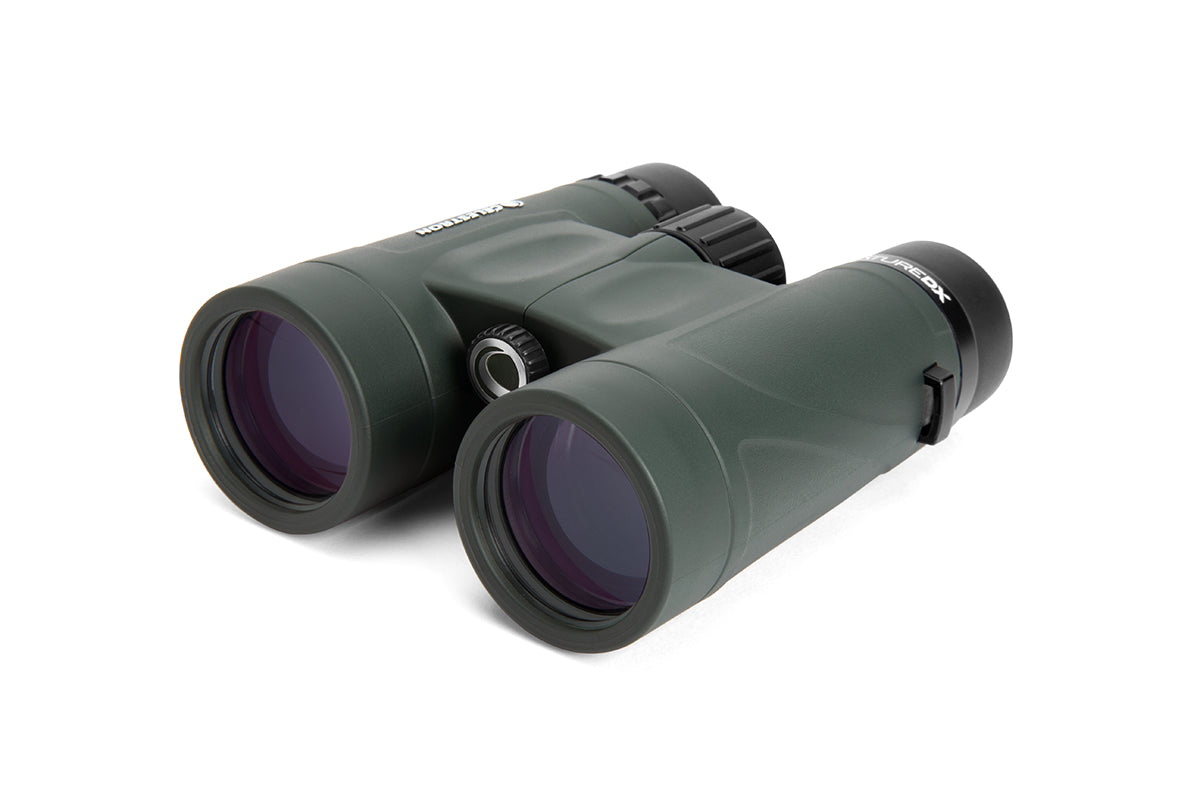
Explore this need in the finder →The Celestron Nature DX 8x42, item 71332, pairs an 8x view with a 42 mm objective and a published 7.4° real field. Its 388 ft-at-1,000-yards field is the most useful distinction from this family’s 10x42: it gives a broader sweep for locating moving wildlife and a little more room to follow it. Celestron lists this exact item at 22.2 oz, with waterproofing and nitrogen fill.
Choose 8x when the scene is as important as the subject
For birding from a trail or scanning a shoreline, the 8x42 has a wide field that helps you find a bird before trying to inspect its markings. It is also the more forgiving choice when the subject is moving across a busy background. The 5.25 mm exit pupil and 17.5 mm eye relief are manufacturer specifications, not a promise that every face or eyeglass frame will see the full field. The eye relief is longer than Celestron’s 14 mm specification for its 10x42 model, so glasses wearers who need a longer stated distance should start here and test the fit with their own glasses.
Magnification is fixed at 8x; there is no zoom lever. If you mostly observe distant, relatively stationary details and prefer the larger apparent subject, choose a 10x42 instead, accepting its narrower 5.8° real field. A 42 mm objective is a useful all-around size, but it does not make this a pocket pair. At 22.2 oz before strap or case, it is a full-size instrument rather than a coat-pocket compact.
Separate item 71332 from the other 8x42 listing
Celestron also lists Nature DX 8x42 item 72322. The optical figures published for the two pages match: 8x, 42 mm, 7.4°, 388 ft at 1,000 yd, 5.25 mm exit pupil and 17.5 mm eye relief. The body figures do not: item 71332 is listed at 22.2 oz and 135 × 126 × 52 mm, whereas 72322 is listed at 24.9 oz and 142 × 128 × 56 mm. The manufacturer does not explain the difference, so this review treats them as separate exact-page configurations and does not guess that one is a new generation, an optical upgrade or a seller bundle. If your weight ceiling is 23 oz, this page’s 71332 figure fits while the 72322 figure does not.
Focus, glasses and weather limits
The exact page lists a 6.5 ft close-focus distance, a ±3 diopter adjustment range and an interpupillary range of 56–74 mm. Celestron’s shared Nature DX manual explains the practical setup: adjust the hinge until the two images merge, focus the left eye with the center wheel, then adjust the right-eye diopter while viewing the same distant object. Twist-up eyecups have intermediate positions; the manual recommends the lowered position for glasses, but an eye-relief number alone cannot establish full-field comfort for a particular wearer. Check that you can see the whole circle without pressing the glasses into the eyecups.
The product page labels item 71332 waterproof and nitrogen-filled. That is a weather-oriented feature, not a scuba rating; Celestron does not specify a depth-and-duration limit in the product table. Its manual advises protecting the moving parts from impact, replacing the lens caps for storage, keeping the binocular in a cool, dry place and cleaning grit before wiping glass. The company lists fully multi-coated optics and phase-coated BaK-4 prisms. Those are named construction features, not independent measurements of brightness, color or edge sharpness.
Tripod use is possible, but the adapter is extra
Celestron marks the binocular tripod-adaptable, and its manual describes exposing the threaded socket beneath the logo plate and using a binocular tripod adapter. The adapter is an optional extra rather than a listed item in the standard box. Thus, a filter asking for a supplied or built-in tripod adapter should exclude 71332; a filter that only asks whether tripod use is possible can keep it in the running. For normal walking birding, the 8x handheld plan is straightforward. For long fixed-position observation, price and confirm a compatible adapter before treating the setup as complete.
How the finder changes the shortlist
Select 8x, 42 mm and a broad real field to keep this item alongside the matching 72322 version and other qualifying wide-view pairs. Requiring waterproofing still fits the manufacturer’s rating. Raising the minimum stated eye relief to 17 mm keeps this 8x configuration but removes the 10x42’s 14 mm specification. Tightening maximum weight to 23 oz favors item 71332 over item 72322. Requiring confirmed ED glass, a locking diopter, or an adapter already in the box does not fit the evidence for this standard Nature DX model. Unknown or unlisted features should not be treated as present.
If the 8x field is the priority but you want a separately documented higher-tier feature set, compare Celestron’s TrailSeeker ED 8x42 or Nikon’s MONARCH M7 8x42; they are not substitutes for a lighter price or an assured eyeglass fit without checking their exact facts. Choose item 71332 for the broad 8x42 scene and its listed lighter body, not because an image or product name proves optical superiority.
Exact item 71332 details: Celestron Nature DX 8x42 product page; operation and care: Celestron Nature DX series manual.
Key specifications
Key details at a glance
| Magnification | 8× |
|---|---|
| Objective diameter | 42 mm |
| Real field of view | 7.4° |
| Eye relief | 17.5 mm |
| Exit pupil | 5.25 mm |
| Close focus distance | 6.5 ft |
More specifications and setup details
| Manufacturer-published weight | 22.2 oz |
|---|---|
| ED glass confirmed for this exact model | No |
| Phase coatings confirmed | Yes |
| Lens and prism coatings | Celestron lists fully multi-coated optics and phase-coated BaK-4 prisms on the exact standard Nature DX page. This item is not labeled Nature DX ED and ED glass is not confirmed; no comparative optical measurement is inferred. |
| Water and fog protection | Celestron lists waterproof construction and nitrogen fill. The exact specification table does not give depth or duration; do not treat this as an underwater rating. Follow the manual’s dry-storage, lens-cap and cleaning instructions. |
| Tripod use | Exact page lists tripod adaptability and an optional tripod adapter; the family manual illustrates a separate binocular adapter between the threaded socket and a photo tripod. Adapter is not in the listed standard included items; exact adapter SKU not established. |
| Published weight note | Celestron’s exact item 71332 product page publishes 22.2 oz (629 g). Dimensions are listed as an unlabeled tuple [135, 126, 52] mm; no axis is inferred. These are manufacturer values, not independent packed measurements. |
| Manufacturer-rated waterproof | Yes |
| Tripod adapter in package | No |
Use the exact model’s instructions for operating limits, supplied equipment and version differences.
Sources for this review
Sources for this assessment
- Celestron Nature DX US collection page 1; 18 Nature DX product links personally enumerated from the displayed row list
- Celestron US Nature DX 8x42 exact product page, item 71332
- Celestron Nature DX five-language manual, English setup, eyecups, tripod, protection, care and safety section
- Celestron Nature DX quick setup guide, English IPD and focus instructions
- CPSC exact item-number ProductName query for Celestron item 71332, empty array on 2026-10-23
Choose your optical trade-off first.
Choose viewing purpose first, then magnification, objective size, scene width and any fit, weather or mounting constraint. A direct-Sun requirement is separate: only exact manufacturer-confirmed solar binoculars can pass it.