
On this page
Your needs, this model
Does it fit your priorities?
Does item 71331 meet a 20 oz limit at 10x and 32 mm?
The exact model page lists 10x32 and 18 oz.
Explore this need in the finder →Does this 10x32 meet a six-degree real-field minimum?
No. The specification table lists 5.8°; the page’s descriptive copy has a contradictory 8x sentence, but its title and item 71331 table say 10x.
Explore this need in the finder →Can the 10x32 confirm at least 15 mm eye relief for glasses?
No. Celestron lists 14 mm; a published number also cannot guarantee an individual frame fit.
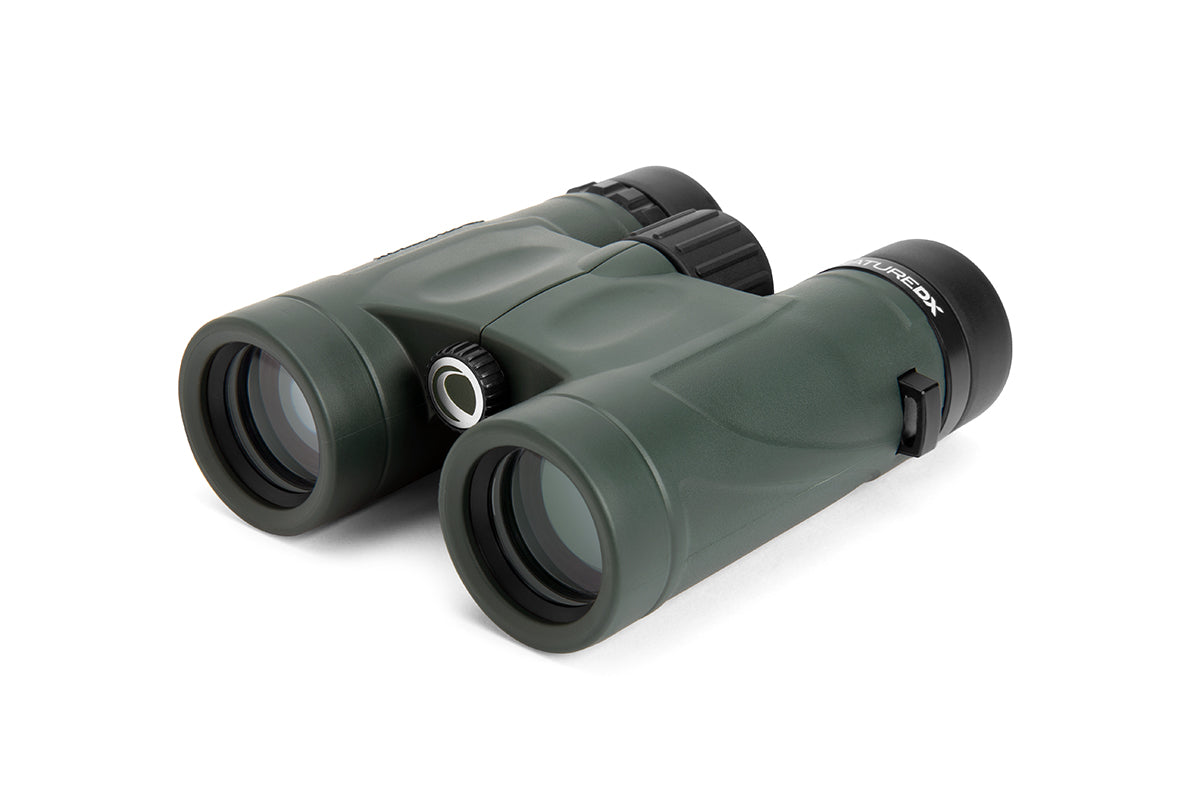
Explore this need in the finder →Nature DX 10x32 item 71331 is the fixed ten-power, 32 mm roof binocular in Celestron’s Nature DX family. At 18 oz it keeps carry weight modest while putting more nominal magnification on a distant subject than the 8x32. The trade is a narrower 5.8° real field, a 3.2 mm exit pupil and 14 mm of stated eye relief. It is for someone who specifically wants ten power in a compact body, not the automatic choice for fast birds or glasses-sensitive viewing.
Ten power in a compact objective
Celestron’s specification table gives a 5.8° angular field and 304 ft at 1,000 yards (101 m at 1,000 m). Those paired figures are approximately consistent after normalizing the distance. This is narrower than the 7.4° Nature DX 8x32 view, so a moving subject takes more work to acquire and keep in frame. In exchange, the subject appears larger at a given distance. That can be useful when watching a stationary bird or distant details, but the model has no listed stabilization; higher magnification also makes hand movement more apparent.
The 32 mm objective yields a manufacturer-listed 3.2 mm exit pupil at 10x. That is a meaningful comparison with this family’s 10x42, listed at 4.1 mm, but not a lab brightness ranking. Light reaching the eye also depends on transmission, focus, eye position, conditions and the observer. If dusk or a long low-light watch is an essential use, the larger 42 or 56 mm model deserves a separate fit and carry evaluation. Celestron lists the 10x32 at 18 oz, while the 12x56 is 36.2 oz; these are different carrying plans, not just two names for more reach.
Fit and nearby subjects
At 14 mm, the stated eye relief is shorter than the 8x32’s 17.5 mm and the ED 8x42’s 17.8 mm. The page describes twist-up eyecups with multiple stops and says they work with or without eyeglasses; individual glasses fit still depends on frame shape and eye position. If you wear glasses, lower the cups and verify the full field before treating the specification as a guarantee. The manufacturer also publishes a 56–74 mm interpupillary range and ±3 diopter adjustment. Its 6.5 ft close focus makes nearby insects, flowers and small details practical subjects when the image is correctly aligned.
The product page contains one inconsistent sentence in its descriptive copy that calls this 10x32 an “8x” model. The exact page title, item number 71331 and its specification table all identify 10x magnification; this assessment follows those repeated model-specific fields rather than the lone mistaken sentence. That discrepancy is worth noticing when cross-checking retailer listings.
Weather, accessories and manual use
The exact page lists fully multi-coated optics, phase-coated BaK-4 prisms, waterproof construction, nitrogen fill, rubber armor, and tripod adaptability. Celestron publishes no immersion depth or duration, so do not interpret “waterproof” as an underwater rating. A separate binocular adapter is required for tripod use and is not in the listed package. For walking observation, 10x is still hand-held, but a buyer who expects long stationary viewing should consider the optional support and the 8x alternatives before deciding that a lightweight body alone makes extended use effortless.
The included-items list names a strap, objective caps, rainguard, case, cloth and manual. In the shared Nature DX instructions, focus the left view with the center wheel, then set the separate right-eye diopter while viewing the same object; adjust interpupillary spacing until the image merges. Eyecup positions can be tested rather than forced to their stops. The manual also advises dry storage and removing dust before cleaning glass. Celestron’s warning is unambiguous: never view or project the Sun through the binocular.
Questionnaire choices that matter
Choose 10x and 32 mm if those are essential; item 71331 is removed by an 8x or 42 mm requirement. A 20-ounce cap fits the published 18 oz figure. A 14 mm eye-relief floor accepts it at the stated threshold, while a 15 mm minimum rejects it; neither result says whether your own glasses will see the full view. A close-focus maximum of 7 ft accepts the listed 6.5 ft. A broad real-field requirement of 6° does not fit 5.8°. Waterproofing is documented, but a requirement for an adapter in the box is not. Leave unknown attributes out of hard-fit expectations rather than treating the absence of a warning as proof.
Compare the Nature DX 8x32 when a wider view and longer stated relief take priority over ten-power reach. Move to ED 10x42 item 72333 if you require explicit ED glass in a ten-power Nature DX, but it is a heavier 24.9 oz body with the same general 5.9°-class scene and just 14.3 mm stated relief. A standard 10x42 is also an option if ED is not a must; use its exact item page when evaluating body weight and fit. This compact 10x32 earns a place when the combination of fixed 10x and 18-ounce carry is the actual requirement.
Exact identity and specifications: Celestron Nature DX 10x32 item 71331. Setup, care and safety: Celestron Nature DX binoculars series manual.
Key specifications
Key details at a glance
| Magnification | 10× |
|---|---|
| Objective diameter | 32 mm |
| Real field of view | 5.8° |
| Field width at 1,000 m | 101 m |
| Eye relief | 14 mm |
| Exit pupil | 3.2 mm |
More specifications and setup details
| Close focus distance | 6.5 ft |
|---|---|
| Manufacturer-published weight | 18 oz |
| ED glass confirmed for this exact model | No |
| Phase coatings confirmed | Yes |
| Lens and prism coatings | Celestron lists fully multi-coated optics and phase-coated BaK-4 roof prisms. This exact model is not identified as ED; no comparative optical measurement is inferred. |
| Water and fog protection | Celestron lists waterproof construction and nitrogen fill. The exact page gives no depth or duration for submersion; do not treat this as an underwater-use specification. Keep caps on and store the instrument dry per the series manual. |
| Tripod use | The exact product page calls the model tripod adaptable; the family manual shows an adapter between the binocular thread and a photographic tripod. The adapter is required and not in the manufacturer-listed package contents. |
| Published weight note | Celestron publishes 18 oz (510 g). Dimensions are the published numeric tuple; where the imperial tuple conflicts, the dossier records the conflict and leaves interpreted inches unknown. These are manufacturer values, not independent packed-weight measures. |
| Manufacturer-rated waterproof | Yes |
| Tripod adapter in package | No |
Use the exact model’s instructions for operating limits, supplied equipment and version differences.
Sources for this review
Sources for this assessment
- Celestron Nature DX US collection page 1; exact linked model row observed
- Celestron exact Nature DX US product page, item 71331
- Celestron Nature DX standard five-language manual; English setup and care inspected
- Celestron Nature DX QSG; English IPD/center-focus/right-eye-diopter instructions inspected
- CPSC exact item-number ProductName query for 71331; empty array on 2026-10-23
Choose your optical trade-off first.
Choose viewing purpose first, then magnification, objective size, scene width and any fit, weather or mounting constraint. A direct-Sun requirement is separate: only exact manufacturer-confirmed solar binoculars can pass it.