
On this page
Your needs, this model
Does it fit your priorities?
Do you want the exact R7 10x42 magnification and objective combination?
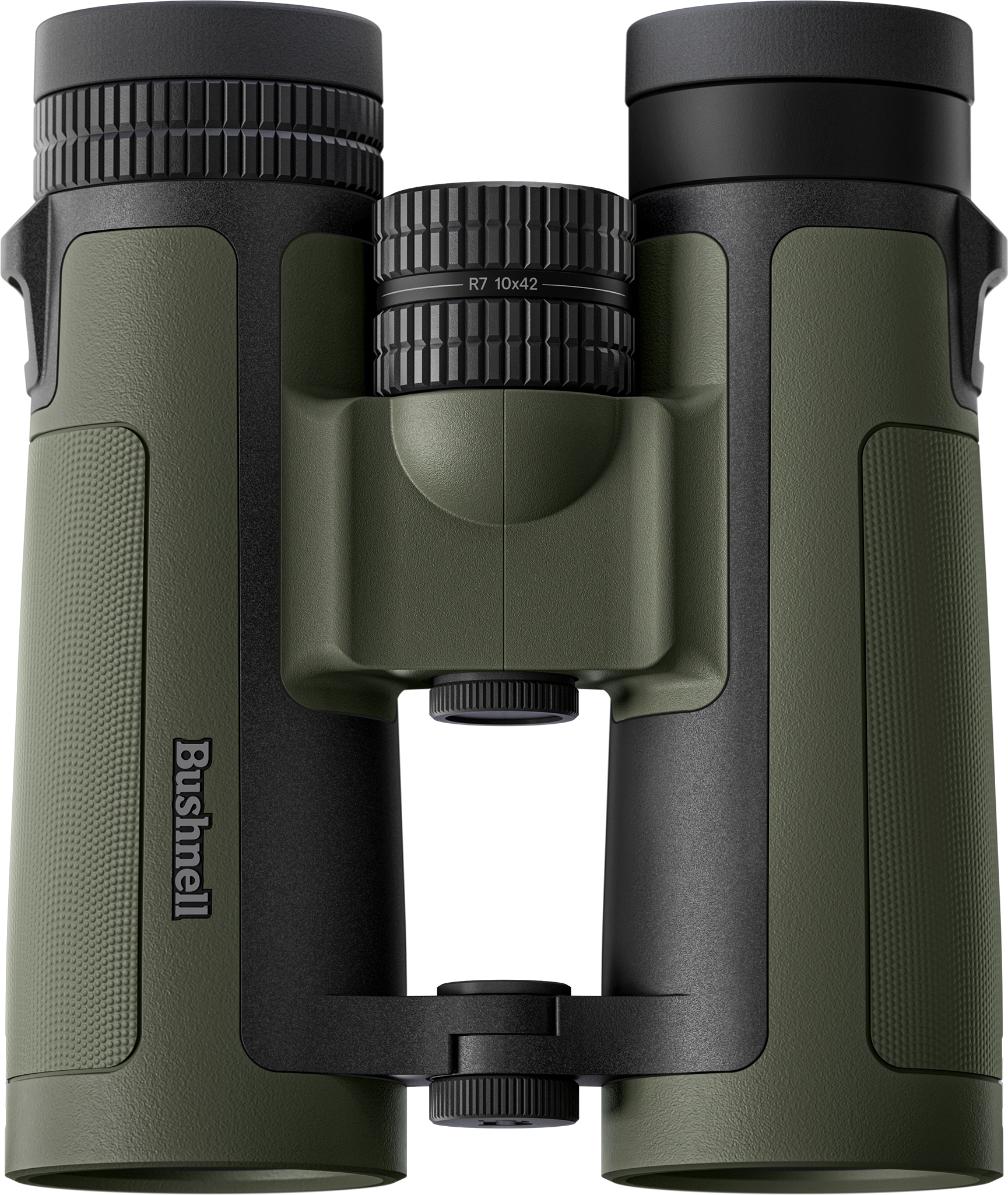
The exact US page identifies Bushnell R7 10x42, product ID BU-R7-1042, with fixed 10x power and 42 mm objectives. This is a source-checked configuration identity, not an optical-performance test.
Explore this need in the finder →Will the listed 27.2 oz instrument weight and its published view fit your carry plan?
The exact page/manual list 27.2 oz and 345 ft at 1,000 yd. Its 18 mm eye relief clears an 18 mm published-value screen, but eye relief does not promise glasses fit. The 8x42 sibling also meets a 28 oz ceiling and has the wider published field.
Explore this need in the finder →Do you need a confirmed direct tripod socket, and is it acceptable to buy the adapter separately?
The shared R7 manual confirms a covered 1/4-20 tripod socket and calls for a compatible 90-degree binocular adapter such as BU-BAHQRADPT. The adapter and tripod are not in the standard kit; adapter-in-box is not a match. The R7-1556 BridgeSet is an IPD stabilizer, not this mounting bracket.
Explore this need in the finder →The Bushnell R7 10x42 (U.S. product ID BU-R7-1042; manual SKU R7-1042) is the compact-objective, higher-power alternative to the R7 8x42. It keeps the same 42 mm objective and listed 27.2-ounce instrument weight but changes the view from 425 to 345 feet at 1,000 yards. Consider it when extra target scale is worth a narrower scene; this assessment relies on Bushnell’s exact product page and shared R7 manual, not a laboratory or field test.
More magnification, less scene width
Bushnell lists fixed 10x magnification, 42 mm objectives, a 345-foot field at 1,000 yards (115 m at 1,000 m), and a 4.2 mm exit pupil. The published width corresponds to about 6.6 degrees of real field, so it clears the site’s six-degree wide-scene threshold, though it is notably narrower than the sibling 8x42’s 425 feet. The extra magnification can make distant detail larger, while also making hand movement more visible and reacquiring fast-moving subjects less forgiving. These are general optical tradeoffs, not a claim that we measured this model’s steadiness or resolution.
Both 42 mm R7 models share a 5-foot close-focus specification, 149 mm listed length, magnesium-alloy chassis, and 27.2-ounce listed weight. The 10x42 publishes 18 mm eye relief and a 4.2 mm exit pupil; the 8x42 lists 19 mm and 5.3 mm. People who wear glasses should treat eye-relief numbers as screening information only. Bushnell includes low-profile eyecups intended for glasses, but face shape, frame size, eye position, and adjustment determine whether the full view is comfortable.
Optics and controls
The exact product specifications identify ED Prime objective glass, field-flattener optics, Schmidt-Pechan roof prisms made from BaK-4, phase and dielectric coatings, and fully multi-coated optics. Bushnell also lists Ultra Wideband coating, a locking diopter, twist-and-detent eyecups, IPX7 waterproofing, nitrogen purging, and EXO Barrier. These manufacturer descriptions distinguish the R7 from a simpler model on paper; they do not substitute for controlled tests of color fringing, edge sharpness, low-light contrast, or sample-to-sample quality.
Three interchangeable eyecup sets are listed: low profile, medium height, and winged. The shared manual recommends low profile with glasses and explains how to set eyecup position to avoid dark edges. It shows a pull-out, push-in locking diopter: unlock, set the right-eye correction after focusing the left eye, then push the ring back to lock. That is more useful than treating “adjustable” as a vague comfort claim, though the actual fit still needs to be checked in person.
Carry and support limits
The standard box contents listed for R7-842 and R7-1042 include a Vault Lite pack/harness, neck strap, lens covers, and Spudz cleaning cloth. The 10x42 is not a lightweight pocket pair: 27.2 ounces describes the instrument alone, before accessories. It has a direct 1/4-20 socket under its tripod-adapter cover. Bushnell’s manual says to use a compatible 90-degree binocular adapter such as BU-BAHQRADPT; the adapter and tripod are separate from the listed package. It also cautions that not every adapter fits the rearward socket position on 42 mm models.
The manual rates all R7 binoculars to IPX7 and cautions against deep or prolonged immersion. That is not an underwater-use promise. For care, it says to remove dust before wiping lenses, use a microfiber cloth or photographic lens cleaner on the cloth, and avoid household window cleaner. Never use an ordinary binocular to view the Sun.
When to move up to a 50 mm model
If you want 10x but prefer a larger exit pupil and longer listed eye relief, the R7 10x50 has 19 mm eye relief and a 5 mm exit pupil, but it weighs 32.7 ounces—5.5 ounces more—and its field is 340 feet, almost the same published width as this 10x42. The 12x50 reaches 12x and narrows to 290 feet. The 8x42 is the R7 choice for the broadest field and less magnification. Compare those differences in the R7 size guide. Choose the 10x42 if 10x power and a full-size but lighter-than-50-mm chassis fit your use, and verify the eyecup fit before buying.
Manufacturer references: the exact Bushnell R7 10x42 product page and shared R7 owner’s guide, English pages 3–6. The exact page-linked image’s photography/render method and republication permission are not disclosed.
Key specifications
Key details at a glance
| Magnification | 10× |
|---|---|
| Objective diameter | 42 mm |
| Real field of view | 6.58° |
| Field width at 1,000 m | 115 m |
| Eye relief | 18 mm |
| Exit pupil | 4.2 mm |
More specifications and setup details
| Close focus distance | 5 ft |
|---|---|
| Manufacturer-published weight | 27.2 oz |
| ED glass confirmed for this exact model | Yes |
| Phase coatings confirmed | Yes |
| Locking diopter ring confirmed | Yes |
| Lens and prism coatings | Exact page lists ED Prime glass, fully multi-coated optics, Ultra Wideband coating, PC-3 phase treatment and EXO Barrier. The 15x56 page lists Abbe-Koenig prisms and PC-3 phase coating but does not list dielectric coating; no dielectric claim is transferred to it. |
| Water and fog protection | IPX7 per the exact R7 manual; avoid deep or prolonged immersion. Do not interpret as an underwater-use rating. |
| Tripod use | The shared exact R7 manual shows a covered direct 1/4-20 socket and a separate compatible 90-degree adapter (such as BU-BAHQRADPT). That adapter and a tripod are absent from the listed standard kit. For 42 mm models, not all adapters fit the rearward position. |
| Published weight note | Bushnell-listed instrument weight only; pack/harness, strap, caps, tripod adapter and support add carried mass. No independent weighing was performed. |
| Manufacturer-rated waterproof | Yes |
| Built-in image stabilization confirmed | No |
| Integrated laser rangefinder | No |
| Onboard ballistic solution display | No |
| Tripod adapter in package | No |
| Direct 1/4-20 tripod thread confirmed | Yes |
Use the exact model’s instructions for operating limits, supplied equipment and version differences.
Sources for this review
Sources for this assessment
Choose your optical trade-off first.
Choose viewing purpose first, then magnification, objective size, scene width and any fit, weather or mounting constraint. A direct-Sun requirement is separate: only exact manufacturer-confirmed solar binoculars can pass it.