
On this page
Your needs, this model
Does it fit your priorities?
Do you want the R3 8x42 configuration for a broader general-viewing scene?
The exact U.S. product page and owner-guide SKU identify BU-R3-842/R3-842 as fixed 8x42. It is the wider-scene member of this Bushnell pair, although the exact page and manual differ by one foot on the published field value.
Explore this need in the finder →Is the 8x42’s published 21 mm eye relief the minimum you want to screen for glasses use?
The exact page and manual agree on 21 mm for this configuration. That is a useful first screen; glasses fit still depends on frame shape, eyecup position, and your own eyes.
Explore this need in the finder →Do you need weather-rated optics and tripod adaptation even though the adapter is separate?
The exact page confirms IPX7 protection and tripod compatibility; the shared guide confirms a covered 1/4-20 port and a separate compatible 90-degree adapter. The kit does not include the tripod adapter.
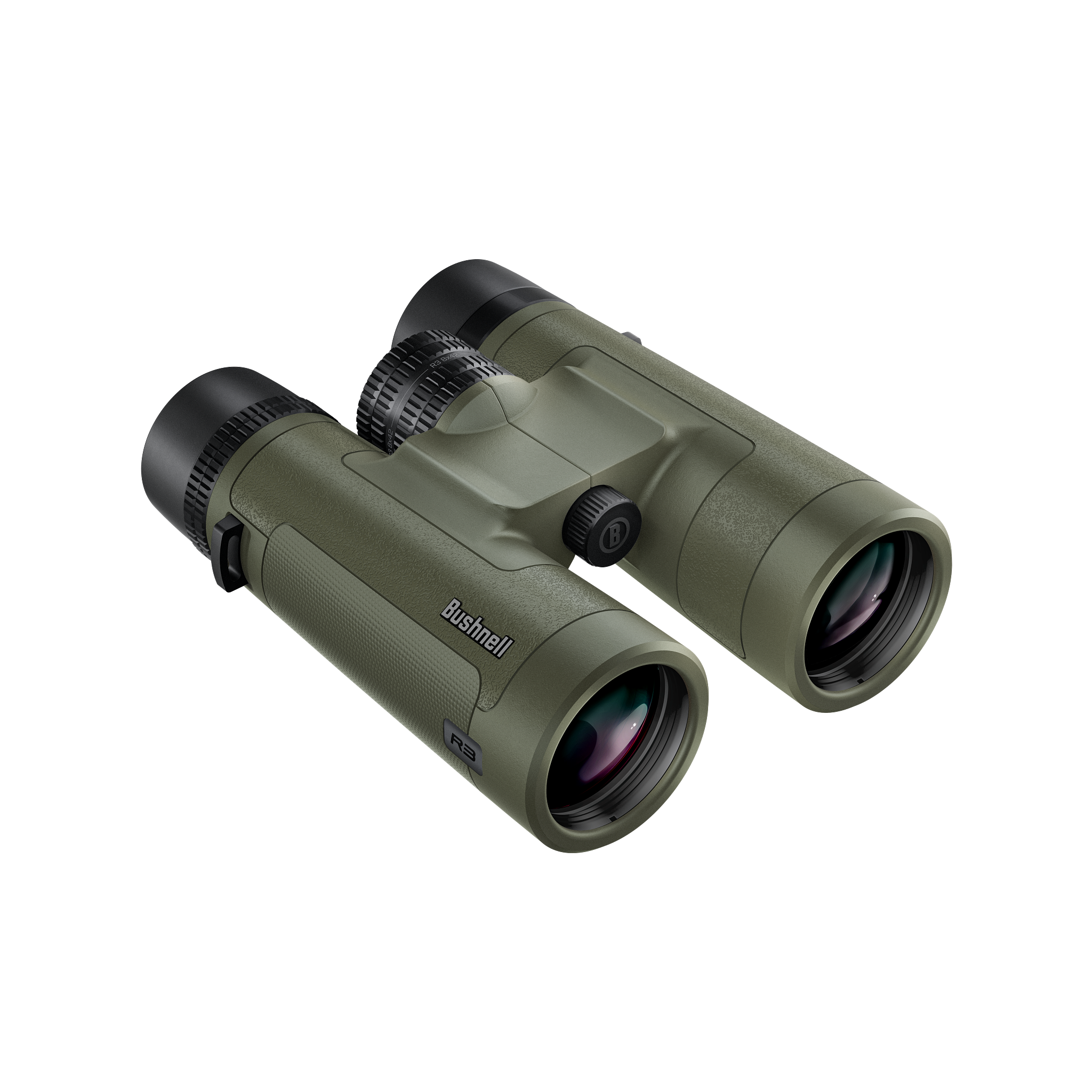
Explore this need in the finder →Bushnell’s R3 8x42 pairs a fixed 8-power view with 42 mm objectives in a roof-prism format. The exact U.S. product page identifies it as BU-R3-842, while the September 2025 owner’s guide calls the model R3-842. Its most useful distinction from the R3 10x42 is the wider, easier-to-follow scene, not a claim of brighter or sharper optics. This is a source-based assessment, not a hands-on test.
Choose it for scanning, not maximum reach
An 8x view shows less apparent enlargement than 10x, but its scene is wider in both Bushnell’s current product listing and its shared manual. The page lists 325 feet at 1,000 yards; the manual table lists 326 feet. Those exact figures disagree slightly, so neither is a reliable hard threshold. The practical ranking is consistent: this 8x42 shows a broader patch of ground than its 10x42 sibling. That can make it less work to pick up a moving bird or animal again after it slips behind brush. Lower magnification also makes hand movement less conspicuous than at 10x, though any binocular can shake when held at arm’s length for a long glassing session.
The shared 42 mm objective size leaves the two models in the same general full-size class. Bushnell lists a 5 mm exit pupil for the 8x42 and 21 mm eye relief. The latter is a useful screening figure for glasses users, not a promise that every frame will show the full circle. The manual gives an interpupillary range of 59–74 mm and describes lowering the twist-up eyecups when wearing glasses. Set the hinge to your eyes before judging fit; if you see dark crescents, adjust the spacing and eyecups rather than assuming the binocular is faulty.
Know what the published numbers cannot settle
There is a small but important difference between the exact product page and the manual beyond the field figure. The page lists 21.3 ounces, while the manual’s specification table gives 22 ounces. The manual also calls out a 16-foot (4.87 m) close focus and a 5.9-by-4.9-inch size; the product page lists some dimensions in millimeters. I would treat this as roughly a 22-ounce binocular rather than use a narrow weight cutoff to choose between R3 sizes. The manufacturer sources do not support a more precise comparison. The manual’s 16-foot close-focus figure is likewise a reminder that this is for ordinary-distance observation, not looking at objects only a few feet away.
The product page identifies a roof prism, BaK-4 glass, fully multi-coated optics, EXO Barrier lens protection, argon gas purging, and an IPX7 water-resistance rating. It describes the construction as fogproof and shockproof. Those features do not amount to a brightness or resolution test: no independent optical measurements were made here. The manual says the R3 is tested to IPX7 and cautions against immersion beyond 1 meter or 30 minutes. Think of the rating as protection for weather and accidental water exposure, not a reason to leave the binocular underwater. EXO Barrier repels water, oil, dust and debris at the lens surface; it does not make the glass scratch-proof.
Setup and included kit
The owner’s guide lists a Vault LITE binocular pack with harness, comfort neck strap, lens cloth, and eyepiece and objective covers. The center wheel focuses both barrels together after setup; the right-side diopter ring is adjusted separately for the difference between your eyes. It is not a locking diopter. The manual walks through covering one objective at a time while focusing, then using the center wheel for distance changes. Take care not to force the diopter ring, and secure the strap before carrying the instrument around your neck.
A covered 1/4-20 socket allows tripod adaptation, but the binocular is not a complete tripod kit. Bushnell’s manual calls for a compatible 90-degree binocular adapter and names its #161002CM as an example; neither that adapter nor a tripod is listed among the standard R3 contents. Tripod compatibility is useful for a stationary observation, but it should not be confused with an adapter included in the box.
Who should shortlist the R3 8x42?
Start here if you scan woodland edges, follow nearby wildlife, or want the easier-to-track field of the two R3 42 mm powers. Pick the R3 10x42 instead if more target scale matters more than a wide scene, and try its shorter 17 mm eye relief with your own glasses before buying. If you are comparing brands as well as powers, the Nikon Monarch M5 8x42 is a useful same-size alternative to compare for fit, handling and published specifications. Do not treat brand tier, coating language, or price as a substitute for matching the binocular to your viewing distance and face.
The R3 is a conventional optical binocular and must never be pointed at the Sun. Its manual also limits the lifetime warranty to the United States and notes exclusions such as loss, theft and deliberate damage, so check Bushnell’s full terms rather than reading “lifetime” as coverage for every event. If glasses fit, carry weight or a very specific field-width threshold is essential, verify it with the exact pair and current documentation: the small field and weight discrepancies above are left unresolved for strict matching.
Sources: Bushnell’s R3 8x42 product page and the R3 owner’s guide, revision 09-25 (English pages 1–6). The exact page-linked image appears to be a product rendering; Bushnell does not state its image method or grant republication permission in the cited material.
Key specifications
Key details at a glance
| Magnification | 8× |
|---|---|
| Objective diameter | 42 mm |
| Real field of view | 6.2° |
| Eye relief | 21 mm |
| Exit pupil | 5 mm |
| Close focus distance | 16 ft |
More specifications and setup details
| ED glass confirmed for this exact model | No |
|---|---|
| Phase coatings confirmed | No |
| Locking diopter ring confirmed | No |
| Water and fog protection | The maker lists IPX7; the owner guide advises avoiding immersion deeper than 1 m or longer than 30 minutes. This is not an underwater-use rating. |
| Tripod use | The owner guide describes a covered direct 1/4-20 socket and a separate compatible 90-degree adapter (Bushnell #161002CM is an example). The adapter and tripod are not listed in the standard package. |
| Published weight note | Exact page lists 21.3 oz but the shared owner guide lists 22 oz. Hard weight matching stays unknown; no independent weighing was performed. |
| Manufacturer-rated waterproof | Yes |
| Built-in image stabilization confirmed | No |
| Integrated laser rangefinder | No |
| Onboard ballistic solution display | No |
| Tripod adapter in package | No |
| Direct 1/4-20 tripod thread confirmed | Yes |
Use the exact model’s instructions for operating limits, supplied equipment and version differences.
Sources for this review
Sources for this assessment
- Bushnell R3 Binoculars - 8x42; U.S. manufacturer page, exact product ID BU-R3-842
- Bushnell R3 Binocular Owner’s Guide, 09-25; shared R3-842/R3-1042 manual
- Bushnell U.S. Hunt Binoculars official collection snapshot; exact card and product handle
- U.S. CPSC SaferProducts narrow exact-name query for Bushnell R3 8x42
Choose your optical trade-off first.
Choose viewing purpose first, then magnification, objective size, scene width and any fit, weather or mounting constraint. A direct-Sun requirement is separate: only exact manufacturer-confirmed solar binoculars can pass it.