
On this page
Your needs, this model
Does it fit your priorities?
Do you want the R3 10x42 configuration for more distant subject scale?
The exact U.S. page and owner-guide SKU identify BU-R3-1042/R3-1042 as fixed 10x42. Compared with the R3 8x42, it shows more apparent enlargement and a narrower scene.
Explore this need in the finder →Does 17 mm of published eye relief meet your selected 10x42 screen?
The exact page and 09-25 manual both state 17 mm. The number should not be treated as a guarantee for eyeglasses; the owner guide says to lower eyecups with glasses and check the full view.
Explore this need in the finder →Can you use the 10x42’s tripod thread without expecting the adapter in the box?
Bushnell confirms tripod compatibility and the guide describes a covered 1/4-20 socket, but names a separate 90-degree adapter. Adapter-in-box is not a supported purchase condition.
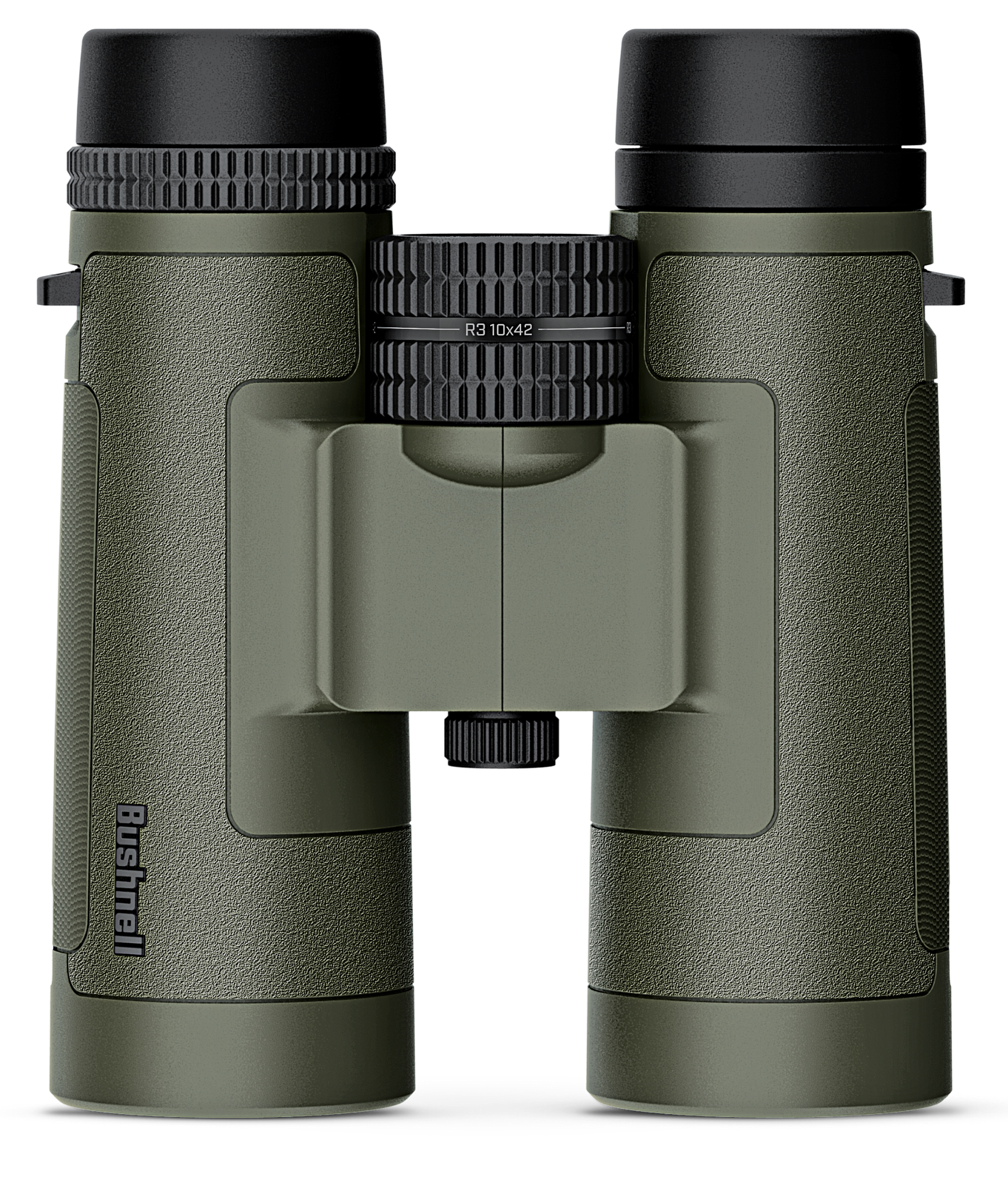
Explore this need in the finder →The Bushnell R3 10x42 (U.S. product ID BU-R3-1042; manual SKU R3-1042) is the higher-power member of the current R3 binocular pair. Its 10x magnification enlarges distant subjects more than the 8x42, while the same 42 mm objective size keeps the two in a similar full-size format. Consider it when detail at open-country or mid-distance viewing matters more than the broadest possible scene. This assessment uses manufacturer documents, not a hands-on comparison.
More target scale, a narrower scene
The current page lists 300 feet at 1,000 yards; the shared 09-25 manual gives 305 feet. Both sources place the 10x42 below the 8x42 in field width, so the relative tradeoff is clear even though the exact field number is not. The 8x sibling is easier to use while scanning across a moving scene; 10x makes the target appear larger but shows less surrounding area. Higher power can also make ordinary hand movement more visible. For a quick look from a trail or truck, that may be a reasonable trade. For long stationary observation, the R3’s tripod socket can support a steadier view if you supply a separate adapter and tripod.
Bushnell lists a 4 mm exit pupil and 17 mm eye relief. Compared with the 8x42’s listed 5 mm and 21 mm, the 10x42 gives less margin for placing your eye behind the eyecups. The manual recommends lowering its twist-up eyecups when using glasses, but a published 17 mm number cannot guarantee your own frames will show the full field. Check fit through both barrels with your actual glasses on, and adjust interpupillary distance until the image is single and free of dark edges. The manual gives a 59–74 mm IPD range for both R3 configurations.
Read the exact specifications with care
The product page and manual do not agree on every number. For field width, the page says 300 feet at 1,000 yards while the manual says 305 feet. On weight, the exact page lists 20.9 ounces and the owner’s guide lists 22 ounces. The manual also lists a 5.9-by-4.9-inch size; the page gives a 152 mm length and millimeter width/height figures. These are small discrepancies, but they matter if you are trying to filter on a very narrow field or weight limit. Treat the instrument as roughly a 22-ounce full-size binocular, not as a verified sub-21-ounce option. The figures are manufacturer specifications and no independent weighing or field-of-view measurement was performed.
The manual lists a 16-foot (4.87 m) closest focus. That gives a useful limit for observing across a clearing, but it is not a close-up focus distance for insects, flowers, or a nearby object on a table. The current product page identifies the roof-prism system, BaK-4 glass, fully multi-coated lenses, EXO Barrier, argon gas purging, and IPX7 water resistance. The page describes the build as waterproof, fogproof and shockproof; it does not identify ED Prime glass, phase coating or dielectric prism coating for this model. Do not infer those more expensive optical treatments from the series name.
Protection and mounting still have boundaries
The R3 manual says the binoculars are tested to IPX7 and advises against immersion deeper than 1 meter or longer than 30 minutes. That is a weather-protection boundary, not an underwater-use plan. EXO Barrier is an outer-lens treatment that repels water, oil, dust and debris; it is not a guarantee against scratches. Bushnell’s care instructions say to blow or brush grit away before wiping, use a clean microfiber cloth, and avoid household window cleaners.
For support, the manual shows a covered standard 1/4-20 socket and calls for a compatible 90-degree binocular tripod adapter, with Bushnell #161002CM as an example. The adapter and tripod are separate from the standard R3 package. In hand, the usual plan is to adjust the center focus wheel for distance after setting the right-eye diopter once; the manual does not describe a locking diopter. The listed kit does include a Vault LITE pack/harness, comfort neck strap, lens cloth, and objective and eyepiece covers.
When to choose it over the 8x42
Choose this 10x42 if you need more apparent scale on distant details and are comfortable with a tighter field and shorter eye relief. The R3 8x42 is the more forgiving starting point for broad scanning and moving subjects; its lower magnification is also less demanding of steady hands. If both powers work, decide how you will carry them and whether you can test eyeglass fit before you rely on the published relief figure. The Vortex Diamondback HD 10x42 is a useful same-power competitor to compare on eye relief, field width and package details rather than assuming the nominal 10x42 format makes every model interchangeable.
The exact Bushnell listing identifies this as a U.S.-only model and promotes a lifetime warranty. The manual says the warranty is valid only in the United States and excludes some situations, so read the current terms. This is ordinary binocular viewing, never direct solar viewing. If exact field width or a sub-21-ounce limit is essential, the manufacturer’s own page and manual are not aligned closely enough to make either an automatic pass; use a broader threshold or verify the specific unit and current documentation.
Sources: Bushnell’s R3 10x42 product page and the R3 owner’s guide, revision 09-25 (English pages 1–6). The page-linked exact 10x42 image appears to be a product rendering, but the manufacturer does not state the image method or grant republication permission in the cited material.
Key specifications
Key details at a glance
| Magnification | 10× |
|---|---|
| Objective diameter | 42 mm |
| Eye relief | 17 mm |
| Exit pupil | 4 mm |
| Close focus distance | 16 ft |
| ED glass confirmed for this exact model | No |
More specifications and setup details
| Phase coatings confirmed | No |
|---|---|
| Locking diopter ring confirmed | No |
| Water and fog protection | The maker lists IPX7; the owner guide advises avoiding immersion deeper than 1 m or longer than 30 minutes. This is not an underwater-use rating. |
| Tripod use | The owner guide describes a covered direct 1/4-20 socket and a separate compatible 90-degree adapter (Bushnell #161002CM is an example). The adapter and tripod are not listed in the standard package. |
| Published weight note | Exact page lists 20.9 oz but the shared owner guide lists 22 oz. Hard weight matching stays unknown; no independent weighing was performed. |
| Manufacturer-rated waterproof | Yes |
| Built-in image stabilization confirmed | No |
| Integrated laser rangefinder | No |
| Onboard ballistic solution display | No |
| Tripod adapter in package | No |
| Direct 1/4-20 tripod thread confirmed | Yes |
Use the exact model’s instructions for operating limits, supplied equipment and version differences.
Sources for this review
Sources for this assessment
- Bushnell R3 Binoculars - 10x42; U.S. manufacturer page, exact product ID BU-R3-1042
- Bushnell R3 Binocular Owner’s Guide, 09-25; shared R3-842/R3-1042 manual
- Bushnell U.S. Hunt Binoculars official collection snapshot; exact card and product handle
- U.S. CPSC SaferProducts narrow exact-name query for Bushnell R3 10x42
Choose your optical trade-off first.
Choose viewing purpose first, then magnification, objective size, scene width and any fit, weather or mounting constraint. A direct-Sun requirement is separate: only exact manufacturer-confirmed solar binoculars can pass it.